This is a guide only. Breaker selection depends on the cable, installation method and BS 7671. New circuits must be designed and certified by a qualified electrician.
Formula and breakdown
n/a
n/a
n/a
This MCB size calculator works out the design current of a circuit from its load in watts and suggests the smallest standard miniature circuit breaker rating that covers it. It is a planning aid to help you talk to an electrician, not a replacement for a full circuit design.
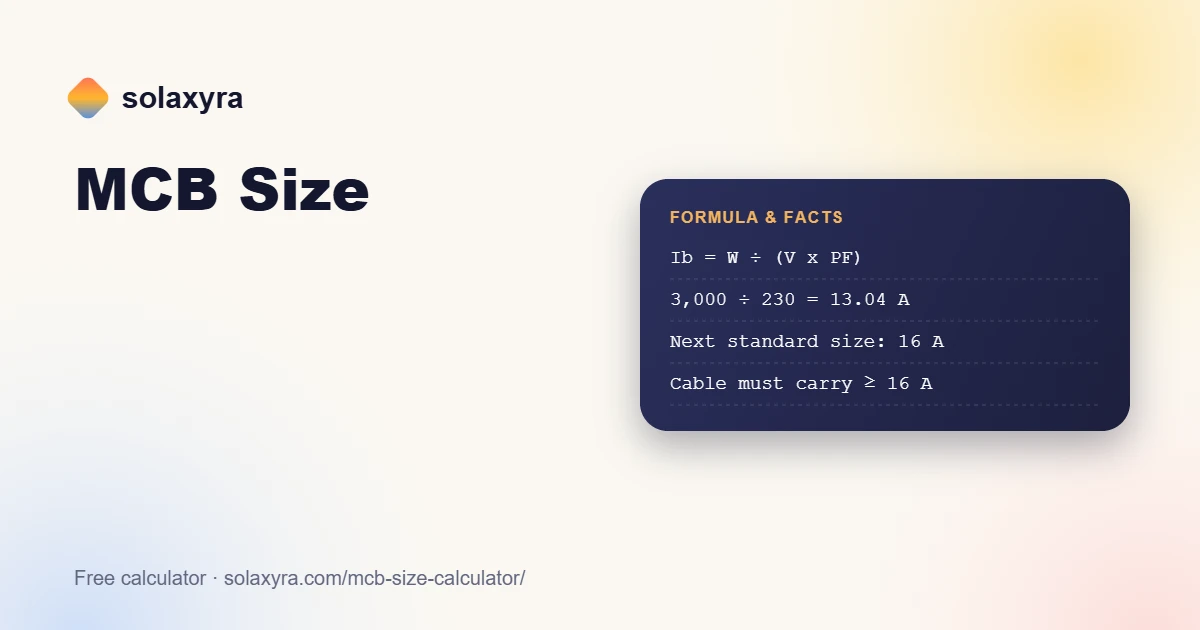
Quick answer: Divide the load by the voltage and power factor to get the design current, then pick the next standard breaker at or above it. A 3,000 W load at 230 V draws 13.04 A, so the smallest standard MCB is 16 A, provided the cable is rated for at least 16 A.
What Is an MCB Size Calculator?
An MCB size calculator finds the design current of a circuit, written Ib, and matches it to standard breaker ratings, written In. Under BS 7671 the basic rule is Ib ≤ In ≤ Iz, where Iz is the current-carrying capacity of the cable as installed. The breaker must be big enough for the load and small enough to protect the cable.
How Do You Use the MCB Size Calculator?
- Add up the load the circuit will carry at the same time, in watts.
- Enter the voltage and choose single or three phase.
- Enter the power factor and the type of load, which guides the breaker curve.
- Read the design current and the suggested minimum rating.

Common Circuits and Typical MCB Ratings
These are typical values seen in UK homes. Your electrician will confirm what suits your installation.
| Circuit | Typical load | Typical MCB | Typical cable |
|---|---|---|---|
| Lighting | up to about 1 kW | 6 A | 1.0 or 1.5 mm² |
| Immersion heater | 3 kW | 16 A | 2.5 mm² |
| Ring final socket circuit | varies | 32 A | 2.5 mm² ring |
| Cooker | varies with diversity | 32 to 40 A | 6 to 10 mm² |
| 7 kW EV charger | 7.4 kW | 32 A (often Type B or C) | 6 mm² or larger |
| 9.5 kW electric shower | 9.5 kW | 40 to 45 A | 10 mm² |
Type B, C or D?
The curve sets how much short surge the breaker tolerates before tripping. Type B suits most domestic circuits. Type C allows bigger inrush currents from motors, transformers and some LED lighting. Type D is for heavy inrush loads. A higher curve also needs a lower earth fault loop impedance to trip fast enough.
Why Not Just Fit a Bigger Breaker?
If a breaker is larger than the cable can safely carry, the cable could overheat before the breaker trips. Replacing a tripping breaker with a larger one without checking the cable is dangerous. Persistent tripping usually means an overload or a fault that needs investigating.
Worked Example: A Garage Heater Circuit
Example: a homeowner in Ipswich wants a dedicated circuit for a 2 kW heater and a 1 kW compressor in a garage.
- Total load = 3,000 W at 230 V with a power factor around 0.9 for the compressor share.
- Ib = 3,000 ÷ (230 × 0.9) = 14.5 A.
- Smallest standard MCB = 16 A, probably Type C for the compressor.
- The electrician checks the cable route and length before confirming.
Frequently Asked Questions
What size MCB do I need for 3 kW?
A 3 kW resistive load at 230 V draws about 13 A, so 16 A is the smallest standard rating.
What size breaker for a 7 kW EV charger?
Most 7 kW chargers use a 32 A breaker on a dedicated circuit, often with specific RCD protection.
Can I replace a 32 A MCB with a 40 A one?
Not unless the cable is rated for 40 A in its installation conditions. Ask an electrician.
What is the difference between an MCB and an RCBO?
An RCBO combines an MCB with residual current protection in one device.
Checked November 2026 by the Solaxyra Editorial Team. Sources: IET: BS 7671 Requirements for Electrical Installations, Electrical Safety First: Fuse boxes and consumer units.