n/a
Home batteries must be installed by a qualified electrician. In the UK the work must meet BS 7671; elsewhere follow local wiring rules and the manufacturer’s manual.
Formula and breakdown
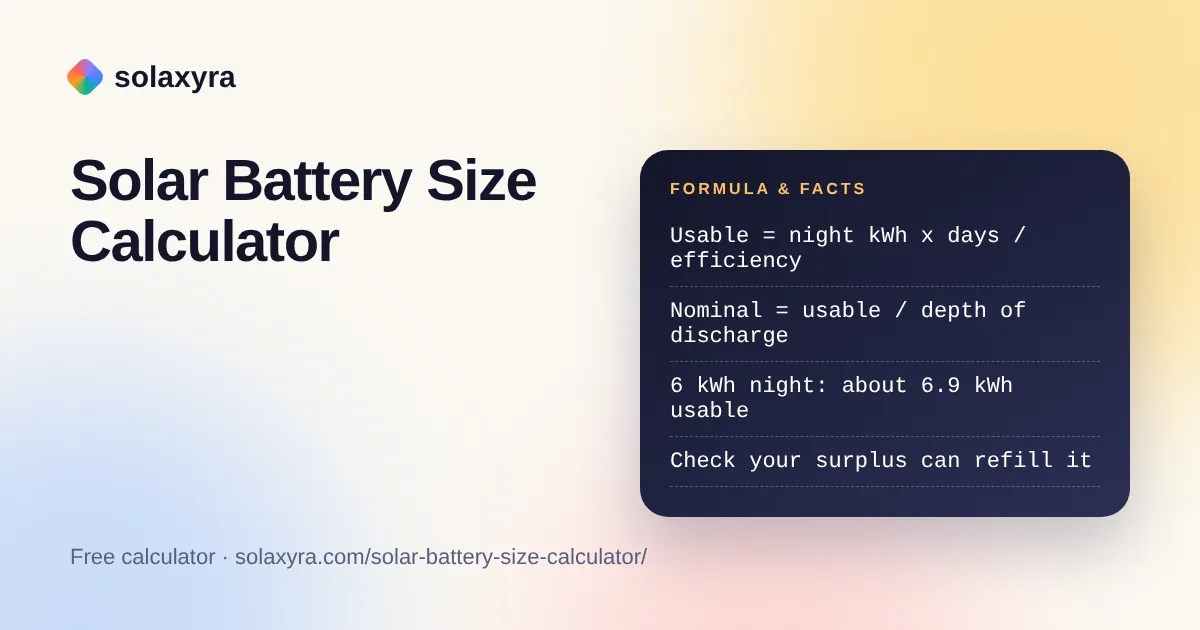
Energy to deliver = evening and overnight kWh x days of cover.
Usable capacity = energy to deliver / battery to home efficiency / (1 − backup reserve) x (1 + ageing margin).
Nominal capacity = usable capacity / depth of discharge. Solar needed to refill = energy to deliver / round-trip efficiency.
n/a
This solar battery size calculator works out the usable and nominal capacity a grid-connected home in the UK or Europe needs to store daytime solar for the evening and night. It accounts for depth of discharge, inverter losses, round-trip efficiency, an ageing margin and any backup reserve, then checks whether your typical solar surplus can actually fill the battery.
Quick answer: A solar battery size calculator multiplies your evening and overnight use by the days of cover, divides by the battery’s discharge efficiency for usable kWh, then divides by depth of discharge for nominal kWh. For 6 kWh a night with 95% efficiency, 90% depth of discharge and a 10% ageing margin, choose about 6.9 kWh usable.
What Is a Solar Battery Size Calculator?
A solar battery size calculator is a tool that converts the electricity you use after dark into the battery capacity, in kWh, that can supply it from stored solar energy. In plain words: take your evening and overnight use, multiply by the number of days you want covered, divide by the share of stored energy that reaches your sockets, add a margin for capacity fade, and divide by the depth of discharge to find the total capacity to buy.
The calculator then works the other way round. It divides the energy you want delivered by the round-trip efficiency to find how much solar surplus is needed to refill the battery, and compares that with your typical daily surplus. A battery your panels cannot fill costs money without adding savings.
How Do You Use the Solar Battery Size Calculator?
- Find your evening and overnight use. Smart meter half-hourly data, a supplier app or an in-home display will show usage between sunset and sunrise. Enter the average daily figure in kWh.
- Set days of cover. Use 1 for everyday solar shifting. Higher values are for backup during power cuts.
- Enter depth of discharge, battery to home efficiency and round-trip efficiency from the battery datasheet. If the datasheet already states usable capacity, set depth of discharge to 100%.
- Add an ageing margin, and a backup reserve if your system keeps part of the battery for outages.
- Enter your typical daily solar surplus, which is roughly what you export on an ordinary sunny day without a battery.
- Read the usable and nominal capacity, then check how much of the refill your surplus covers.
What Size Solar Battery Do You Need for Your Home?
You need a battery whose usable capacity is roughly your evening and overnight use divided by its discharge efficiency, plus around 10% for ageing. A home using 6 kWh between sunset and sunrise therefore needs about 6.9 kWh usable, or about 7.7 kWh nominal at 90% depth of discharge. Size from night-time use rather than total daily use, because during the day your panels supply you directly and the battery is not needed.
The other limit is your surplus. In summer many systems export far more than a battery can hold, but in winter there may be little or nothing left over after daytime use. The calculator shows the largest usable size your typical surplus can fill each day. If that is smaller than the size your night-time use suggests, the smaller battery will often do the same everyday job for less money, unless you also plan to charge it from a cheaper overnight tariff. To see how a battery changes the share of solar you use, try the solar self-consumption calculator.
What Is the Difference Between Usable and Nominal Capacity?
Usable capacity is the energy you can actually draw, while nominal capacity is the total the cells hold; usable equals nominal multiplied by the depth of discharge. Depth of discharge is defined in the Wikipedia article on depth of discharge as the share of capacity removed from a fully charged battery in normal use, the complement of state of charge. Battery management systems limit it because, for almost all rechargeable chemistries, deeper cycling shortens cycle life.
Datasheets for home batteries often list both figures. Always compare products on usable capacity, and enter 100% depth of discharge in this calculator if the figure you have is already the usable one, so the limit is not applied twice.
Why Do Efficiency Losses Change the Battery Size?
Efficiency losses mean a battery must store more energy than your home receives: at 95% battery to home efficiency, delivering 6 kWh needs 6.3 kWh drawn from the battery. Round-trip efficiency covers the whole journey, from solar into the battery and back out to your sockets, so it is always lower than the discharge efficiency alone. It decides how much surplus you need for a refill: at 90% round-trip efficiency, delivering 6 kWh needs about 6.7 kWh of solar surplus. The calculator uses discharge efficiency to size the battery and round-trip efficiency to size the refill, which keeps the two questions separate.
Solar Battery Size Reference Table
Results from this solar battery size calculator for one day of cover, 90% depth of discharge, 95% battery to home efficiency, 90% round-trip efficiency, a 10% ageing margin and no backup reserve.
| Evening and overnight use | Usable capacity | Nominal capacity | Solar surplus needed to refill |
|---|---|---|---|
| 3 kWh | 3.5 kWh | 3.9 kWh | 3.3 kWh |
| 5 kWh | 5.8 kWh | 6.4 kWh | 5.6 kWh |
| 7 kWh | 8.1 kWh | 9.0 kWh | 7.8 kWh |
| 10 kWh | 11.6 kWh | 12.9 kWh | 11.1 kWh |
| 12 kWh | 13.9 kWh | 15.4 kWh | 13.3 kWh |
Is a Bigger Solar Battery Always Better?
No, a bigger battery is only better if you can fill it and use it most days. Capacity you rarely cycle still costs money: the Energy Saving Trust says battery storage tends to cost around £5,000 to £8,000. Before choosing a larger size, check three things: whether your evening use really needs it, whether your typical surplus can refill it, and whether a time-of-use tariff would let you charge it cheaply overnight in winter. The home battery savings calculator puts a yearly value on that decision.
Off-grid cabins, boats and vans are different, because there is no grid to fall back on. They need several days of cover and a design around the worst month of the year, so use the off-grid solar calculator or the battery bank size calculator for those.
Is It Safe to Install a Home Solar Battery Yourself?
No, a home battery connected to your house wiring must be installed or checked by a qualified electrician. In the UK the work must meet BS 7671, the wiring regulations; elsewhere, follow your local wiring rules. Installers also follow the manufacturer’s manual on location, ventilation, clearances and cable sizes. Use this calculator to plan the size and to compare quotes, not as an installation guide.
Worked Example: Emma’s Battery in Leeds
Emma in Leeds already has solar panels. Her smart meter data shows she uses about 9 kWh between sunset and sunrise, and on a typical spring or autumn day she exports about 7 kWh. The battery she is considering lists 95% depth of discharge, 96% battery to home efficiency and 90% round-trip efficiency. She adds a 10% ageing margin and no backup reserve, and enters these figures in the solar battery size calculator.
- Usable capacity: 9 kWh / 96% x 1.10 = 10.3 kWh.
- Nominal capacity: 10.3 kWh / 95% = 10.9 kWh.
- Solar surplus needed to refill: 9 kWh / 90% = 10.0 kWh. Her 7 kWh surplus covers only 70% of that.
- The largest usable size her surplus fills each day is 7 x 90% / 96% x 1.10 = 7.2 kWh.
Emma decides a battery of about 7 kWh usable will cycle fully on most days, while a 10 kWh unit would only fill completely in summer or if she charged it overnight on a cheaper tariff.
Frequently Asked Questions
What size solar battery do I need?
Size it to the electricity you use between sunset and sunrise, not your full daily use. Divide that figure by the battery’s discharge efficiency, add a margin for ageing, then check your typical solar surplus can refill it. For 6 kWh a night, about 6.9 kWh usable suits most cases.
What is the difference between usable and nominal battery capacity?
Nominal capacity is the total energy the cells can hold. Usable capacity is the part the battery management system lets you draw, which is nominal capacity multiplied by the depth of discharge. Many home battery datasheets quote both, so always compare usable figures.
What is depth of discharge?
Depth of discharge is the share of a battery’s capacity that is removed from a full charge in normal use. It is the complement of state of charge, so a battery at 30% charge has a 70% depth of discharge. Shallower cycling usually extends cycle life.
Can a solar battery be too big?
Yes. If your typical daily surplus cannot refill it, the extra capacity sits unused for much of the year and adds cost without savings. The calculator compares your surplus with the refill energy and suggests the largest size your surplus can fill.
How many days of storage should a grid-connected home have?
One day is normal for a grid-connected home, because the aim is to move daytime solar into the evening. Several days of cover are only needed for backup during long power cuts or for off-grid systems, which need a different sizing approach.
Who can install a home solar battery?
A home battery should be installed by a qualified electrician who is trained on that product. In the UK the electrical work must meet BS 7671, the wiring regulations. Elsewhere, follow your local wiring rules and the manufacturer’s installation manual.
Checked October 2026 by the Solaxyra Editorial Team. Sources: Wikipedia: Depth of discharge, Energy Saving Trust: Solar panels.