Assumes a balanced load and sinusoidal supply. Work on three-phase installations must be done by a qualified electrician (UK: to BS 7671).
Formula and breakdown
…
This three phase power calculator works out real power (kW), apparent power (kVA) and reactive power (kVAr) from the voltage, line current and power factor of a three-phase load, or the line current from a known power, for electricians, engineers, farm and workshop owners on 230/400 V supplies in the UK, Ireland and Europe. It accepts either the line-to-line or the line-to-neutral voltage and shows the voltage and current inside each winding for star and delta connections.
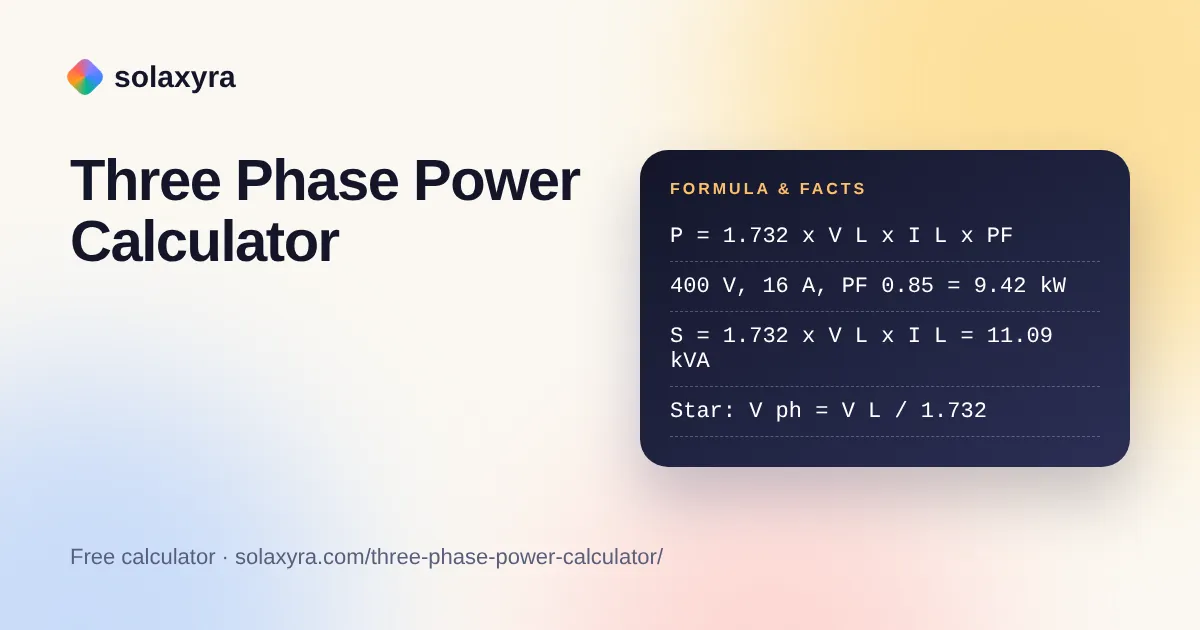
Quick answer: Three-phase real power is P = 1.732 x line voltage x line current x power factor. At 400 V, 16 A per line and a power factor of 0.85, that gives 11.09 kVA and 9.42 kW. This three phase power calculator also returns kVAr, per-phase power, and the voltage and current in each star or delta winding.
What Is a Three Phase Power Calculator?
A three phase power calculator is a tool that finds the power in a balanced three-phase AC circuit from its line voltage, line current and power factor. In plain words: multiply the line-to-line voltage by the line current and by 1.732 to get apparent power, then multiply by the power factor to get real power.
Three-phase supplies use three conductors whose voltages peak one third of a cycle apart. In Europe the voltage between any line and neutral is 230 V and between any two lines is 400 V, the 230/400 V system described in the Wikipedia article on three-phase electric power. Large motors, commercial kitchens and 22 kW AC car chargers commonly run on it.
How Do You Use the Three Phase Power Calculator?
- Choose what you know: the current (to find power) or the power (to find current).
- Enter the voltage and say whether it is line to line (400 V) or line to neutral (230 V). Switching the dropdown fills in the matching European value.
- Enter the line current from a clamp meter or nameplate, or the real power in kW.
- Enter the power factor, the ratio of real to apparent power explained in the power factor article on Wikipedia and shown as cos phi on most motor nameplates. Use 1 for purely resistive loads such as heater banks.
- Pick star or delta if you want the voltage and current inside each winding. Total power is the same either way.
- Read kW, kVA and kVAr, open the breakdown to see each step, and copy the result for your records.
Why Is There a 1.732 in the Three-Phase Power Formula?
The factor 1.732 is the square root of 3, and it appears because the line-to-line voltage of a three-phase system is 1.732 times the line-to-neutral voltage. Total power is three times the power of one phase, 3 x V ph x I x PF. Replacing V ph with V L / 1.732 turns the 3 into 1.732, giving P = 1.732 x V L x I L x PF.
So you have two equivalent formulas. With the line voltage, use 1.732 x 400 V. With the phase voltage, use 3 x 230 V. Mixing them, for example 1.732 x 230 V, understates power by more than 40 percent, which is one of the most common errors in quick site calculations.
What Is the Difference Between Star and Delta Connection?
In a star (wye) connection each winding sits between one line and the neutral point, so it sees 230 V and carries the full line current; in a delta connection each winding sits between two lines, so it sees 400 V and carries the line current divided by 1.732. The total power drawn from the supply is the same for the same line voltage, line current and power factor.
The difference matters for motor terminal boxes and heater elements. A heater element rated for 230 V must be wired in star on a 400 V supply; wired in delta it would see 400 V and be overloaded. Motor nameplates often show two voltages, such as 230 V delta and 400 V star, telling the installer which link arrangement suits the supply. Changing connections is work for a qualified electrician.
How Much Power Can a Three-Phase Supply Carry?
Each amp per line on a 400 V three-phase supply carries about 0.69 kVA, so 100 A per line is about 69.3 kVA and 32 A per line is about 22.2 kVA. Compare that with a 230 V single-phase supply, where each amp carries 0.23 kVA, and you can see why three-phase is used for larger loads.
The rating of your own supply depends on the cut-out fuse and the agreement with your network operator, so check the label at the meter position or ask the operator rather than assuming. To turn a known kVA rating back into amps, use the kVA to amps calculator, and to check that cable runs stay within volt drop limits, the voltage drop calculator has a three-phase mode.
How Do You Calculate Three-Phase Power When the Load Is Unbalanced?
Calculate each phase separately with P = V ph x I x PF using 230 V and that phase’s own current and power factor, then add the three results. The 1.732 formula is only exact when all three line currents are equal. Workshops, flats fed from one three-phase supply and sites with many single-phase tools are often unbalanced, so measuring all three lines is worth the extra minute. If you need the power factor itself from a meter reading of kW and kVA, the power factor calculator works it out.
Three-Phase Power Table at 400 V
Apparent power is 1.732 x 400 V x line current. Real power columns multiply by the power factor shown. Values are rounded.
| Line current | Apparent power | Real power at PF 1.0 | Real power at PF 0.95 | Real power at PF 0.85 |
|---|---|---|---|---|
| 10 A | 6.93 kVA | 6.93 kW | 6.58 kW | 5.89 kW |
| 16 A | 11.09 kVA | 11.09 kW | 10.53 kW | 9.42 kW |
| 20 A | 13.86 kVA | 13.86 kW | 13.16 kW | 11.78 kW |
| 32 A | 22.17 kVA | 22.17 kW | 21.06 kW | 18.84 kW |
| 63 A | 43.65 kVA | 43.65 kW | 41.47 kW | 37.10 kW |
| 100 A | 69.28 kVA | 69.28 kW | 65.82 kW | 58.89 kW |
| 125 A | 86.60 kVA | 86.60 kW | 82.27 kW | 73.61 kW |
Worked Example: A Vacuum Pump Motor on a Welsh Dairy Farm
Rhys runs a dairy farm in Carmarthenshire. His electrician clamps the three lines feeding the milking vacuum pump on the 400 V supply and reads 24 A on each, so the load is balanced. The motor nameplate gives a power factor of 0.84 and shows it is connected in delta.
- Apparent power: 1.732 x 400 x 24 / 1,000 = 16.63 kVA.
- Real power: 16.63 x 0.84 = 13.97 kW.
- Reactive power: the square root of (16.63 squared minus 13.97 squared) = 9.02 kVAr.
- Each delta winding sees 400 V and carries 24 / 1.732 = 13.86 A.
- Energy over an 8-hour milking day: 13.97 x 8 = 111.7 kWh.
At an example unit rate of 26.32p per kWh, that is about £29.41 a day; Rhys would replace that with his business tariff. The watts to kWh calculator can project the same load over a month or a year. If the power factor looks low, a correction study by his electrician could reduce the kVA his supply has to carry.
Frequently Asked Questions
What is the formula for three-phase power?
Real power is P = 1.732 x V L x I L x PF, where V L is the line-to-line voltage, I L the line current and PF the power factor. Apparent power is the same without the power factor, and reactive power is the square root of kVA squared minus kW squared.
How many kW is 32 A three-phase at 400 V?
32 A on a 400 V three-phase supply is 1.732 x 400 x 32 = 22.2 kVA. At a power factor of 1, such as a resistive heater bank, that is 22.2 kW; at a power factor of 0.85 it is about 18.8 kW of real power.
Should I use 400 V or 230 V in the three-phase formula?
Use 400 V, the line-to-line voltage, with the 1.732 factor. If you only know the 230 V line-to-neutral voltage, use P = 3 x 230 x I x PF instead. Both give the same answer on a UK or EU 230/400 V supply; mixing them gives a wrong result.
Does star or delta change the total power?
No. For the same line voltage, line current and power factor, total power is identical whether the load is connected in star or delta. The connection only changes what each winding sees: in star, the line current and 230 V; in delta, 400 V and the line current divided by 1.732.
Why is three-phase power more efficient than single-phase?
Three-phase delivers more power for the same conductor current. A 400 V three-phase circuit at 16 A carries about 11 kVA, while a 230 V single-phase circuit at 16 A carries about 3.7 kVA. Three-phase motors also run smoothly and start without extra capacitors.
Can I measure three-phase power with a single clamp meter reading?
Only if the load is balanced, meaning each line carries about the same current. Measure all three lines; if they differ, add the power of each phase separately using 230 V line to neutral, or use a three-phase power analyser. Live testing must be done by a competent electrician.
Checked October 2026 by the Solaxyra Editorial Team. Sources: Three-phase electric power (Wikipedia), Power factor (Wikipedia).