Sizing estimate only. Fusing, cable sizes, battery location and connection to a property must be designed and checked by a qualified electrician.
Formula and breakdown
n/a
n/a
n/a
This battery bank size calculator works out how many amp-hours and how many batteries an off-grid cabin, boat, campervan or backup system needs, and how to arrange them in series and parallel at 12 V, 24 V or 48 V. It is written for users in the UK, Ireland and Europe, uses metric units, and lets you replace every example default with your own datasheet figures.
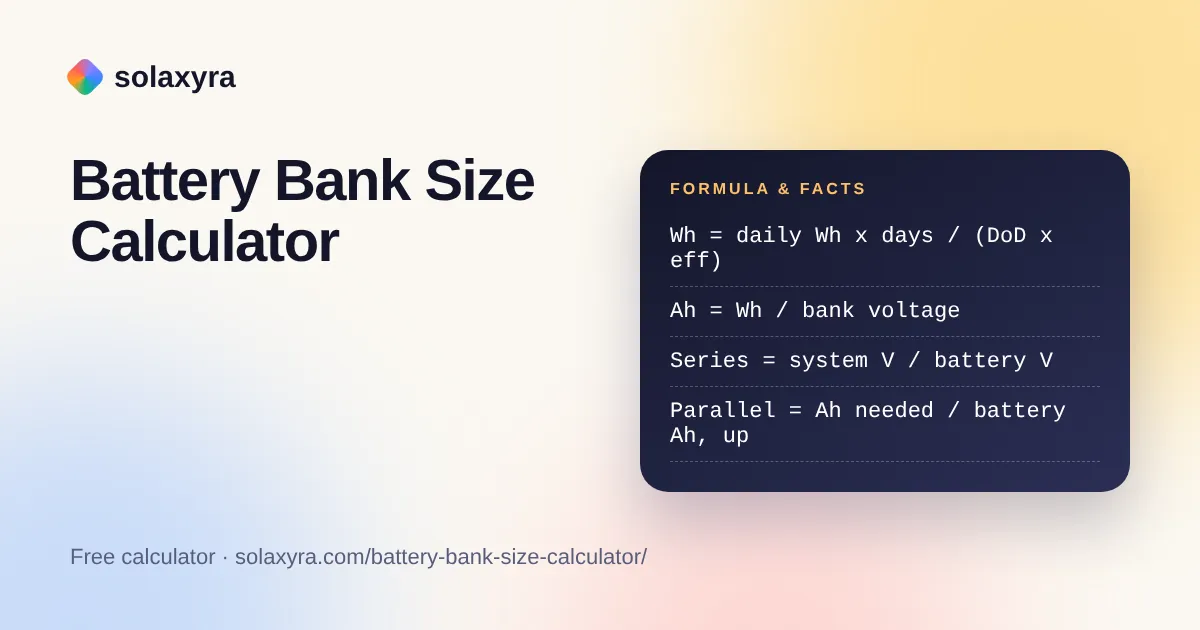
Quick answer: A battery bank size calculator multiplies daily watt-hours by the days of autonomy, then divides by usable depth of discharge and system efficiency to get nominal energy. Dividing by bank voltage gives amp-hours. For 2 kWh a day over 2 days at 90% depth of discharge and 90% efficiency, you need about 4.9 kWh, or 193 Ah at 25.6 V.
What Is a Battery Bank Size Calculator?
A battery bank size calculator is a tool that turns your daily energy use and the number of days you want in reserve into the battery capacity, in kWh and amp-hours, that you should buy. In plain words: required energy equals daily use times days of autonomy, divided by the usable share of the battery and by the efficiency of everything between the battery and your appliances.
The calculator then picks a layout. Batteries in series add their voltages, so the series count is the system voltage divided by one battery’s voltage. Batteries in parallel add their amp-hours, so the parallel count is the required amp-hours divided by one battery’s rating, always rounded up. Because you can only buy whole batteries, it also shows the bank you would actually install and how many days that bank really covers.
How Do You Use the Battery Bank Size Calculator?
- Enter your daily energy use in Wh or kWh. List each appliance’s watts times hours of use per day and add them up.
- Set the days of autonomy: how many days the batteries must carry the load with no solar, wind, generator or grid charging.
- Choose the system voltage (12, 24 or 48 V) and the battery type, then check the usable depth of discharge against your datasheet.
- Enter inverter and wiring efficiency. Use 100% if every load runs on DC.
- If the batteries will sit somewhere cold, enter the capacity the datasheet gives at your lowest expected temperature.
- Enter the voltage and Ah of the individual battery you plan to buy, then read the layout, the installed capacity and the autonomy it delivers.
How Many Days of Autonomy Do You Need?
Use the longest run of days in which your panels, generator or grid cannot recharge the bank; every extra day of autonomy adds one full day of use to the battery size. A cabin with a backup generator may only need one day, while a remote site relying on solar in a northern European winter may need several. The battery bank size calculator uses 2 days as an example default only.
Autonomy is expensive, so it pays to check whether the charging side can do more of the work. Adding panel capacity, a generator or a mains charger often costs less than doubling the bank. The off-grid solar calculator sizes the panels, battery, inverter and controller together from the same daily load.
How Does Battery Type Change Bank Size?
A bank planned at 50% usable depth of discharge needs 1.8 times the nominal capacity of one planned at 90%, for the same daily use and autonomy. Depth of discharge is the share of capacity removed from a full battery, and for almost all rechargeable chemistries deeper regular cycling shortens cycle life, as the depth of discharge reference notes. Lead-acid banks are therefore usually sized for a shallower working range than lithium iron phosphate banks. The 90% and 50% presets in the tool are editable examples; your battery’s datasheet and warranty terms decide the real figure.
| Daily use | Required energy (2 days, LiFePO4 90% DoD) | Ah at 12.8 V | Ah at 25.6 V | Ah at 51.2 V | Required energy (lead-acid 50% DoD) |
|---|---|---|---|---|---|
| 1 kWh | 2.47 kWh | 193 | 96 | 48 | 4.44 kWh |
| 2 kWh | 4.94 kWh | 386 | 193 | 96 | 8.89 kWh |
| 5 kWh | 12.35 kWh | 965 | 482 | 241 | 22.22 kWh |
| 10 kWh | 24.69 kWh | 1,929 | 965 | 482 | 44.44 kWh |
All rows assume 2 days of autonomy, 90% inverter and wiring efficiency and full capacity at operating temperature, as calculated by the battery bank size calculator above.
Should You Build a 12V, 24V or 48V Battery Bank?
Doubling the system voltage halves the current for the same power, so larger banks and inverters are easier to wire safely at 24 V or 48 V. Current equals power divided by voltage: a 2,000 W inverter load needs about 167 A from a 12 V bank before losses, about 83 A at 24 V and about 42 A at 48 V. Lower current means thinner cables, smaller fuses and less voltage drop, which you can check with the voltage drop calculator.
12 V still suits small vans and boats where most appliances are 12 V. For home backup and cabins with several kilowatt-hours of daily use, 48 V keeps currents and cable sizes manageable. The calculator warns when a 12 V bank becomes large enough that a higher voltage would be sensible.
How Do You Wire Batteries in Series and Parallel?
Connect batteries in series to raise voltage and in parallel to raise capacity; a 2S2P bank of four 12.8 V 100 Ah batteries gives 25.6 V and 200 Ah. Victron Energy’s battery bank wiring guidance recommends connecting the main positive and negative leads diagonally across a parallel bank so each battery shares the current more evenly, and suggests a maximum of around 3 or 4 parallel strings for large lead-acid banks. The battery bank size calculator flags any design that needs more than 4.
Before mixing batteries, read the manufacturer’s manual; lithium batteries with their own management systems often have specific rules on series and parallel limits, matching and communication. A battery bank stores a large amount of energy, and a short circuit can release it as heat very quickly, so every string needs correctly rated fuses or breakers and cables sized for the current.
Where Can You Safely Install a Battery Bank at Home?
In UK homes, BSI’s PAS 63100:2024 says domestic battery storage must not be installed in bedrooms, escape routes, lofts or roof spaces, or within 2 m of stored flammable materials. It must also not go in basements or cellars without access to the outside. Any battery bank connected to a property’s electrical installation must be designed or checked by a qualified electrician: in the UK, a registered electrician working to BS 7671; elsewhere in Europe, under your national wiring rules.
Worked Example: Gareth’s Off-Grid Cabin in Snowdonia
Gareth has a small off-grid cabin in Snowdonia. His fridge, lights, laptop, water pump and router use 3.5 kWh a day, and he wants 3 days of autonomy for grey winter spells before starting his generator. He plans a 48 V system with 51.2 V 100 Ah lithium iron phosphate rack modules, a 90% usable depth of discharge and an inverter path efficiency of 92%. The battery room is heated, so cold capacity stays at 100%.
- Required energy: 3,500 Wh x 3 / (0.90 x 0.92) = 12,681 Wh, or 12.68 kWh.
- Required capacity: 12,681 Wh / 51.2 V = 247.7 Ah.
- Layout: 48 / 51.2 rounds to 1 module in series; 247.7 / 100 rounds up to 3 in parallel, so 1S3P.
- Installed bank: 300 Ah at 51.2 V = 15.36 kWh nominal.
- Usable energy: 15.36 x 0.90 x 0.92 = 12.72 kWh, which covers about 3.03 days.
The battery bank size calculator confirms that three modules meet his target. To check how long the bank lasts if he runs a heater on a dull evening, Gareth can use the battery runtime calculator.
Frequently Asked Questions
How do I calculate the size of a battery bank?
Multiply daily watt-hours by days of autonomy, then divide by the usable depth of discharge and by system efficiency. Divide the result by the bank voltage to get amp-hours. For 2,000 Wh a day, 2 days, 90% and 90%, that is about 4,938 Wh or 193 Ah at 25.6 V.
How many batteries do I need for a 24V system?
With 12 V or 12.8 V batteries, you need 2 in series for each 24 V string. Then divide the required amp-hours by one battery’s rating and round up to find the number of parallel strings. Total batteries equal series count times parallel count.
Can I mix old and new batteries in one bank?
Usually not advisable. Batteries of different age, capacity or type can charge and discharge unevenly, so the weakest one limits the whole bank. Check the manufacturer’s manual before mixing, especially for lithium batteries with built-in management systems.
Why does the calculator round up the number of batteries?
You can only buy whole batteries, and rounding down would leave the bank short of your target. The results show both the exact capacity required and the bank you would actually install, along with the days of autonomy that installed bank provides.
Does cold weather change the battery bank size?
Yes. Batteries deliver less capacity when cold, and many lithium batteries must not be charged below 0 °C. Enter the capacity percentage your datasheet gives at the lowest temperature the batteries will see, or keep them in a heated or insulated space.
Is a bigger battery bank always better?
No. An oversized bank costs more and may rarely be fully recharged by a small solar array or charger. Size the bank and the charging source together so the batteries regularly reach full charge, and follow the charging advice in the manufacturer’s manual.
Checked October 2026 by the Solaxyra Editorial Team. Sources: Victron Energy: Wiring Unlimited, battery bank wiring, Wikipedia: Depth of discharge, Wikipedia: Ampere-hour, Wikipedia: Lithium-ion battery, BSI PAS 63100:2024 overview.