Formula and breakdown
n/a
n/a
This tool converts a current reading in amps into watts and kilowatts for DC, single-phase and three-phase supplies, and then turns that power into daily energy and running cost. It is set up for the UK and Europe, with 230 V and 400 V as defaults, and also covers 120 V and 240 V. Use the amps to watts calculator when you have a clamp meter reading, a fuse or breaker rating, or a current figure from a datasheet and want to know the power behind it.
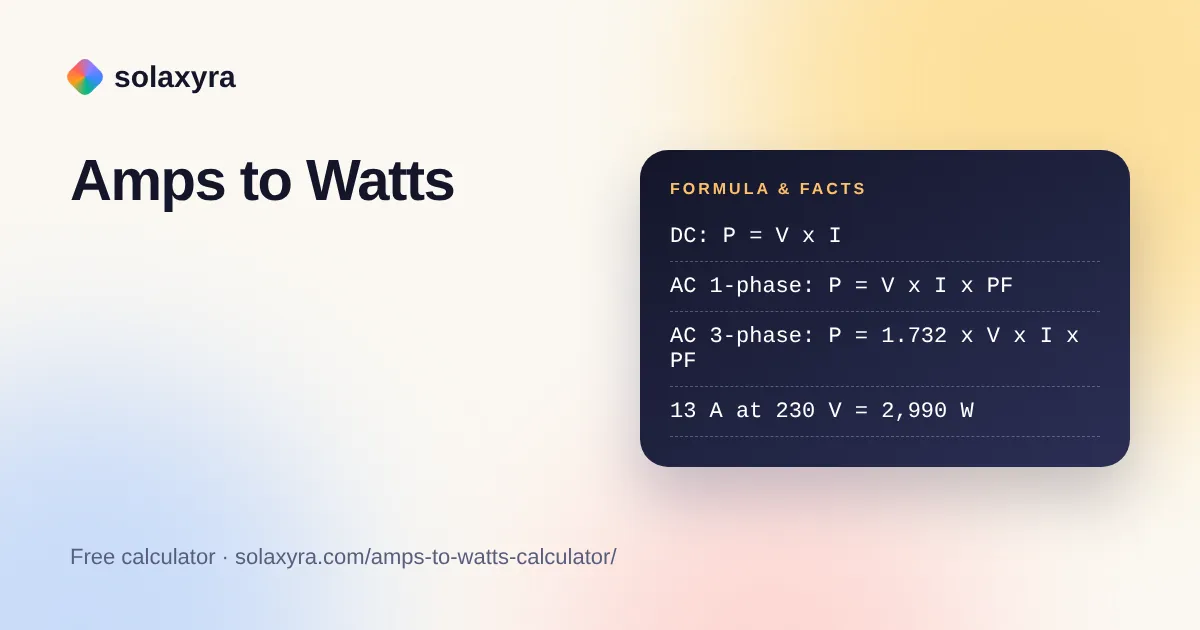
Quick answer: An amps to watts calculator multiplies current by voltage: P = V x I for DC, P = V x I x PF for single-phase AC and P = 1.732 x line voltage x I x PF for three-phase AC. So 10 A at 230 V and power factor 1 is 2,300 W; 10 A at 120 V is 1,200 W.
What Is an Amps to Watts Calculator?
An amps to watts calculator is a tool that works out the real power, in watts, carried by a known current at a known voltage. Put simply, watts equal volts times amps on a DC circuit; on AC you multiply by the power factor as well, and on a balanced three-phase supply you also multiply by the square root of 3 (1.732) when you use the voltage between lines.
The calculation is the reverse of a watts to amps conversion, but it answers different questions. People usually start from amps when they have measured something, when they want to know what a circuit can carry, or when a charger or battery datasheet quotes current instead of power.
How Do You Use the Amps to Watts Calculator?
- Select DC, AC single-phase or AC three-phase.
- Type the current in amps. For three-phase, use the current in one line of a balanced load.
- Enter the voltage or choose a preset: 230 V for UK and EU sockets, 400 V line to line for three-phase, 120 V or 240 V for North America, or a battery voltage for DC.
- Set the power factor for AC. Use 1 for heaters and kettles; for motors use the rating plate value.
- Optionally enter hours of use per day, your price per kWh and your currency to see energy and cost.
- Read watts, kilowatts, apparent power in VA, energy per day and cost per day and year, and open the breakdown for the working.
How Many Watts Is 13 Amps at 230 V?
13 amps at 230 V single-phase is 2,990 W, or just under 3 kW, when the power factor is 1. At 240 V the same current is 3,120 W, and at 120 V it is only 1,560 W. The table shows other common currents.
| Current (A) | 230 V single-phase (W) | 240 V single-phase (W) | 120 V single-phase (W) | 400 V three-phase (W) | 12.8 V DC (W) |
|---|---|---|---|---|---|
| 1 | 230 | 240 | 120 | 693 | 12.8 |
| 3 | 690 | 720 | 360 | 2,078 | 38.4 |
| 5 | 1,150 | 1,200 | 600 | 3,464 | 64.0 |
| 10 | 2,300 | 2,400 | 1,200 | 6,928 | 128.0 |
| 13 | 2,990 | 3,120 | 1,560 | 9,007 | 166.4 |
| 16 | 3,680 | 3,840 | 1,920 | 11,085 | 204.8 |
| 20 | 4,600 | 4,800 | 2,400 | 13,856 | 256.0 |
| 32 | 7,360 | 7,680 | 3,840 | 22,170 | 409.6 |
All AC values assume a power factor of 1; multiply by your power factor for motors and other inductive loads. The three-phase column is current per line on a balanced 400 V supply. The DC column uses 12.8 V, the nominal voltage of a four-cell lithium iron phosphate battery.
A current rating tells you the most a circuit or device is designed to carry, not what it uses. A 32 A circuit does not use 7.4 kW all the time; it only allows up to that much. For a fixed appliance’s real draw, measure it.
Why Is a Clamp Meter Reading Not the Same as Watts?
A clamp meter measures current only, so volts times amps gives apparent power in volt-amperes, and you need the power factor to get real watts. The volt-ampere is the product of RMS voltage and RMS current; it equals watts only for purely resistive loads.
That matters most for motors, compressors, fluorescent fittings and older power supplies. A fridge compressor reading 1.2 A at 230 V shows 276 VA, but at a power factor of 0.7 it is using about 193 W. If you cannot find the power factor, a plug-in energy monitor that shows both watts and VA gives a direct reading, and the power factor calculator turns those two numbers into a factor.
How Do You Convert Amps to Watts on a Three-Phase Supply?
On a balanced three-phase supply, multiply 1.732 by the line to line voltage, the current in one line and the power factor: P = 1.732 x 400 V x I x PF in the UK and EU. A motor drawing 16 A per line at 400 V and PF 0.9 therefore uses about 9,977 W, roughly 10 kW.
If you only know the voltage from one phase to neutral, 230 V in Europe, the equivalent formula is 3 x 230 V x I x PF. Both give the same answer because 400 V is 230 V multiplied by the square root of 3, as explained in the three-phase power reference. If the three lines carry different currents, the load is unbalanced: work out each phase at 230 V separately and add them. For kVA and kVAr on the same supply, use the three-phase power calculator.
How Do You Turn Amps Into Running Cost?
Convert amps to kilowatts, multiply by hours of use to get kWh, then multiply by your unit price. A 10 A resistive load at 230 V is 2.3 kW; running two hours a day uses 4.6 kWh, which costs about 1.21 pounds a day at the Great Britain price cap unit rate of 26.32p per kWh that applies from 1 October to 31 December 2026 for direct debit customers, according to Ofgem’s price cap announcement.
Replace that default with the unit rate on your own bill, especially if you are on a fixed or time-of-use tariff or live outside Great Britain. For appliances that you know in watts rather than amps, the electricity cost calculator is quicker.
Measuring current on live equipment carries a risk of electric shock. Use a properly rated clamp meter around a single conductor only, never open enclosures you are not trained to work in, and ask a qualified electrician, in the UK one working to BS 7671, to take readings inside consumer units or distribution boards.
Worked Example: Ciara’s Pottery Kiln in Cork
Ciara runs a small pottery studio in Cork. Her electrician clamps the kiln’s dedicated circuit during a firing and reads a steady 11.2 A on the 230 V supply. The kiln uses resistive heating elements, so the power factor is 1.
- Power: P = 230 V x 11.2 A x 1 = 2,576 W, or 2.58 kW.
- Energy for a five-hour firing at full power: 2.576 kW x 5 h = 12.88 kWh.
- Cost: her bill shows 0.35 euros per kWh, so one firing costs 12.88 x 0.35 = about 4.51 euros.
In reality the elements cycle on and off near the top temperature, so the true energy will be a little lower; the calculation gives Ciara a safe upper figure for pricing her work. She enters 5 hours, 0.35 and EUR in the calculator and reads the same result, then compares it with a second, larger kiln rated 16 A, which would draw 3,680 W at the same voltage.
Frequently Asked Questions
How many watts is 10 amps?
10 amps is 2,300 W at 230 V, 2,400 W at 240 V and 1,200 W at 120 V, assuming a power factor of 1. On a 400 V three-phase supply, 10 A per line is about 6,928 W. On a 12 V battery, 10 A is 120 W.
Can I convert amps to watts without the voltage?
No. Watts depend on both current and voltage, so the same amps mean very different power at 12 V and at 230 V. If you do not have a measured voltage, use the nominal one: 230 V in the UK and Europe, 120 V in North America, or the battery’s rated voltage.
Why does the calculator show VA as well as watts?
Volt-amperes are the product of volts and amps before power factor is applied. Generators, UPS units and transformers are often rated in VA or kVA because their limit is the current they can carry. Watts are the useful power, and they are what you pay for.
Does a 16 A breaker mean the circuit uses 3,680 W?
No. A 16 A breaker means the circuit is protected for up to 16 A, which is 3,680 W at 230 V. The actual power used depends on what is switched on. Never assume you can load a circuit to the breaker rating without checking with an electrician.
How do I convert amp-hours to watt-hours?
Multiply amp-hours by the battery voltage. A 100 Ah battery at 12.8 V stores 1,280 Wh, or 1.28 kWh. This is energy, not power, so it is a different calculation from amps to watts, which gives the rate of energy use at one moment.
What power factor should I use for an LED light or a laptop charger?
Use the figure on the product datasheet if one is given, as modern drivers and chargers vary widely. Without a datasheet, measure with a plug-in meter showing watts and VA. Using 1 will slightly overstate the power of a low power factor device, which is the cautious direction.
Checked October 2026 by the Solaxyra Editorial Team. Sources: Wikipedia, Volt-ampere, Wikipedia, Three-phase electric power, Wikipedia, Power factor, Ofgem, Energy price cap 1 October to 31 December 2026, Wikipedia, Mains electricity by country.