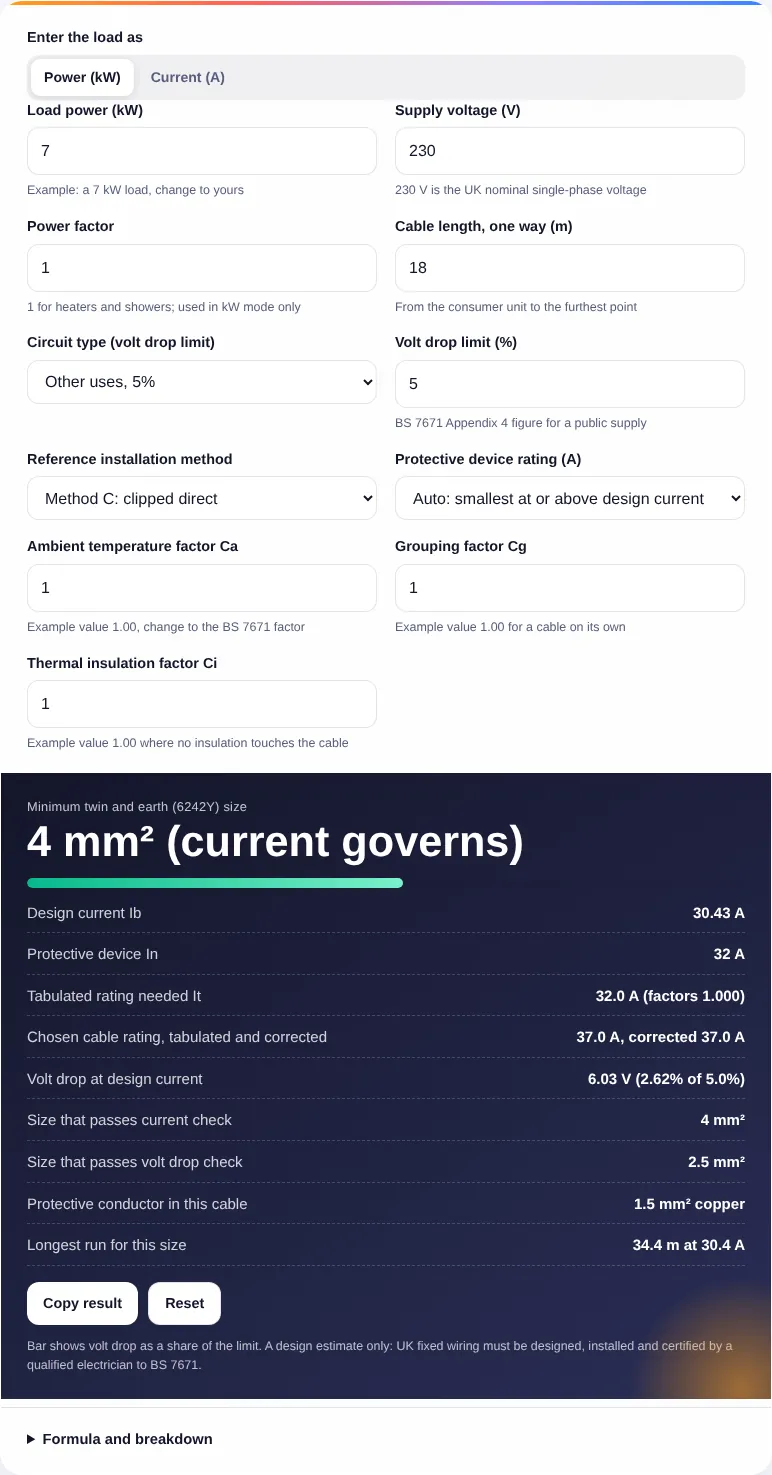
Bar shows volt drop as a share of the limit. A design estimate only: UK fixed wiring must be designed, installed and certified by a qualified electrician to BS 7671.
Formula and breakdown
n/a
n/a
n/a
n/a
This cable size calculator finds the smallest twin and earth (6242Y) cable for a single-phase circuit in a UK home, checking both current-carrying capacity and volt drop the way BS 7671 does, for homeowners, students and installers who want a first figure before an electrician designs the circuit. It shows every step, so you can see whether the current rating or the cable length decides the size.
Quick answer: A cable size calculator first sets a protective device at or above the design current, divides that rating by any correction factors, and picks the first cable whose tabulated rating is high enough. It then checks volt drop over the run. A 7 kW load on a 32 A device over 18 m needs 4 mm² clipped direct.

What Is a Cable Size Calculator?
A cable size calculator is a tool that works out the minimum conductor cross-sectional area, in mm², that can carry a circuit’s current safely and deliver it without too much voltage loss. In plain words: the cable’s rating after correction for heat and grouping must be at least the rating of the fuse or circuit-breaker protecting it, and the volts lost along the cable must stay within the limit for that type of circuit.
This version covers flat twin and earth cable to BS 6004, the type known as 6242Y, in sizes from 1 mm² to 16 mm². Its current ratings and volt drop figures come from Table 4D5 of the IET Wiring Regulations as published on cable datasheets, so the numbers match what an electrician would read from the book for reference methods A and C.
How Do You Use the Cable Size Calculator?
- Choose whether to enter the load in kilowatts or as a current in amps, then type the figure from the appliance rating plate.
- Leave the voltage at 230 V for a UK single-phase circuit. In kW mode, keep the power factor at 1 for heaters, showers and cookers.
- Enter the cable length one way, from the consumer unit to the furthest point on the circuit.
- Pick lighting (3%) or other uses (5%) for the volt drop limit, or type your own limit.
- Pick the installation method: clipped direct to a surface, or in conduit inside an insulated wall.
- Leave the device rating on Auto, or select the circuit-breaker you plan to use. Enter correction factors for ambient temperature, grouping and thermal insulation if they apply.
- Read the minimum size and which check governs, then open the breakdown to see the arithmetic.
How Is Cable Size Calculated in the UK?
UK cable sizing follows three rules: the device rating In must be at least the design current Ib, the cable’s tabulated rating It must be at least In divided by all correction factors, and the volt drop must not exceed 3% for lighting or 5% for other uses from a public supply.
The design current comes from the load: Ib = P / (V x power factor). A 7 kW load at 230 V draws 30.43 A, so the next standard circuit-breaker is 32 A. With no correction factors, the cable must have a tabulated rating of at least 32 A. The cable size calculator then reads the volt drop for each size from its mV/A/m figure: volt drop = mV/A/m x Ib x length / 1000.
The IET explains the same formula in its Wiring Matters article on voltage drop, which also gives the 5% figure for loads other than lighting. If you only want the volts lost for a cable you already have, the voltage drop calculator does that check on its own.
What Size Twin and Earth Cable Do I Need?
For a given current, twin and earth clipped to a surface carries more than the same cable in conduit inside an insulated wall: 2.5 mm² is rated 27 A clipped direct but only 20 A in method A. The table lists every size this cable size calculator uses.
| Size (mm²) | Method A, in conduit in insulated wall (A) | Method C, clipped direct (A) | Volt drop (mV/A/m) | Earth conductor (mm²) | Conductor resistance at 20 °C (Ω/km) |
|---|---|---|---|---|---|
| 1 | 11.5 | 16 | 44 | 1 | 18.1 |
| 1.5 | 14.5 | 20 | 29 | 1 | 12.1 |
| 2.5 | 20 | 27 | 18 | 1.5 | 7.41 |
| 4 | 26 | 37 | 11 | 1.5 | 4.61 |
| 6 | 32 | 47 | 7.3 | 2.5 | 3.08 |
| 10 | 44 | 64 | 4.4 | 4 | 1.83 |
| 16 | 57 | 85 | 2.8 | 6 | 1.15 |
The cable size calculator takes its ratings and mV/A/m from a 6242Y datasheet that states they follow Table 4D5 of the IEE Wiring Regulations; the earth conductor sizes and resistances are from the same datasheet, to BS EN 60228. Other reference methods in Table 4D5, such as cable above a plasterboard ceiling or in a stud wall, have different ratings. We could not verify those columns from a primary source today, so they are not offered as presets; an electrician will use the current edition of BS 7671.
How Do Correction Factors Change the Cable Size?
Correction factors reduce what a cable can carry, so the required tabulated rating rises in direct proportion: with a combined factor of 0.5, a 32 A circuit needs a cable rated 64 A in the table. The three common factors are Ca for ambient temperature above the 30 °C reference, Cg for cables grouped together, and Ci for cable touching or surrounded by thermal insulation.
The cable size calculator multiplies the three factors you enter and divides the device rating by the result. Each defaults to 1.00 as an example value, which fits a single cable clipped to a surface in a normal room. Take real values from Appendix 4 of BS 7671 for your situation. Cable buried in loft insulation is the case that most often forces a larger size, because heat cannot escape.
When Does Volt Drop Decide the Cable Size?
Volt drop decides the size on long runs: in the default example, 4 mm² can run about 34 m at 30.4 A before it passes the 5% limit, while 6 mm² reaches about 52 m. Beyond that length, a cable that is cool enough is still too thin to deliver the voltage.
Lighting has the tighter 3% limit. A 5 A lighting circuit over 40 m passes the current check on 1 mm², but loses 8.8 V, which is 3.8%, so the cable size calculator moves it up to 1.5 mm² at 5.8 V. Garden offices, detached garages and EV chargers at the end of a long drive are where volt drop matters most. The limits apply from the origin of the installation to the load, so a long sub-main uses part of the allowance before the final circuit begins.
Who Must Design and Install a New Circuit?
A new circuit in a home in England must meet Part P of the Building Regulations, and installing a new circuit or replacing a consumer unit is notifiable work. The Approved Document P guidance on gov.uk says installations should be designed, installed, inspected and tested to BS 7671. The Welsh Government publishes its own Approved Document P for Wales.
In practice this means using a registered electrician who can self-certify the work, or notifying building control before work starts. The cable size is only one part of the design. The electrician must also confirm the earth fault loop impedance is low enough for the device to disconnect in time, which our earth loop impedance calculator estimates, and check the supply can take the extra load with a maximum demand calculator. To turn an appliance rating into amps first, use the kW to amps calculator.
Worked Example: Cable Size for a 7 kW Load
Example: a 7 kW electric load in a UK home is fed by a 6242Y cable clipped to the surface along an 18 m route from the consumer unit. There is no grouping or insulation and the room is at a normal temperature, so all correction factors are 1.00.
- Design current: 7,000 W / 230 V = 30.43 A.
- Protective device: the next standard rating at or above 30.43 A is 32 A.
- Required tabulated rating: 32 / (1.00 x 1.00 x 1.00) = 32 A. Method C: 2.5 mm² is rated 27 A (too low), 4 mm² is rated 37 A (passes).
- Volt drop on 4 mm²: 11 x 30.43 x 18 / 1000 = 6.03 V, which is 2.62% of 230 V and inside the 5% limit of 11.5 V.
- Result: 4 mm² twin and earth with a 1.5 mm² earth conductor, with current as the governing check.
If the same cable ran in conduit inside an insulated wall (method A), 4 mm² is rated only 26 A, so the answer becomes 6 mm² at 32 A. That single change of route adds a size, which is why the installation method matters as much as the load.
Frequently Asked Questions
What size cable do I need for a 32 A circuit?
For 6242Y twin and earth with no correction factors, 4 mm² is the smallest size rated above 32 A when clipped direct (37 A). In conduit inside an insulated wall it needs 6 mm² (32 A). Volt drop over the run can push the size higher still on long circuits.
Is 2.5 mm² cable good for 20 A?
2.5 mm² twin and earth is rated 27 A clipped direct and 20 A in conduit in an insulated wall, so it can be protected by a 20 A device in both methods, provided no extra derating applies and volt drop over the run stays within the limit for the circuit.
What is the maximum volt drop allowed by BS 7671?
For an installation supplied from the public network, BS 7671 Appendix 4 gives 3% for lighting and 5% for other uses, measured from the origin of the installation to the load. At 230 V that is 6.9 V for lighting and 11.5 V for other circuits.
Does cable length affect cable size?
Yes. Length does not change the current rating, but volt drop rises in proportion to length. Past a certain run, which the calculator shows as the longest run for the chosen size, a larger cable is needed only to keep the voltage at the load within the limit.
Why does cable in insulation need to be bigger?
A cable warms as current flows through it, and thermal insulation stops that heat escaping. To keep the conductor below its maximum temperature of 70 °C for PVC cable, the allowed current falls, so a larger size is needed for the same load.
Can I use this cable size calculator to wire my own circuit?
No. It gives a design estimate for planning and checking quotes. New circuits in homes are notifiable under Part P in England and must be designed, installed, tested and certified by a qualified electrician to BS 7671, including earth fault and protective device checks.
Checked October 2026 by the Solaxyra Editorial Team. Sources: BS 6004 twin and earth PVC cable datasheet, ratings to Table 4D5 (Farnell), 6242Y twin and earth datasheet (Rapid Electronics), IET Wiring Matters: voltage drop, Professional Electrician: calculating voltage drop (Appendix 4 limits), Approved Document P, 2013 edition (gov.uk), Wikipedia: Circuit breaker (preferred ratings).