Bar shows the share of the roof face covered by panels. Simple rectangular roofs only: subtract roof windows, vents and chimneys separately.
Formula and breakdown
This solar panel roof area calculator works out how many panels physically fit on one face of your roof, in portrait or landscape, after leaving clearance at the edges and gaps between panels. It is designed for homeowners in the UK, Ireland and Europe planning a rooftop system, and it turns the count into kWp and an estimate of yearly generation.
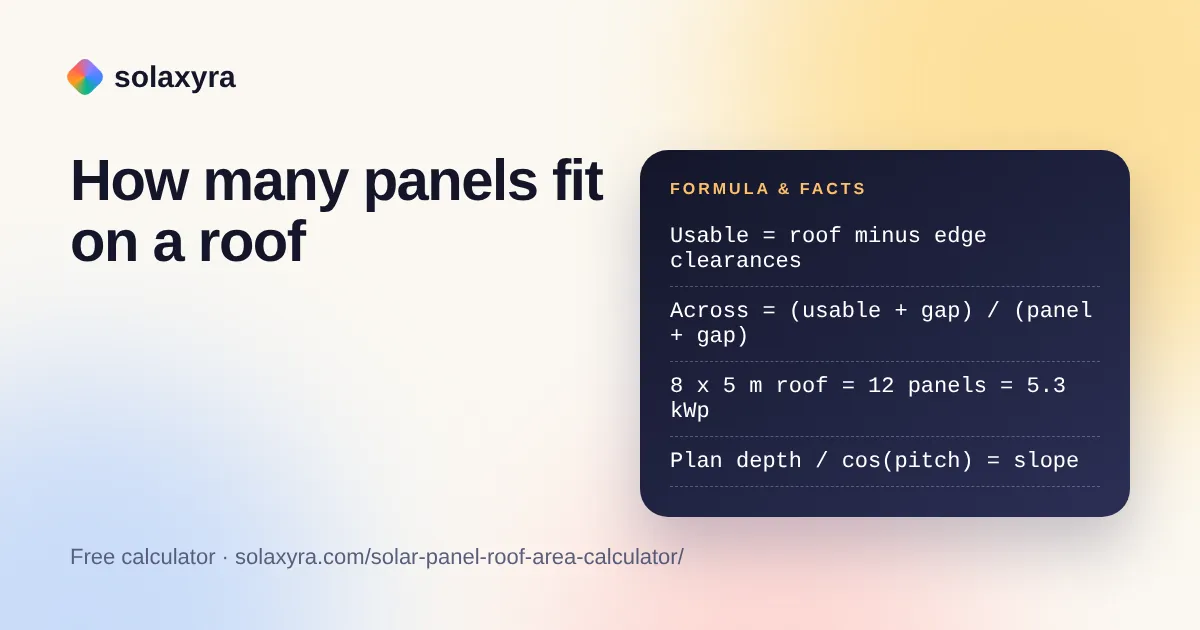
Quick answer: A solar panel roof area calculator subtracts edge clearances from the roof face, then counts how many panels plus gaps fit across and up the slope. An 8 x 5 m roof with 0.3 m clearances fits 12 panels of 1,762 x 1,134 mm in portrait or landscape, about 5.3 kWp with 445 W panels.
What Is a Solar Panel Roof Area Calculator?
A solar panel roof area calculator is a tool that fits whole panels into the usable rectangle of a roof face and reports how many fit, in which layout, and what system size they add up to. Dividing roof area by panel area overstates the answer, because panels come in fixed sizes and only whole panels count. This tool counts rows and columns instead.
The method in plain words:
- Usable width = roof width − 2 x side clearance.
- Usable depth = slope depth − ridge clearance − eaves clearance.
- Panels across = whole number of (usable width + gap) / (panel width + gap), and the same for rows up the slope.
- Total = across x up, worked out for portrait and landscape; best fit keeps the larger.
- System size (kWp) = number of panels x panel watts / 1,000.
How Do You Use the Solar Panel Roof Area Calculator?
- Choose metric or imperial. Values already entered convert automatically.
- Measure one roof face: the width along the eaves and the depth from eaves to ridge. If you measured the depth from a drawing or map, choose "on plan" and enter the roof pitch.
- Enter the clearances at the ridge, eaves and sides. The 0.3 m defaults are examples only; your installer sets the real values from the mounting system and roof type.
- Enter the gap between panels and the panel length, width and wattage from the datasheet.
- Leave the layout on "Best fit" or force portrait or landscape. Read the count, layout, kWp, roof coverage and yearly estimate.
How Much Roof Space Do Solar Panels Need?
A modern home panel of around 430 to 455 W takes up about 2 m2, so plan on roughly 2 m2 per panel plus edge clearances. The JinkoSolar Tiger Neo 54HL4R-B datasheet, for example, lists 430 to 455 W models measuring 1,762 x 1,134 mm, which is 1.998 m2 each. The Energy Saving Trust puts a typical 4.5 kWp home system at about 20 to 30 m2 of roof, usually around 12 panels.
The table below uses the same 1,762 x 1,134 mm panel at 445 W, 0.3 m clearance on every edge and a 20 mm gap, with the best of portrait and landscape.
| Roof face (width x slope depth) | Roof area | Panels that fit | System size | Yearly estimate at 806 kWh/kWp |
|---|---|---|---|---|
| 6 x 4 m | 24 m2 | 6 (landscape 3 x 2) | 2.67 kWp | about 2,150 kWh |
| 8 x 5 m | 40 m2 | 12 (either layout) | 5.34 kWp | about 4,300 kWh |
| 10 x 5 m | 50 m2 | 16 (portrait 8 x 2) | 7.12 kWp | about 5,740 kWh |
| 10 x 6 m | 60 m2 | 24 (portrait 8 x 3) | 10.68 kWp | about 8,610 kWh |
| 12 x 7 m | 84 m2 | 30 (landscape 6 x 5) | 13.35 kWp | about 10,760 kWh |
806 kWh per kWp is the median measured across UK Feed-in Tariff installations in 2024/25. Your own roof may differ; the solar panel output calculator estimates output for a given orientation and location.
Is Portrait or Landscape Better for Fitting More Panels?
The better layout is simply the one whose panel dimensions divide more neatly into your roof, and on many roofs the two give different counts. In the table, a 6 x 4 m face takes 4 panels in portrait but 6 in landscape, while a 10 x 6 m face takes 24 in portrait but only 20 in landscape. Best fit mode checks both and shows the other result too, so you can see what you would give up for a layout you prefer for looks or access.
Mixing portrait and landscape on one face can squeeze in an extra panel or two, but it complicates the mounting rails. Ask your installer whether their system supports it.
Why Does Roof Pitch Matter When You Measure From a Plan?
Depth measured on a plan or satellite map is the horizontal distance, which is always shorter than the real slope, so it undercounts panels. The slope depth equals the plan depth divided by the cosine of the pitch. At 35 degrees a 4 m plan depth becomes about 4.88 m on the slope, and at 40 degrees a 4.2 m plan depth becomes about 5.48 m. That difference is often enough for an extra row.
Width along the eaves is not affected by pitch, so only the depth needs correcting. If you can safely measure on the roof itself, use that figure and leave the option on "along the slope". Never go onto a roof without proper access equipment; a tape measure from a scaffold or a professional survey is the safe route.
Do You Need Planning Permission for Roof Solar Panels?
In England, solar panels on a house roof are usually permitted development, so no planning application is needed, as long as they meet the conditions in the General Permitted Development Order, Schedule 2 Part 14. On a pitched roof the panels must not protrude more than 0.2 m beyond the roof slope and must not rise above the highest part of the roof, excluding any chimney. They must also be sited to minimise their effect on the appearance of the building and the amenity of the area, as far as practicable.
Listed buildings and scheduled monuments are outside these permitted development rights, and extra limits apply in conservation areas and World Heritage Sites. Scotland, Wales and Northern Ireland have their own rules, and the rest of Europe varies by country and municipality. Check with your local planning authority before you commit, and have any roof structure, fixing and electrical work carried out by a qualified installer.
Worked Example: A Pitched Roof in Norwich
Daniel in Norwich has a south-facing roof face 9.5 m wide. His house drawings show a plan depth of 4.2 m, and the roof pitch is 40 degrees. His installer suggests 0.3 m clearance on every edge, 20 mm gaps and 445 W panels of 1,762 x 1,134 mm.
- Slope depth = 4.2 / cos(40) = 5.48 m.
- Usable area = (9.5 − 0.6) x (5.48 − 0.6) = 8.90 x 4.88 m.
- Portrait: 7 across x 2 up = 14 panels.
- Landscape: 5 across x 4 up = 20 panels.
- Best fit: 20 panels x 445 W = 8.9 kWp, or roughly 7,170 kWh a year at 806 kWh per kWp.
Had Daniel used the 4.2 m plan depth without correcting for pitch, the calculator would have found only 15 panels. Before ordering, he checks how much of that output he would use with the solar panel calculator, because a bigger array is only worth it if the extra energy is used or paid for.
Frequently Asked Questions
How much roof space do I need for solar panels?
Allow about 2 m2 for each modern panel of around 445 W, plus edge clearance. The Energy Saving Trust says a typical 4.5 kWp home system covers about 20 to 30 m2 of roof and usually uses around 12 panels.
Is portrait or landscape better for fitting more panels?
Neither is always better. It depends on how the roof's width and slope depth divide by the panel's length and width. Check both, which this calculator does automatically. A few centimetres of extra clearance can swing the result either way.
Should I measure my roof along the slope or from a plan?
Panels sit on the slope, so you need the slope length. A depth taken from a drawing or map is the horizontal distance and is shorter. Divide it by the cosine of the roof pitch, or choose the on-plan option and enter the pitch.
How close to the roof edge can solar panels go?
There is no single fixed figure for every roof. Installers leave space at the ridge, eaves and verges for wind loads, fixings, access and drainage, following the mounting system's instructions. The 0.3 m used here is an example only, so ask your installer.
Do I need planning permission for solar panels on my roof?
In England most houses can add roof panels under permitted development if they stick out no more than 0.2 m from a pitched roof slope and do not rise above the highest part of the roof, excluding chimneys. Listed buildings need consent, and other UK nations have their own rules.
How many kWp can I fit on a typical roof?
Multiply the number of panels that fit by the panel rating in kW. Twelve 445 W panels give 5.34 kWp. At the measured UK median of about 806 kWh per kWp, that is roughly 4,300 kWh a year before any shading.
Checked October 2026 by the Solaxyra Editorial Team. Sources: General Permitted Development (England) Order 2015, Schedule 2 Part 14, Energy Saving Trust solar panels guide, JinkoSolar Tiger Neo JKM430-455N-54HL4R-B datasheet, DESNZ Feed-in Tariff load factor analysis 2024/25.