Estimate for a typical year. Real output changes from year to year with the weather.
Formula and breakdown
n/a
n/a
n/a
n/a
This plug in solar calculator estimates how many kWh a plug-in solar kit will generate in a typical year, how much of that you will use at home, what it is worth on your bill and how long the kit takes to pay for itself, with UK rules built in and yield data for Ireland and the main EU markets. Enter your panel watts, the way the panels are mounted and your tariff, and every step of the sum is shown below the result.
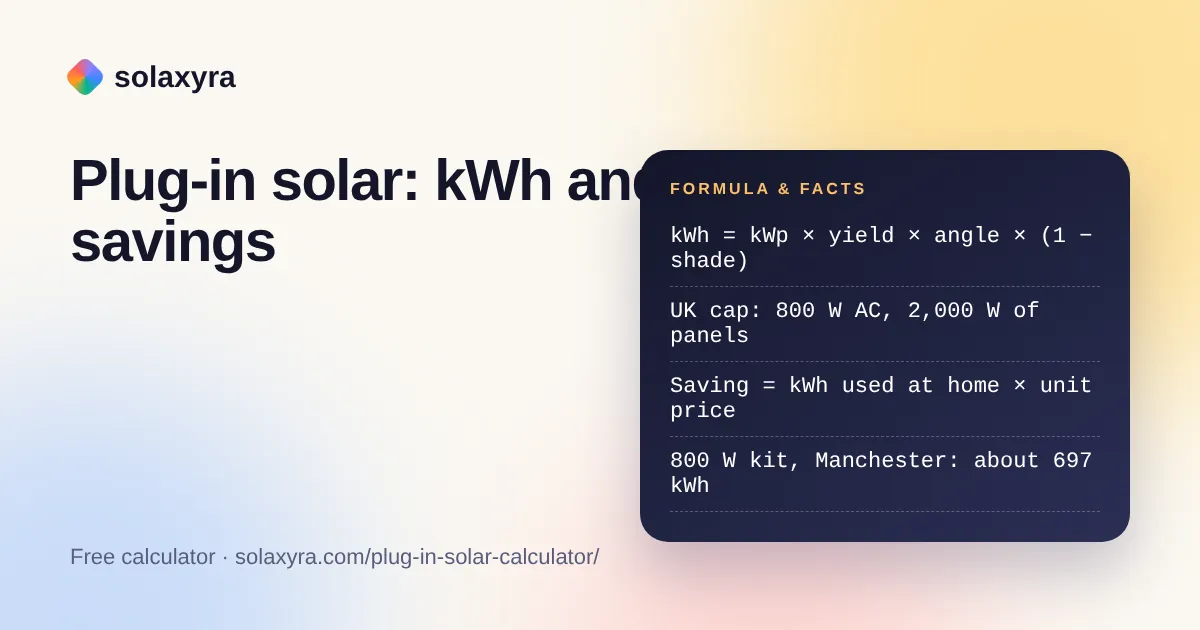
Quick answer: A plug in solar calculator multiplies panel kWp by local yield, adjusts for tilt, direction, shade and the 800 W inverter limit, then values the kWh you use yourself at your unit price. An 800 W kit on a south-facing 30° stand in Manchester gives about 697 kWh a year, worth about £92 at 26.32p per kWh with half used at home.
What Is a Plug In Solar Calculator?
A plug in solar calculator is a tool that turns the size, angle and location of a small socket-connected solar kit into yearly kWh, bill savings and a payback time. In plain words: yearly generation equals panel kWp, times the kWh each kWp produces at your location, times the share of sunlight your tilt and direction receive, minus shading and any output the inverter has to cut off. Savings equal the kWh you use at home times your unit price, plus any export payment.
The location yield comes from the World Bank Global Solar Atlas, which publishes long-term average output per kWp for a well-angled system. The calculator then models how much of that sunlight reaches your panels month by month, so a vertical railing kit, an angled stand and a low frame on a flat roof each get their own figure rather than one flat percentage.
How Do You Use the Plug In Solar Calculator?
- Pick the region closest to you. UK users can choose London, the Midlands, the North West or Scotland, because output falls the further north you go.
- Choose a mounting preset or type your own tilt. 90° is a panel hanging flat against a railing or wall; 30° is a typical angled stand.
- Select the direction the panels face. South is best in Europe; east and west lose some output but spread it across the day.
- Enter the total panel watts printed on the datasheets and the inverter output limit. In the UK the limit is 800 W.
- Add a shading loss for rails, trees or the balcony above, and the share of the electricity you expect to use as it is generated.
- Enter your unit price, any export payment and the kit price. Open "Formula and breakdown" to check every step.
Is Plug-In Solar Legal in the UK?
Yes, plug-in solar kits of up to 800 W have been legal in Great Britain since 27 August 2026, as confirmed in the government announcement on plug-in solar. The government's interim product specification sets the detail: the device may deliver no more than 800 VA and 3.5 A, the panels attached to it may total no more than 2,000 W, and it connects with a moulded BS 1363 plug fused at no more than 5 A into a fixed socket. Extension leads, multi-way adaptors and plug-in RCD adaptors are not allowed, and the device must be listed on the ENA type test register for G98.
Other rules from the same specification and from Energy Saving Trust guidance are worth knowing before you buy:
- Only one plug-in solar device is allowed per household.
- The kit must not be combined with a home battery.
- You must register the device online with your name, postcode and the make and model.
- Plug-in solar is not currently legal in Northern Ireland.
- Mounts must not depend on cable ties, rope, tape or straps, and some surfaces, including timber balconies and aluminium composite cladding, are excluded.
How Much Electricity Does an 800 W Plug-In Kit Produce?
An 800 W kit on an angled, south-facing, unshaded stand produces roughly 730 to 820 kWh a year in most of the UK, about 880 kWh in central Germany and about 950 kWh in Vienna. The Energy Saving Trust gives about 700 kWh a year for a typical UK installation, which sits close to our figures once some shading is allowed for. The table shows our modelled results for the same 800 W kit at 30°, facing south, with no shading.
| Location | Yearly output (kWh) | Best month | December |
|---|---|---|---|
| London and South East | 821 | 101 kWh (July) | 27 kWh |
| Midlands (Birmingham) | 778 | 97 kWh (May, July) | 25 kWh |
| North West (Manchester) | 734 | 97 kWh (May) | 22 kWh |
| Scotland (Edinburgh) | 728 | 101 kWh (May) | 18 kWh |
| Ireland (Dublin) | 771 | 102 kWh (May) | 24 kWh |
| Germany (Frankfurt) | 883 | 109 kWh (June) | 24 kWh |
| Netherlands (Amsterdam) | 837 | 109 kWh (May) | 23 kWh |
| Spain (Madrid) | 1,323 | 143 kWh (July) | 73 kWh |
Mounting matters more than many buyers expect. In the Midlands the same kit gives about 778 kWh on a 30° stand, 650 kWh on a 30° stand facing east and 572 kWh hanging vertically on a south-facing railing. If your only option is a balcony, the balcony solar calculator compares railing, angled and wall mounts month by month.
Is It Worth Fitting More Than 800 W of Panels?
Adding panels beyond 800 W raises yearly output, but the 800 W inverter limit throws away part of the extra on bright days, so each added watt is worth less. The calculator estimates that loss hour by hour. For a south-facing 30° kit in the Midlands, 1,600 W of panels produces about 1,437 kWh with 120 kWh lost to the limit, and 2,000 W produces about 1,666 kWh with 280 kWh lost.
Extra panels help most in the mornings, evenings and winter, when output is far below 800 W anyway. Two practical points apply in the UK. First, the specification suggests a professional assessment once panels exceed 960 W. Second, a larger kit pushes more electricity out to the grid at midday, so the share you use yourself usually falls, and plug-in kits are rarely paid for exports.
How Much Money Can Plug-In Solar Save?
Most UK households will save roughly £70 to £110 a year with an 800 W kit, depending on location, mounting and how much of the output they use at home. The government puts the figure at up to £110 a year, and the Energy Saving Trust estimates about £100 if someone is home during the day and about £70 if the house is empty.
The biggest lever after location is self-consumption. Electricity you use as it is generated replaces power you would otherwise buy at the full unit rate, which is 26.32p per kWh under the Ofgem price cap for October to December 2026. Electricity that flows out to the grid earns nothing unless your supplier agrees to pay for it. Running the washing machine, dishwasher or other timed appliances in the middle of the day raises the share you use. Our solar self-consumption calculator helps you estimate that share more carefully.
Do You Need an Electrician for Plug-In Solar?
You can install a compliant kit yourself, but your home wiring must be in good condition, and a qualified electrician should check it first if you are unsure. The interim specification advises confirming that the circuit has modern residual current protection, and says homes with older fuse boxes need an electrician's inspection and possibly an upgrade. Any change to fixed wiring, such as adding an outdoor socket, must be done by a registered electrician and meet BS 7671; the Energy Saving Trust also says outdoor sockets should be rated at least IP65.
Once installed, press the test button on your RCD or RCBO about every six months in daylight. If it does not trip, unplug the kit and call an electrician.
Worked Example: Priya in Manchester
Priya rents a ground-floor flat in Manchester with a small south-facing yard. She buys a kit with two 400 W panels and an 800 W inverter for £450, and fixes it to an angled ground stand at 30°. A fence shades the bottom edge in winter, so she enters a 5% shading loss. She works from home on two days a week and estimates that she uses half of what the panels make.
- Generation: about 697 kWh a year, from 92 kWh in May to 21 kWh in December. Nothing is lost to the 800 W limit.
- Used at home: 697 × 50% = about 349 kWh.
- Saving: 349 kWh × 26.32p = about £91.79 a year.
- Payback: £450 ÷ £91.79 = about 4.9 years.
If Priya instead fitted 2,000 W of panels, the calculator shows about 1,548 kWh a year, with 195 kWh lost to the limit. Because she would export much more at midday, she drops her home-use estimate to 35%, which gives a saving of about £143 a year. Whether the larger kit pays back faster depends on its price, so she compares both quotes with the solar payback calculator.
Frequently Asked Questions
Is plug-in solar legal in the UK?
Yes. Plug-in solar kits rated up to 800 W became legal in Great Britain on 27 August 2026. The device must meet the government's interim product specification, appear on the ENA type test register and be registered online. Plug-in solar is not currently legal in Northern Ireland.
How much electricity does an 800 W plug-in solar kit produce?
In the UK an 800 W kit on a south-facing angled stand typically produces about 700 to 820 kWh a year, depending on region and shading. A vertical railing mount gives around a quarter less. Southern Europe sees much higher figures, above 1,200 kWh in Madrid or Rome.
Can I connect more than 800 W of panels to a plug-in kit?
In the UK the panels may total up to 2,000 W, but the inverter output stays capped at 800 W. Extra panels lift morning, evening and winter output, while some midday output is lost. A professional assessment is advised for kits above 960 W of panels.
Do I need an electrician to install plug-in solar?
Not to plug it in, but your wiring must be safe. Use a fixed socket with modern RCD protection, never an extension lead. If your home has an old fuse box, no RCD, or you need a new outdoor socket, a registered electrician must check or do the work to BS 7671.
Can I get paid for the electricity my plug-in panels export?
Usually not. The Energy Saving Trust says you cannot sell exported electricity from a plug-in kit without your supplier's agreement and MCS certification, which plug-in kits do not normally have. Set the export payment to 0 in the calculator unless your supplier confirms a rate.
Can I add a battery to plug-in solar in the UK?
No. The UK interim product specification says a plug-in solar device must not be connected to, or used with, a battery energy storage system. If you want storage, a fixed solar and battery installation fitted by a certified installer is the route to consider.
Checked October 2026 by the Solaxyra Editorial Team. Sources: GOV.UK plug-in solar announcement, Plug-in Solar Device Interim Product Specification, Energy Saving Trust plug-in solar advice, Ofgem price cap October to December 2026, Global Solar Atlas (World Bank).