12 V systems carry high currents. Fuse every positive cable close to the battery and have the installation checked by a qualified electrician. Any 230 V hook-up or inverter wiring in the UK must meet BS 7671; elsewhere follow your local wiring rules.
Formula and breakdown
n/a
n/a
n/a
n/a
This campervan solar calculator works out the solar panel wattage and leisure battery size a 12 V van needs, from your own list of loads, the season you travel in, and how much charge your engine adds through a DC-DC charger, with defaults that suit touring in the UK and northern Europe.
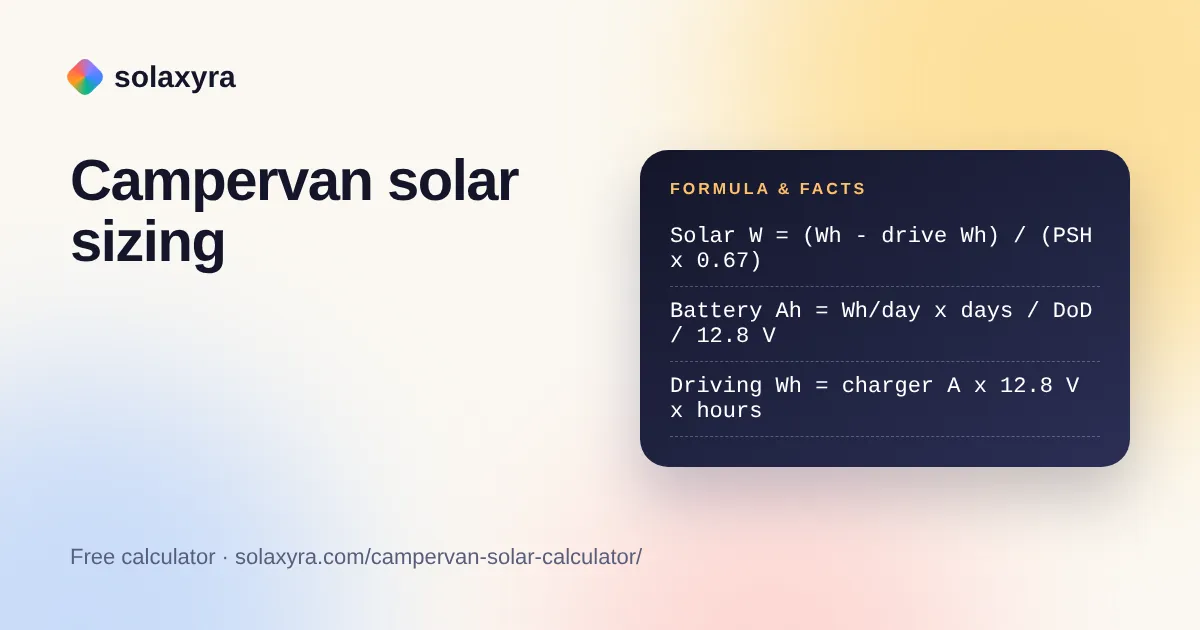
Quick answer: A campervan solar calculator adds up daily 12 V use in watt-hours, subtracts what driving puts back, and divides the rest by peak sun hours times about 0.67 for system losses. A 600 Wh day needs roughly 450 W of panels at 2 sun hours. Battery Ah equals daily Wh times days, divided by usable depth and 12 V.
What Is a Campervan Solar Calculator?
A campervan solar calculator is a planning tool that sizes the roof panels, leisure battery and charge controller for a van’s 12 V system from the energy you use each day. The formula in plain words: daily energy is each load’s watts times its hours; solar watts equal the energy left after driving, divided by sun hours and losses; battery amp-hours equal daily energy times the days you want to last, divided by usable depth of discharge and battery voltage.
Unlike a house, a van has three charging sources that change from week to week: the sun, the alternator while driving, and mains hook-up at a campsite. The tool covers the first two, so you can see how a long driving day changes what the roof has to do.
How Do You Use the Campervan Solar Calculator?
- Enter the watts and daily hours for each 12 V load. For a compressor fridge, enter the hours the compressor actually runs, not 24.
- Add any 230 V devices that run through an inverter, such as a laptop charger, and set the inverter efficiency.
- Pick the season. Each button fills an example sun-hour value that you can overwrite with a real figure for your route from PVGIS, the EU’s free solar data tool, using a horizontal panel.
- Enter your DC-DC charger current and the hours you usually drive per day. Use 0 if you have no charger.
- Choose lithium or AGM and the days you want to manage with no sun or driving.
- Read the panel size, battery size and controller rating, and open the breakdown to see each step.
How Much Solar Do You Need on a Campervan?
A van with a compressor fridge, lights and phone charging might use 500 to 900 Wh a day, which needs about 190 to 340 W of panels at an example 4 summer sun hours, and far more in winter. The calculator divides the energy left after driving by peak sun hours and a 0.67 performance ratio, the figure the PVGIS user manual uses for off-grid systems because energy passes through a controller and battery before it is used.
Flat roof panels make winter much harder. The sun is low, so a horizontal panel catches little light from November to February. The table uses example sun hours to show the scale of the change; check PVGIS for real monthly values on your route.
| Daily energy left for solar | Summer (example 4 h) | Spring or autumn (example 2 h) | Winter (example 0.7 h) |
|---|---|---|---|
| 400 Wh | 149 W | 299 W | 853 W |
| 600 Wh | 224 W | 448 W | 1,279 W |
| 800 Wh | 299 W | 597 W | 1,706 W |
| 1,000 Wh | 373 W | 746 W | 2,132 W |
Many van roofs only have space for a few panels, so winter touring usually relies on driving or hook-up as well. If you also stay put for long spells, the off grid solar calculator handles larger, tilted arrays.
What Size Leisure Battery Do You Need?
Size the leisure battery so it covers about two days of use with no charging: daily Wh times two, divided by usable depth of discharge and battery voltage. For 900 Wh a day that is about 176 Ah of lithium at 80% usable, or 300 Ah of AGM at 50% usable.
The calculator uses 12.8 V for lithium iron phosphate and 12 V for lead-acid when it converts watt-hours to amp-hours; 12.8 V is the nominal voltage given on a typical LiFePO4 leisure battery datasheet, which also claims up to 70% weight saving over lead-acid. Lithium lets you use more of the rated capacity, and the lower weight matters in a van close to its payload limit. AGM batteries last longer when kept above half charge, so the default for them is 50%. Your battery’s manual sets the real limit. To compare capacities in kWh, try the Ah to kWh calculator.
How Much Does Driving Charge a Leisure Battery?
A DC-DC charger adds roughly its rated current times battery voltage for every hour you drive, so a 30 A unit gives about 380 Wh per hour into a 12.8 V lithium battery. That is often more than a whole autumn day of solar on a small roof.
DC-DC chargers, also called battery-to-battery or B2B chargers, control the charge from the alternator to suit the leisure battery, which matters with lithium and with smart alternators that vary their output voltage. Real output can be lower when the alternator is hot or the battery is nearly full, so treat the driving figure as a best case. The charger’s input cable from the starter battery must be sized and fused for its full input current.
Do You Need an MPPT Charge Controller in a Van?
An MPPT controller is the usual choice for van solar because it converts excess panel voltage into extra charging current; size it at panel watts divided by 12 V, plus 25%. For 400 W that is about 42 A, so a 50 A controller fits.
Check the controller’s maximum PV input voltage against the panels’ open-circuit voltage in cold weather, especially if you wire panels in series. The MPPT charge controller calculator runs that check, and the solar cable size calculator helps keep voltage drop low on the run from roof to controller.
Worked Example: Eilidh’s Autumn Tour of the Highlands
Eilidh in Inverness plans a two-week October trip in her converted van with a lithium leisure battery and a 20 A DC-DC charger.
- Loads: fridge 40 W for 9 h (360 Wh), lights 12 W for 6 h (72 Wh), USB charging 20 W for 3 h (60 Wh), diesel heater fan and water pump 25 W for 6 h (150 Wh), and a 60 W laptop for 2 h through an 85% inverter (141 Wh). Total 783 Wh a day.
- Driving: about 1.5 hours a day at 20 A and 12.8 V gives 384 Wh.
- Left for solar: 783 minus 384 is 399 Wh.
- For this example she assumes 1.5 peak sun hours for a flat panel in Scottish October; her PVGIS check should confirm it. Solar: 399 divided by (1.5 x 0.67) is 397 W, so a 400 W roof array.
- Battery: 783 Wh x 2 days, divided by 0.80 and 12.8 V, is 153 Ah. She picks 200 Ah to allow for wet days parked up.
- Controller: 400 W divided by 12 V, times 1.25, is 42 A, so a 50 A MPPT controller.
She has the fuses, cable sizes and the 230 V inverter circuit checked by a qualified electrician before the trip.
Frequently Asked Questions
Is 200 W of solar enough for a campervan?
In summer, 200 W can cover a fridge, lights and phones if daily use stays under about 500 Wh. In spring, autumn and winter it usually falls short in the UK, so you will need driving charge or hook-up as well.
How many peak sun hours does a flat van roof get in the UK?
It varies a lot by month and latitude, and flat panels lose most in winter when the sun is low. Use PVGIS with a horizontal panel at your location to get the daily figure for each month rather than relying on a single average.
Should I choose lithium or AGM for a campervan?
Lithium iron phosphate gives more usable capacity per kilogram and accepts high charge currents from solar and DC-DC chargers. AGM costs less upfront but needs a larger bank because only about half its capacity is used to protect its life.
Does the calculator include the inverter?
Yes. Enter the watts and hours of 230 V devices in the inverter row and set its efficiency. The tool divides that energy by the efficiency, so a 60 W laptop for three hours counts as about 212 Wh at 85%.
Can I rely on driving to charge my leisure battery?
On travel days a DC-DC charger often supplies more energy than solar, but it does nothing when you stay parked for several days. Size the battery for the days you expect to stay put and let driving top it up between stops.
Who should install campervan solar and wiring?
Panels, controllers and fuses are often fitted by owners, but high 12 V currents can start fires if cables or fuses are wrong. Have the system checked by a qualified electrician, and have any 230 V wiring meet BS 7671 in the UK.
Checked October 2026 by the Solaxyra Editorial Team. Sources: PVGIS user manual, European Commission JRC, PVGIS overview, European Commission JRC, 12.8 V LiFePO4 Smart battery datasheet, Victron Energy.