Never fit a higher fuse than the appliance or cable needs. Fixed wiring, new circuits and consumer units are work for a qualified electrician (UK: BS 7671).
Formula and breakdown
n/a
n/a
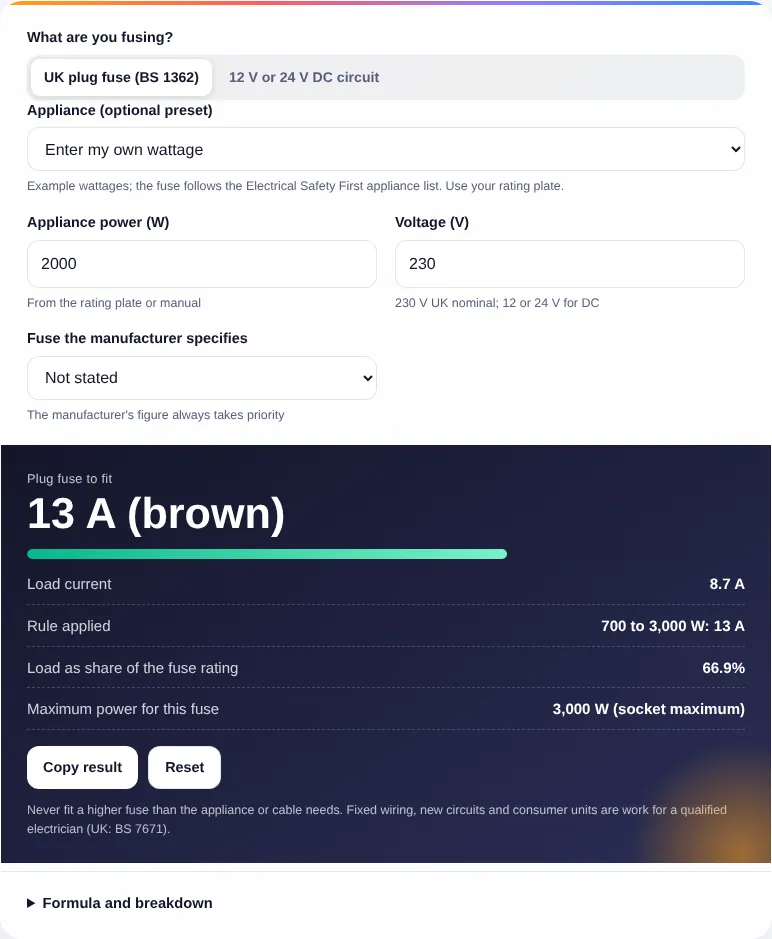
This fuse size calculator tells UK households which BS 1362 plug fuse an appliance needs, 3 A, 5 A or 13 A, from its wattage, and it also sizes a blade fuse for a 12 V or 24 V DC circuit in a campervan, boat or small solar setup. It shows the load current, how hard the fuse is working and the rule behind the answer.
Quick answer: A fuse size calculator divides watts by volts to get the current, then picks the fuse. In the UK, appliances from 700 to 3,000 W take a 13 A brown BS 1362 fuse and low-power items such as lamps take 3 A red. Always fit the rating the manufacturer specifies.

What Is a Fuse Size Calculator?
A fuse size calculator is a tool that works out the current an electrical load draws and matches it to the standard fuse that will carry that current in normal use but break the circuit under a fault. In plain words: current in amps equals power in watts divided by voltage, and the fuse is the standard rating that sits above that current without being larger than the cable can safely carry.
In a UK plug, the fuse has a specific job. As the Wikipedia article on BS 1363 explains, it is there to protect the flexible cord between the plug and the appliance under fault conditions, because a ring circuit can deliver far more current than a thin appliance cord can handle. That is why a smaller fuse on a lamp or laptop lead matters, even though the socket could supply 13 A.
How Do You Use the Fuse Size Calculator?
- Choose UK plug fuse or 12 V or 24 V DC circuit.
- For a plug, pick an appliance preset or type the wattage from the rating plate. Leave the voltage at 230 V unless you have a reason to change it.
- If the manual names a fuse rating, select it; the fuse size calculator then uses that figure.
- For DC, enter the load in watts, the system voltage, the fuse margin given in the device manual and the current rating of the cable.
- Read the fuse, the load current and the loading bar, and check any warning that appears.
What Size Fuse Does an Appliance Need in the UK?
Appliances rated from 700 to 3,000 W need a 13 A fuse, and low-power items such as table lamps, televisions and computers need a 3 A fuse, according to Electrical Safety First’s guidance on plugs and fuses. The same guidance lists washing machines, dishwashers, fridges, freezers, power drills, vacuum cleaners, microwaves, kettles, toasters and irons as 13 A appliances, and notes that 5 A fuses are still used in some older equipment.
The fuse size calculator applies that rule and also shows the arithmetic. A 2,000 W iron at 230 V draws 8.7 A, which is 67% of a 13 A fuse. If you only need the current for another purpose, the watts to amps calculator covers DC, single-phase and three-phase supplies.
| BS 1362 fuse | Colour | Current at full rating | Power at 230 V | Power at 240 V |
|---|---|---|---|---|
| 3 A | Red | 3 A | 690 W | 720 W |
| 5 A | Black | 5 A | 1,150 W | 1,200 W |
| 13 A | Brown | 13 A | 2,990 W | 3,120 W |
The table is simple multiplication of amps by volts, and it explains where the 700 W boundary comes from: a 3 A fuse runs out of headroom at about 700 W. UK mains is nominally 230 V, with a permitted range of plus 10% and minus 6% according to the Wikipedia article on mains electricity, so many homes measure closer to 240 V.
Why Do Some Low-Wattage Appliances Need a 13 A Fuse?
Fridges and freezers are on the 13 A list even though they draw little power while running. Compressors and motors draw a short surge when they start, and a 3 A fuse could blow at every start. This is why the fuse size calculator gives a fridge preset 13 A and warns you when a low wattage points to 3 A: check the manual for anything with a motor, pump or compressor.
Can You Fit a Bigger Fuse if One Keeps Blowing?
No: never fit a higher fuse than the appliance needs. Electrical Safety First says to replace a fuse only with another of the same rating. A fuse that keeps blowing is a sign of a fault in the appliance, the cord or the plug, and a larger fuse would let that fault overheat the cord instead of cutting the supply. Unplug the appliance and have it checked or repaired by a competent person.
The UK Plugs and Sockets etc. (Safety) Regulations 1994 require a standard plug to contain or come with a fuse link that conforms to BS 1362, so a genuine fuse carries that marking on its body. Do not use foil, wire or unmarked fuses as a substitute.
What If an Appliance Is Rated Above 3,000 W?
An appliance above 3,000 W cannot run from a 13 A plug, because 3,000 W is the maximum rating of a wall socket. Electric showers, cookers, large immersion heaters and home EV chargers are wired to their own circuit with a suitably rated breaker. That is fixed wiring work for a qualified electrician, and in the UK it must meet BS 7671. The calculator stops with a message rather than suggest a plug fuse for these loads.
How Do You Size a Fuse for a 12 V DC Circuit?
Divide the load in watts by the system voltage, multiply by the margin the device manual gives, and choose the next standard fuse at or above the result, provided it is no larger than the cable rating. The default of 125% is only an example; change it to the figure in your equipment manual.
The calculator picks from the standard blade fuse series listed in the Wikipedia article on automotive fuses: 1, 2, 3, 4, 5, 7.5, 10, 15, 20, 25, 30, 35 and 40 A. Above 40 A it tells you to move to a higher-current fuse type. The cable check matters as much as the fuse: if the fuse is larger than the cable can carry, the cable becomes the weak point. Use the solar cable size calculator to pick a cross-section, and the campervan solar calculator to total your 12 V loads.
Worked Example: Fusing a Kettle Plug and a Van Fridge
Example: a household in Leeds needs to replace the fuse in a 3,000 W kettle plug, and also wants to fuse a 120 W compressor fridge in a 12 V campervan.
- Kettle current: 3,000 W / 230 V = 13.0 A. The kettle is on the 13 A list, so fit a 13 A brown BS 1362 fuse, the largest a plug takes.
- Van fridge current: 120 W / 12 V = 10 A.
- With a 125% margin from the fridge manual: 10 A x 1.25 = 12.5 A.
- Next blade fuse at or above 12.5 A: 15 A.
- Cable check: the cable is rated 30 A in this example, so a 15 A fuse protects it.
Knowing the current also helps with running costs: the electricity cost calculator turns the same wattage into pence per hour.
Frequently Asked Questions
What fuse do I need for a 3 kW appliance?
A 3,000 W appliance draws about 13 A at 230 V, so it takes a 13 A fuse. That is the most a BS 1363 plug and socket is designed to supply. Anything rated above 3 kW, such as an electric shower or cooker, needs its own circuit installed by a qualified electrician.
Can I put a 13 A fuse in everything?
No. The plug fuse protects the flexible cord, and thin cords on lamps and small electronics can overheat before a 13 A fuse blows. Fit the rating the manufacturer specifies, and when replacing a blown fuse use the same rating, never a higher one.
What colour is a 3 A fuse?
BS 1362 fuses rated 3 A are coloured red and 13 A fuses are brown. Other ratings, including 5 A, are black. The rating is also printed on the ceramic body, and a genuine fuse is marked BS 1362.
Why does my fridge need a 13 A fuse if it only uses 150 W?
Electrical Safety First lists fridges and freezers among the appliances that take a 13 A fuse even though their running power is low. Motors and compressors draw a short surge when starting, so follow the manual rather than the wattage alone.
Is a 5 A fuse still used?
Yes, but less often. Electrical Safety First says 5 A fuses are still used in some older equipment and are still sold. Some appliance manuals specify 5 A, and that figure takes priority over any general rule based on wattage.
How do I size a fuse for a 12 V circuit?
Divide the load in watts by 12 to get the current, add the margin given in the device manual, and pick the next standard fuse at or above that figure. The fuse must not be larger than the current rating of the cable it protects.
Checked October 2026 by the Solaxyra Editorial Team. Sources: Electrical Safety First: Plugs and fuses, Plugs and Sockets etc. (Safety) Regulations 1994, regulation 6, Wikipedia: BS 1363, Wikipedia: Automotive fuse.