Bar shows the share of the charge one day of sun covers.
Formula and breakdown
n/a
n/a
n/a
This calculator estimates how long a solar panel takes to charge a 12 V, 24 V or 48 V battery, for campervan, boat, shed and off-grid owners in the UK, Ireland and the rest of Europe. Enter your panel wattage, battery size, charge level and local sun hours to get a realistic solar panel battery charging time in peak sun hours and in days.
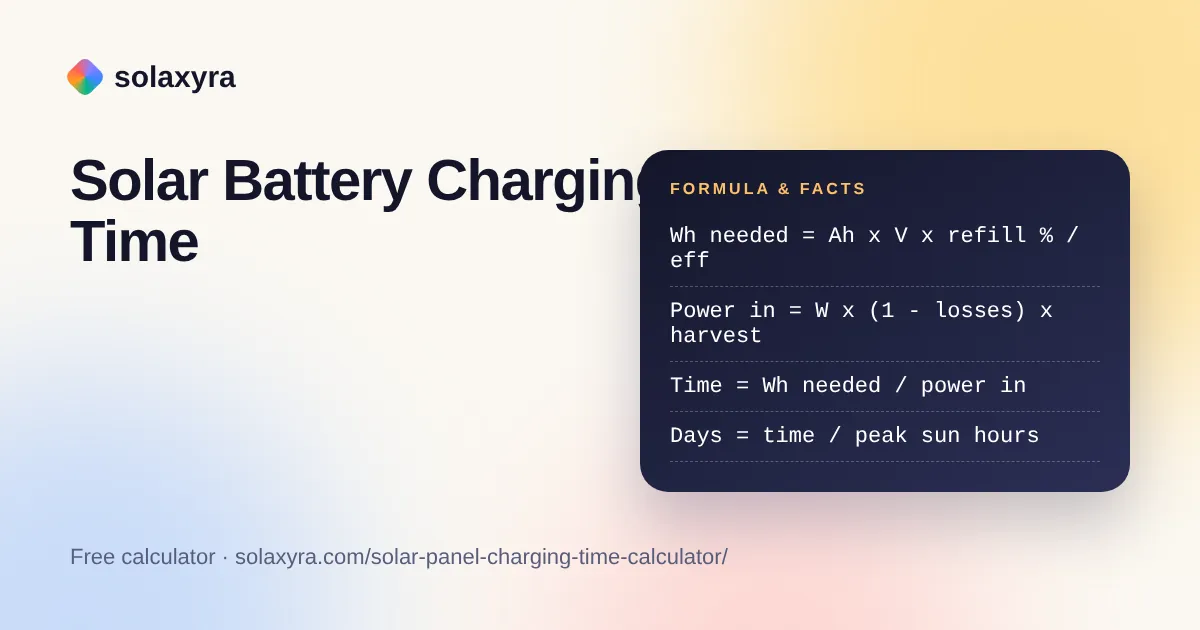
Quick answer: Solar panel battery charging time equals the energy the battery needs (Ah x V x share to refill, divided by charge efficiency) divided by the power that reaches it after array and controller losses. A 200 W panel with an MPPT controller refills a 12.8 V 100 Ah lithium battery from 20% in about 6.6 peak sun hours.
What Is a Solar Panel Charging Time Calculator?
A solar panel charging time calculator is a tool that works out how many hours of strong sunshine, and how many days, a solar array needs to bring a battery from one state of charge to another. In plain words: charging time equals the watt-hours the battery is missing, grossed up for battery losses, divided by the watts the panel really delivers once heat, dirt, wiring and the charge controller have taken their share.
The calculator gives solar panel battery charging time in peak sun hours first because that unit removes the weather from the sum. One peak sun hour is one hour of sunlight at 1,000 W per square metre, the irradiance used in the standard test conditions (with cells at 25 degrees C) that set a panel’s rated watts. A dull winter day gives only a fraction of what a clear summer day gives, and southern Europe gets more than the north. Dividing by your local daily figure turns the answer into days.
How Do You Use the Solar Panel Charging Time Calculator?
- Choose the battery chemistry. Lithium iron phosphate (LiFePO4) packs are nominally 12.8 V per 12 V block, so the tool uses that voltage; lead-acid, AGM and gel use 12 V.
- Pick the controller type. MPPT controllers convert the panel’s higher voltage into extra charging current; PWM controllers do not.
- Enter the panel rating in watts and the number of identical panels.
- Enter the battery capacity in amp-hours and the system voltage (12, 24 or 48 V).
- Set the start and target state of charge. Charging from 50% to 100% is half the work of charging from flat.
- Type in peak sun hours for your month and place. The default of 3.5 is only an example.
- Add any load that runs while the sun is up, such as a compressor fridge, so the tool subtracts it.
- Adjust the efficiency examples if you know your own figures, then read the time, the charge current and the share of the job one day covers.
How Long Does It Take a 100 W Solar Panel to Charge a 100 Ah Battery?
A 100 W panel with an MPPT controller needs roughly 13 peak sun hours to take a 12.8 V 100 Ah lithium battery from 20% to full, which is about three days at 4 peak sun hours a day and close to nine days at 1.5. The reason is simple arithmetic: the battery is missing about 1,024 Wh, while the panel delivers around 82 W after typical losses.
The same panel looks much quicker on a 50% discharged lead-acid battery, because only 600 Wh is missing. That does not mean lead-acid charges faster; it means it is normally used over a smaller window. The final stage of a lead-acid charge is also slow, because the chemical reaction has to spread from the plate surface into the bulk of the material, a process described in the lead-acid battery reference article. That is why the tool lets you add absorption hours.
Peak sun hours needed for a 12 V 100 Ah battery
| Panel (W) | Lithium 20% to 100%, MPPT | Lead-acid 50% to 100%, MPPT | Lead-acid 50% to 100%, PWM |
|---|---|---|---|
| 100 | 13.2 h | 8.6 h | 10.3 h |
| 200 | 6.6 h | 4.3 h | 5.1 h |
| 300 | 4.4 h | 2.9 h | 3.4 h |
| 400 | 3.3 h | 2.2 h | 2.6 h |
Assumptions for every row: 14% array losses, MPPT harvest 95%, PWM harvest 80%, charge efficiency 95% for lithium and 85% for lead-acid, no load running, and absorption time not included. Change any of these in the calculator.
Is an MPPT Controller Faster Than PWM for Charging a Battery?
An MPPT controller usually charges noticeably faster in cool, bright weather, because a PWM controller drags the panel down to battery voltage and wastes the difference. Victron Energy’s technical note on choosing between PWM and MPPT shows a 100 W, 36-cell panel harvesting about 81 W through PWM against 100 W through MPPT at 25 degrees C cell temperature, a loss of roughly 19%.
The same note shows the gap almost closing on very hot panels, because panel voltage falls as cells heat up. Northern Europe spends far more time in the cool, bright conditions where MPPT wins, which is why the calculator suggests 95% harvest for MPPT and 80% for PWM as starting points. Two practical rules follow:
- With PWM, the panel’s nominal voltage must match the battery: a 12 V panel (36 cells) for a 12 V battery.
- With MPPT you can wire panels in series for a higher array voltage and thinner cable, within the controller’s input limit. Our MPPT charge controller sizing tool checks the current rating and the cold-weather voltage.
How Many Peak Sun Hours Should You Use in the UK and Europe?
Use the daily figure for the worst month you need to charge in, taken from the European Commission’s free PVGIS service rather than a national average. PVGIS, run by the Joint Research Centre, gives monthly solar radiation and PV output for almost any location, without registration. In its monthly radiation tool, the daily irradiation on your panel’s tilt in kWh per square metre is numerically the same as peak sun hours.
Seasonal swing is the main reason solar panel battery charging time varies so much. A van battery that refills in an afternoon in June can need most of a week in December from the same panel. If you plan to stay off grid through winter, size from the December figure, and use the off-grid solar calculator to balance panels, battery and daily load together.
What Makes Solar Panel Battery Charging Time Longer in Real Life?
Real systems charge more slowly than a panel’s label suggests, because the label assumes laboratory test conditions that rarely occur outdoors. The main causes are:
- Heat. Panel output falls as cells warm up, so a hot roof in July can give less than a cold, clear March day.
- Angle and shade. Flat van roofs and partial shade from roof boxes or trees cut output sharply.
- Loads during the day. A fridge drawing 30 W from a 300 W array removes a tenth of the charging power.
- Battery acceptance. Lead-acid batteries taper current near full. Lithium batteries also have charging limits: Victron’s Lithium Battery Smart range, for example, specifies charging only between +5 and +50 degrees C, and its battery management stops a charge outside that window.
- Cable losses. Long, thin cables at 12 V waste energy as heat.
Battery installations in homes, boats and vehicles carry fire and electrical risks. Have the system designed or checked by a qualified electrician or marine or vehicle specialist and follow the manufacturer’s instructions; in the UK, fixed electrical work in a building must meet BS 7671.
Worked Example: Aoife’s Campervan in Galway
Aoife has two 175 W panels on her campervan roof, an MPPT controller and a 12.8 V 200 Ah LiFePO4 battery. After a cloudy weekend the battery is at 30%, and her compressor fridge averages 30 W. For September she uses 3 peak sun hours a day, the figure she found in PVGIS for her area.
- Energy the battery needs: 200 Ah x 12.8 V x 70% = 1,792 Wh. Divided by 95% charge efficiency gives 1,886 Wh from the controller.
- Charging power: 350 W x 86% (after 14% losses) x 95% MPPT harvest = 286 W. Minus the 30 W fridge leaves 256 W.
- Time: 1,886 Wh / 256 W = 7.4 peak sun hours.
- Days: 7.4 / 3 = about 2.5 sunny September days.
If Aoife had a PWM controller, harvest would fall to about 80%, leaving 211 W after the fridge, and the same charge would take about 8.9 peak sun hours, or three days. The calculator also shows a charge current of about 20 A, a gentle rate of 0.1 C, but always check the maximum charge current in the battery’s datasheet. To see how long the full battery then runs her fridge, try the battery runtime calculator.
Frequently Asked Questions
How do I calculate solar charging time by hand?
Multiply battery amp-hours by voltage and by the share you need to refill, then divide by charge efficiency. Divide that by panel watts after losses and controller harvest. The answer is peak sun hours; divide by your local daily peak sun hours to get days of charging.
Can a solar panel overcharge a battery?
Yes, a panel connected straight to a battery can overcharge it, so a charge controller is needed between them. The controller limits voltage and moves through charge stages, and many have settings for lithium or lead-acid.
Why is my battery charging slower than the calculator says?
The usual causes are fewer real peak sun hours than assumed, heat, shade, a load running in daytime, or a lead-acid battery tapering current near full. Check the controller’s display for actual watts and compare with the charging power figure the calculator shows.
Does a lithium battery charge faster from solar than lead-acid?
Usually yes, because lithium iron phosphate accepts current at a steady rate until nearly full and wastes less energy as heat. Lead-acid needs a slow absorption stage at the end. The panel’s output, not the chemistry, still sets the top speed on most small systems.
What size solar panel do I need to charge a 100 Ah battery in one day?
Divide the missing watt-hours by your daily peak sun hours, then by about 0.82 for losses with MPPT. For a 12.8 V 100 Ah lithium battery from 20% with 4 peak sun hours, that is about 1,078 Wh, needing roughly 330 to 350 W of panels.
Can I charge a 24 V battery bank with a 12 V panel?
Not with a PWM controller, which needs panel voltage above battery voltage. An MPPT controller can only charge a 24 V bank if the panel string voltage is high enough, so two 12 V panels are normally wired in series. Check the controller manual for its exact input range.
Checked October 2026 by the Solaxyra Editorial Team. Sources: Victron Energy, Which solar charge controller: PWM or MPPT, European Commission JRC, PVGIS, Victron Lithium Battery Smart technical data, Wikipedia, Lead-acid battery, Wikipedia, Lithium iron phosphate battery, Wikipedia, Nominal power (photovoltaic).