Estimates from rated power. Appliances with thermostats or motors (fridges, washing machines, heaters) draw full power only part of the time, so use an average figure for them.
Formula and breakdown
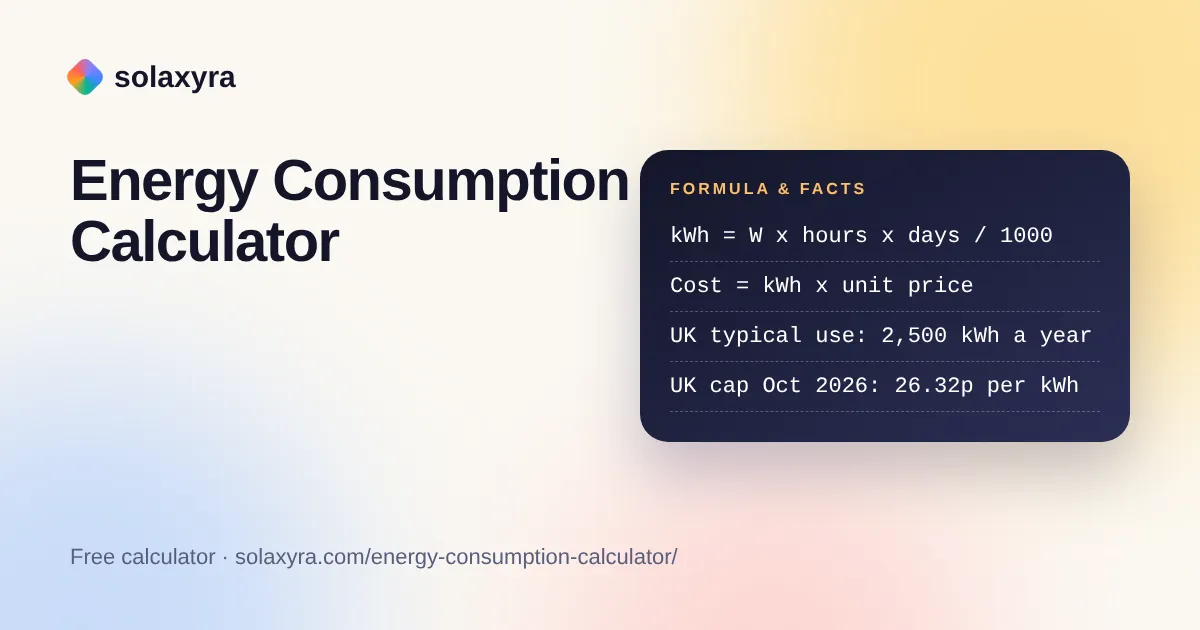
kWh per year = watts x quantity x hours per day x (days per week / 7) x 365 / 1000
Cost = kWh x unit price, plus 365 x standing charge
This energy consumption calculator adds up the electricity used by every appliance in your home and shows the total in kWh per day, month and year, with the cost at your tariff, for households in the UK, Ireland, Europe and elsewhere. Add as many appliances as you like, edit their watts and hours, and the breakdown ranks which ones use the most energy.
Quick answer: An energy consumption calculator adds up each appliance’s watts multiplied by hours of use to give kWh per day, month and year, then multiplies by your unit price. At the UK cap of 26.32p per kWh, Ofgem’s typical household use of 2,500 kWh a year costs about £658 before standing charges.
What Is an Energy Consumption Calculator?
An energy consumption calculator is a tool that converts appliance power ratings and usage times into kilowatt-hours, the unit your electricity bill is charged in. The formula in plain words: power in watts, multiplied by the number of identical units, multiplied by hours used per day and by the share of days used each week, multiplied by 365 and divided by 1,000, gives kWh per year. Multiplying the kWh by your unit price gives the energy cost; adding the daily standing charge times 365 gives the full yearly bill for those appliances.
A watt measures power at one moment; a kilowatt-hour measures energy over time. A 1,000 W heater running for one hour uses 1 kWh, and so does a 10 W router running for 100 hours. That is why small appliances left on all day can rival big ones used for minutes.
How Do You Use the Energy Consumption Calculator?
- Start with the five example appliances, or press Reset to restore them.
- Edit each row: name, power in watts, quantity, hours per day and days per week. Decimals work, so 0.2 hours is 12 minutes.
- Add more appliances from the list of typical values, or add a blank row for anything else.
- Remove rows you do not need with the button under each appliance.
- Enter your unit price and daily standing charge, and choose your currency.
- Read the yearly, monthly and daily kWh, the costs, and the breakdown ranked from biggest user to smallest.
How Much Electricity Does a Typical UK Home Use?
Ofgem’s typical domestic consumption value for electricity is 2,500 kWh a year, which applies from July 2026 and replaces the previous 2,700 kWh. That figure comes from Ofgem’s summary of price cap changes from 1 July 2026, which also sets typical gas use at 9,500 kWh. The energy consumption calculator compares your total with 2,500 kWh so you can see whether your appliance list explains your bill. Homes with electric heating, an electric shower or an EV use far more than the typical figure.
Which Household Appliances Use the Most Energy?
Appliances that heat water or air use the most energy per hour, while appliances that run around the clock use the most through sheer hours. The table shows yearly figures for common appliances using editable typical values, priced at 26.32p per kWh.
| Appliance (typical, editable) | Watts | Use | kWh per year | Cost per year at 26.32p |
|---|---|---|---|---|
| Electric shower | 9,000 | 12 minutes a day | 657 | £172.92 |
| Fridge-freezer (average draw) | 30 | 24 hours a day | 263 | £69.17 |
| Dishwasher | 1,000 | 1 hour, 5 days a week | 261 | £68.62 |
| Kettle | 3,000 | 12 minutes a day | 219 | £57.64 |
| LED TV | 80 | 4 hours a day | 117 | £30.74 |
| 8 LED bulbs | 8 each | 5 hours a day | 117 | £30.74 |
| Washing machine (average draw) | 500 | 1 hour, 4 days a week | 104 | £27.45 |
Wattages are typical examples. Your rating plates and habits will give different numbers.
How Do You Work Out the Cost of Your Energy Use?
Multiply your total kWh by the unit price and add the daily standing charge for each day of the year. The defaults are the direct debit electricity rates in the Ofgem price cap for October to December 2026: 26.32p per kWh and 54.83p per day. The standing charge alone is about £200 a year, so it is shown on a separate line; set it to zero if you only want the cost of running the appliances. Irish and European users can switch the currency and type in the rate from their own bill. For a single appliance with cost per hour and per day, the electricity cost calculator is quicker, and the watts to kWh calculator handles one-off conversions.
Why Is the Calculator’s Total Lower Than My Bill?
The usual reason is missing appliances or longer real hours, because a list rarely captures every charger, standby load and occasional use. Fridges, freezers, washing machines and heaters also cycle on and off, so their real use depends on settings, load and room temperature rather than the rating plate alone. To close the gap, read your meter at the same time on two days, compare the difference with the calculator’s daily average, then adjust hours in the energy consumption calculator until they match. A plug-in energy monitor on individual appliances gives the most accurate figures.
Worked Example: Daniel Checks His Bill in Manchester
Daniel in Manchester wants to know where his electricity goes. He keeps the five example appliances and adds an electric shower (9,000 W for 12 minutes a day) and a dishwasher (1,000 W for an hour, five days a week).
- Electric shower: 9,000 x 0.2 x 365 / 1,000 = 657 kWh a year.
- Dishwasher: 1,000 x 1 x (5 / 7) x 365 / 1,000 = 261 kWh a year.
- The five example appliances: 820 kWh a year.
- Total: 1,737 kWh a year, or 4.76 kWh a day, about 69% of Ofgem’s typical 2,500 kWh.
- Energy cost at 26.32p: £457.28. With the 54.83p daily standing charge: £657.41.
The breakdown shows the shower is his biggest single user at 38% of the total. Cutting shower time from 12 to 8 minutes would save about 219 kWh, or £57.64 a year. His bill shows about 2,300 kWh, so he also looks for the missing 560 kWh in chargers, a games console and his oven. If Daniel later considers panels, he can take his yearly total into the solar panel calculator, or size panels for one device with the appliance solar panel calculator.
Frequently Asked Questions
How do I calculate the energy consumption of an appliance?
Multiply its power in watts by the hours it runs each day, then divide by 1,000 to get kWh per day. A 100 W appliance used for 5 hours uses 0.5 kWh a day, or about 183 kWh a year if it runs every day.
What is the average electricity use of a UK home?
Ofgem’s typical domestic consumption value for electricity is 2,500 kWh a year from July 2026, down from 2,700 kWh. At 26.32p per kWh that costs about £658 a year, plus a standing charge of 54.83p a day, about £200.
Which appliances use the most electricity?
Appliances that heat water or air usually have the highest power ratings: electric showers, heaters, tumble dryers, ovens and kettles. Low-power appliances that run all day, such as fridge-freezers and routers, also add up because of their long hours. The breakdown in the calculator ranks your own list.
Why does my bill show more kWh than the calculator?
Common reasons are appliances you have not listed, standby loads, heating or hot water on electricity, and longer real hours than estimated. Rated watts can also differ from real draw. Compare a few weeks of meter readings with the calculator’s daily figure to find the gap.
Does the calculator include the standing charge?
Yes, as a separate line. The standing charge is a fixed daily amount you pay whatever you use, set at 54.83p a day for electricity under the October to December 2026 cap. Set it to zero to see energy cost only.
How do I find an appliance’s wattage?
Check the rating plate on the back or base, the manual, or the energy label. Some labels give energy per year or per 100 cycles instead of watts, so convert that to a daily figure. A plug-in energy monitor measures real use most accurately.
Checked October 2026 by the Solaxyra Editorial Team. Sources: Ofgem energy price cap October to December 2026, Ofgem typical consumption values from July 2026.