Generator kVA ratings normally assume a 0.8 power factor, so the size shown covers both the kVA and the kW limit.
Formula and breakdown
kVA = kW / PF
kVAr
Current
Generator
This kW to kVA calculator turns the real power of a load in kilowatts into the apparent power in kilovolt-amperes, for electricians, site managers and anyone hiring or buying a generator in the UK, Ireland or the rest of Europe. Enter the power and the power factor, choose single-phase 230 V or three-phase 400 V, and you also get reactive power, line current and a generator size that respects the usual 0.8 power factor rating.
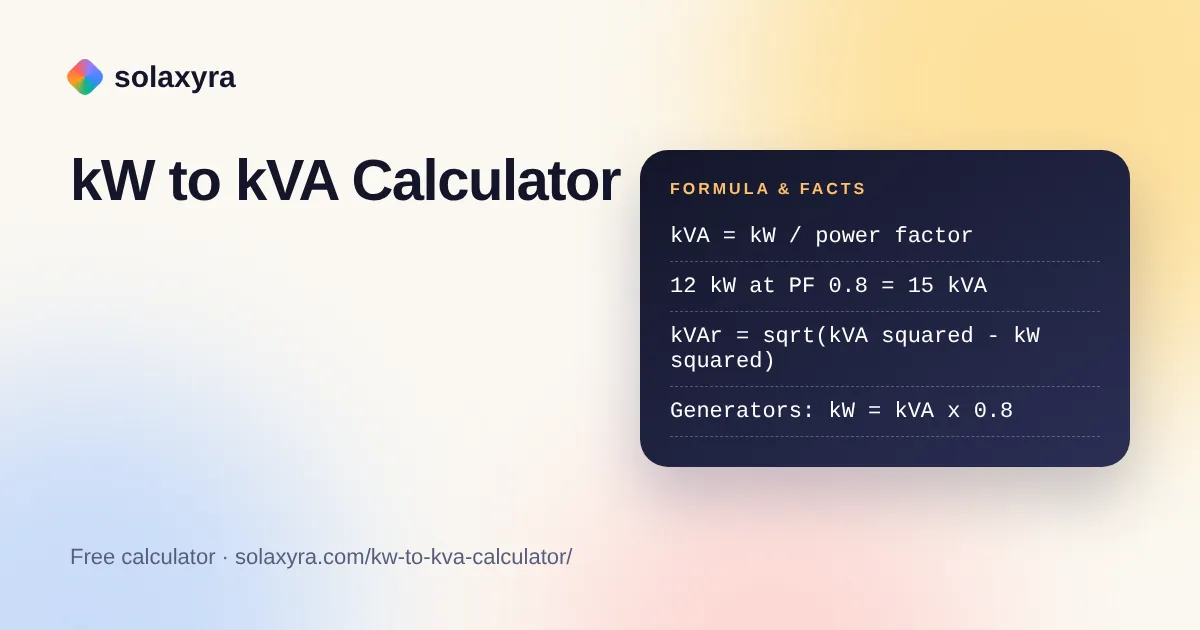
Quick answer: To convert kW to kVA, divide real power by the power factor: kVA = kW / PF. At a power factor of 0.8, 12 kW needs 15 kVA. At a power factor of 1, as with a heater, kW and kVA are equal. The kW to kVA calculator also shows reactive power, current and a generator size.
What Is a kW to kVA Calculator?
A kW to kVA calculator is a converter that finds the apparent power (kVA) a supply must deliver for a given real power (kW) and power factor. In plain words: apparent power equals real power divided by the power factor, and the power factor is a number between 0 and 1 that tells you how much of the current flowing in an AC circuit does useful work.
Real power is what turns into heat, light or motion and what your meter bills. Apparent power is the product of voltage and current, and it decides how large cables, transformers and generators must be. The gap between the two is reactive power (kVAr), which builds magnetic or electric fields in motors and capacitors and then returns to the supply. The three form a right-angled triangle, so kVA squared equals kW squared plus kVAr squared, as the power factor reference on Wikipedia sets out.
How Do You Use the kW to kVA Calculator?
- Pick the unit, kW or W. Small appliances are often labelled in watts, so the W option saves a step.
- Enter the real power. Use the rating plate, the data sheet or a reading from a power meter.
- Enter the power factor, or choose a preset. Presets are labelled examples; your own measured figure is better.
- Choose single-phase or three-phase. The voltage switches to 230 V or 400 V, and you can type another value, such as 240 V or 120 V, if you are outside Europe.
- Set a generator headroom percentage if you are sizing a generator. The 25 percent default is an example margin, not a rule.
- Read the kVA result, then open “Formula and breakdown” to see each step with your numbers, and use Copy result to paste it into a quote or report.
Why Is kVA Higher Than kW?
kVA is higher than kW whenever the power factor is below 1, because part of the current carries reactive power that does no useful work but still loads the cables and the source. At a power factor of 0.8, kVA is 1.25 times the kW figure; at 0.9 it is about 1.11 times.
Resistive loads such as kettles, immersion heaters and oil-filled radiators have a power factor very close to 1, so their kW and kVA match. Induction motors, welding sets, transformers and some older lighting run lower, especially when lightly loaded. That is why a workshop full of motors needs more kVA from its supply than a room full of heaters with the same kW total.
What Power Factor Should You Use for kW to kVA?
Use the power factor printed on the equipment rating plate or data sheet; if you have nothing better, 0.8 is the cautious planning value used for most generator ratings. Many motors state “cos phi” on the plate, which is the same thing as power factor for a sinusoidal supply.
For a mix of loads the overall power factor is not a simple average, so a clamp meter or power analyser reading by an electrician is the reliable route. If you already know both the kW and kVA of an installation, the power factor calculator works the value out, and the kVA to kW calculator runs the conversion the other way.
How Do You Size a Generator From kW to kVA?
Take the larger of two figures, the load in kVA and the load in kW divided by 0.8, then add headroom for starting surges and future loads. This works because most generators are rated in kVA at a 0.8 power factor, so a 20 kVA machine can deliver about 16 kW of real power, and because, as the volt-ampere entry on Wikipedia notes, the kVA rating of a machine is set by the current its windings can carry.
The calculator does this check for you. If your load power factor is better than 0.8, the engine’s kW limit is the one you hit first, so a plain kW / PF answer would undersize the generator. Motors can draw several times their running current for a moment at start-up, so ask the supplier for the surge figure of each motor rather than relying on a fixed margin.
Connecting a generator to a building’s wiring is not a plug-in job. In the UK it needs a correctly rated changeover switch so the generator can never feed back into the grid, and the work must be done or checked by a registered electrician to meet BS 7671; elsewhere follow your national wiring rules.
Does kVA Apply to DC Circuits?
No, kVA only has meaning in AC circuits; in a DC circuit voltage and current are steady and in step, so volts times amps is already the real power in watts. Batteries, solar strings and 12 V systems are therefore described in W and kW, not kVA. Once a solar inverter turns DC into AC, its output side has a kVA rating like any other AC source.
kW to kVA Conversion Table
Each figure is kW divided by the power factor at the top of the column, rounded to two decimals.
| Real power | PF 1.00 | PF 0.95 | PF 0.90 | PF 0.85 | PF 0.80 |
|---|---|---|---|---|---|
| 1 kW | 1.00 kVA | 1.05 kVA | 1.11 kVA | 1.18 kVA | 1.25 kVA |
| 5 kW | 5.00 kVA | 5.26 kVA | 5.56 kVA | 5.88 kVA | 6.25 kVA |
| 10 kW | 10.00 kVA | 10.53 kVA | 11.11 kVA | 11.76 kVA | 12.50 kVA |
| 20 kW | 20.00 kVA | 21.05 kVA | 22.22 kVA | 23.53 kVA | 25.00 kVA |
| 50 kW | 50.00 kVA | 52.63 kVA | 55.56 kVA | 58.82 kVA | 62.50 kVA |
| 100 kW | 100.00 kVA | 105.26 kVA | 111.11 kVA | 117.65 kVA | 125.00 kVA |
Worked Example: Sizing a Workshop Generator in Galway
Aoife runs a joinery workshop near Galway and wants a standby generator for her single-phase 230 V supply. Her electrician measures the working load at 9 kW with an overall power factor of 0.9.
- Apparent power: 9 / 0.9 = 10.0 kVA.
- Reactive power: the square root of (10 squared minus 9 squared) = 4.36 kVAr.
- Current at 230 V: 10,000 / 230 = 43.5 A.
- Generator kW check: 9 / 0.8 = 11.25 kVA, which is larger than 10.0 kVA, so the engine’s kW rating sets the size.
- With 25 percent headroom: 11.25 x 1.25 = 14.1 kVA.
Had Aoife simply divided 9 kW by her load’s 0.9 power factor, she would have looked at a 10 kVA machine whose engine can only give 8 kW, which is not enough. Her electrician will also confirm the planer and saw motor start-up currents and fit a changeover switch before the generator is connected. To check the current against her cable and breaker sizes, she can use the kVA to amps calculator.
Frequently Asked Questions
Is kW the same as kVA?
No. kW is real power, the part that does useful work such as heat or motion. kVA is apparent power, which also includes reactive power that flows back and forth in AC circuits. The two are only equal when the power factor is exactly 1, as with a simple resistive heater.
How many kW is a 20 kVA generator?
A 20 kVA generator rated at the usual 0.8 power factor can supply about 16 kW of real power, because 20 x 0.8 = 16. Always check the rating plate and data sheet, since prime and standby ratings differ and some machines are rated at another power factor.
What happens to kVA when the power factor is 1?
When the power factor is 1, kVA equals kW, so 5 kW is also 5 kVA. Purely resistive loads such as kettles, immersion heaters and panel heaters are close to this. Motors, transformers and older fluorescent fittings sit lower, so their kVA is higher than their kW.
Can I convert kW to kVA without knowing the power factor?
Not exactly. The power factor is part of the formula, so any answer without it is an estimate. Use the value on the rating plate or data sheet, ask an electrician to measure it, or use 0.8 as a cautious planning figure when sizing a generator.
Is the kW to kVA formula different for three-phase loads?
No. kVA = kW / PF works for single-phase and three-phase loads alike. The phase only changes the current: single-phase current is kVA x 1000 / V, and three-phase line current is kVA x 1000 / (1.732 x line voltage), using 400 V in the UK and EU.
Why are generators rated in kVA at 0.8 power factor?
The alternator windings are limited by current, which depends on kVA, while the engine is limited by real power in kW. Rating at 0.8 power factor gives both limits in one figure: the kW rating is 80 percent of the kVA rating. Check the manufacturer data sheet for your machine.
Checked October 2026 by the Solaxyra Editorial Team. Sources: Power factor (Wikipedia), Volt-ampere (Wikipedia), Aggreko: kW and kVA.