This is the full-load current only. Cable, fuse and breaker sizes depend on installation method, grouping, temperature and volt drop, so they must be chosen by a qualified electrician (UK: to BS 7671).
Formula and breakdown
…
This kVA to amps calculator converts the apparent power rating of a transformer, generator, UPS or supply into the current it carries at full load, for single-phase and three-phase AC systems in the UK, Ireland and Europe, with North American voltages as an option. Enter the kVA and the voltage, say whether a three-phase voltage is measured line to line or line to neutral, and the tool returns amps per line, kVA per phase and, if you wish, real power at a chosen power factor.
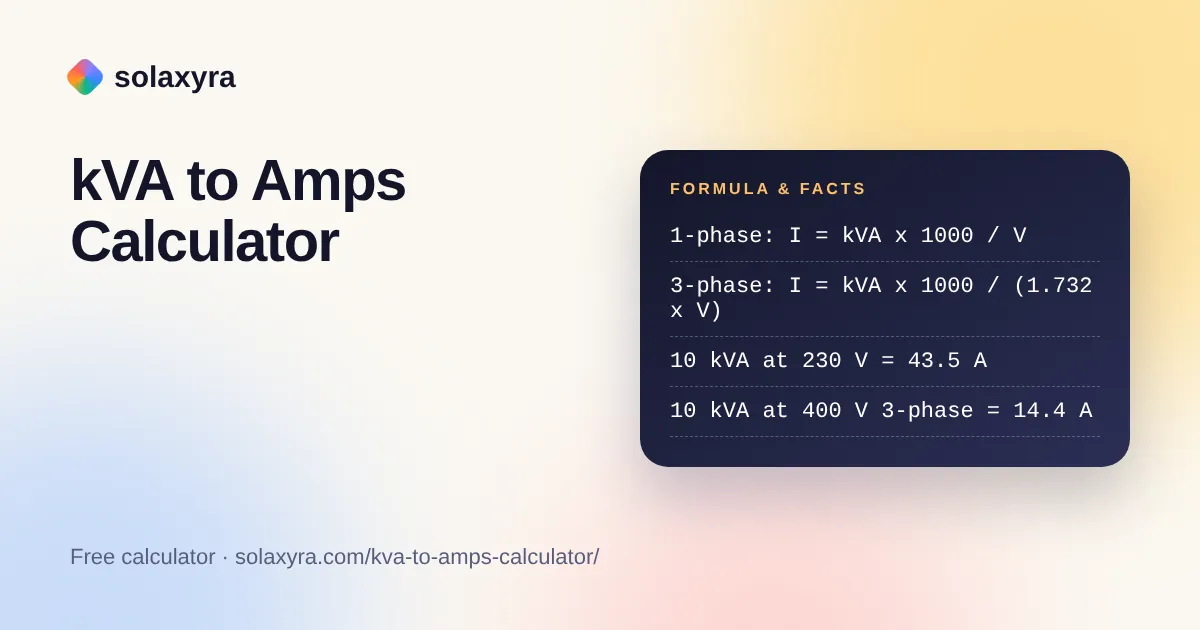
Quick answer: For single-phase AC, amps = kVA x 1,000 / volts, so 10 kVA at 230 V is 43.5 A. For three-phase, amps = kVA x 1,000 / (1.732 x line volts), so 10 kVA at 400 V is 14.4 A per line. This kVA to amps calculator needs no power factor and does not apply to DC.
What Is a kVA to Amps Calculator?
A kVA to amps calculator is a converter that works out the current drawn from, or supplied by, an AC source of a given apparent power at a given voltage. In plain words: multiply the kVA by 1,000 to get volt-amperes, then divide by the voltage for single-phase, or by 1.732 times the line voltage for three-phase.
The figure 1.732 is the square root of 3. On a balanced three-phase system the voltage between any two lines is 1.732 times the voltage between a line and neutral, which is why UK and EU supplies are described as 230/400 V, a relationship covered in the Wikipedia article on three-phase electric power.
How Do You Use the kVA to Amps Calculator?
- Choose AC single-phase or AC three-phase. The DC button is there to explain why kVA cannot be used for DC.
- Enter the kVA from the rating plate of the transformer, generator, UPS or inverter.
- Pick a common voltage or type your own. The defaults are 230 V for single-phase and 400 V for three-phase.
- For three-phase, say whether your voltage is line to line (such as 400 V) or line to neutral (such as 230 V). The tool converts between the two.
- Optionally enter a power factor to see the real power in kW, and a rating in amps to see what share of it the current uses.
- Read the current, check the formula and breakdown panel, then copy the result if you need it for a schedule or quote.
How Many Amps Is 1 kVA?
One kVA is about 4.35 A on a 230 V single-phase supply and about 1.44 A per line on a 400 V three-phase supply. That gives two handy rules of thumb for UK and EU work: single-phase amps are a little over four times the kVA, and three-phase amps are a little under one and a half times the kVA.
The shortcut “kVA times 5” that appears on some French sites is a rounding for 200 V and overstates the current at 230 V by about 15 percent, so use the exact formula when the number matters.
Why Don’t You Need the Power Factor for kVA to Amps?
You do not need the power factor because kVA is already volts multiplied by amps; it includes both the useful and the reactive part of the current. The power factor only matters when you start from real power in kW. In that case use the kW to amps calculator, or first turn the load into apparent power with the kW to kVA calculator.
This is also why transformers and generators are rated in kVA: the heating of their windings depends on current, whatever mix of loads is connected, as the volt-ampere entry on Wikipedia explains. The optional power factor field in the tool only adds a kW figure; it never changes the amps.
Can You Convert kVA to Amps for DC?
No, kVA only applies to alternating current; in a DC circuit volts times amps is already real power in watts, so you convert with amps = watts / volts. Batteries, solar strings and 12 V or 48 V systems therefore never carry a kVA rating on their DC side. For those, the watts to amps calculator has a DC mode.
What Is the Difference Between Line and Phase Voltage?
Line voltage is measured between two of the three line conductors, and phase voltage is measured between one line and neutral; on a UK or EU supply they are 400 V and 230 V. Both lead to the same current if you use the matching formula:
- Line to line: I = kVA x 1,000 / (1.732 x 400 V).
- Line to neutral: I = kVA x 1,000 / (3 x 230 V).
The common mistake is to use 230 V with the 1.732 factor, which inflates the current by nearly three quarters. The calculator’s voltage dropdown removes that risk. Both formulas assume a balanced load; with uneven single-phase loads on each line, the busiest line carries more than the average.
kVA to Amps Chart for UK and EU Voltages
Full-load current, rounded to one decimal. Single-phase columns use I = kVA x 1,000 / V; three-phase columns use line-to-line voltage and the 1.732 factor.
| kVA | 230 V single-phase | 240 V single-phase | 400 V three-phase | 415 V three-phase |
|---|---|---|---|---|
| 1 | 4.3 A | 4.2 A | 1.4 A | 1.4 A |
| 3 | 13.0 A | 12.5 A | 4.3 A | 4.2 A |
| 6 | 26.1 A | 25.0 A | 8.7 A | 8.3 A |
| 10 | 43.5 A | 41.7 A | 14.4 A | 13.9 A |
| 15 | 65.2 A | 62.5 A | 21.7 A | 20.9 A |
| 20 | 87.0 A | 83.3 A | 28.9 A | 27.8 A |
| 50 | 217.4 A | 208.3 A | 72.2 A | 69.6 A |
| 100 | 434.8 A | 416.7 A | 144.3 A | 139.1 A |
| 250 | 1,087.0 A | 1,041.7 A | 360.8 A | 347.8 A |
| 500 | 2,173.9 A | 2,083.3 A | 721.7 A | 695.6 A |
| 1,000 | 4,347.8 A | 4,166.7 A | 1,443.4 A | 1,391.2 A |
Worked Example: A 500 kVA Transformer in Manchester
Daniel manages a distribution warehouse in Manchester supplied by a 500 kVA transformer with a 400 V three-phase secondary. He wants to know the full-load current on the low-voltage side before planning new EV chargers with his electrical contractor.
- Line-to-line method: 500 x 1,000 / (1.732 x 400) = 721.7 A per line.
- Line-to-neutral check: 500 / 3 = 166.7 kVA per phase, and 166,700 / 230.9 V = 721.7 A.
- Real power at a power factor of 0.9: 500 x 0.9 = 450 kW.
His meter readings show a typical peak of 430 A per line, so the site uses about 60 percent of the transformer rating at peak. The contractor will still confirm spare capacity with measured data, check volt drop with a tool such as the voltage drop calculator, and design the extension to BS 7671. Any change to the main switchboard is work for a qualified electrician, not a calculator.
Frequently Asked Questions
How many amps is 1 kVA?
On a 230 V single-phase supply, 1 kVA is about 4.35 A. On a 400 V three-phase supply it is about 1.44 A in each line, because the power is shared across three conductors. At 120 V single-phase, common in North America, 1 kVA is about 8.33 A.
How many amps is a 100 kVA transformer at 400 V?
A 100 kVA three-phase transformer at 400 V line to line has a full-load current of about 144 A per line: 100 x 1,000 / (1.732 x 400) = 144.3 A. If the same 100 kVA were single-phase at 230 V, the current would be about 435 A.
Do I need the power factor to convert kVA to amps?
No. kVA is apparent power, which is simply volts multiplied by amps, so dividing by the voltage gives the current directly. You only need the power factor when you start from kW, because kW is the real power and leaves out the reactive part of the current.
Can I convert kVA to amps for a DC battery system?
No. kVA describes AC circuits where voltage and current can be out of step. In DC, volts times amps is already real power in watts, so use amps = watts / volts instead. An inverter’s AC output can have a kVA rating, but its battery side cannot.
Should I use 230 V or 400 V for a three-phase load?
Use 400 V with the 1.732 formula, or 230 V with the factor of 3. Both give the same answer on a UK or EU 230/400 V supply because 400 is 1.732 times 230. Mixing them, for example 230 V with 1.732, overstates the current by nearly three quarters.
Can I choose a cable or breaker from the kVA to amps result?
Not on its own. The result is the full-load current. Cable and protective device sizes also depend on installation method, ambient temperature, grouping, length and fault levels, so they must be chosen by a qualified electrician; in the UK the work must meet BS 7671.
Checked October 2026 by the Solaxyra Editorial Team. Sources: Volt-ampere (Wikipedia), Three-phase electric power (Wikipedia).