Bar shows the share of the benefit that comes from bill savings. Standing charges are not affected by solar. First-year figures, before price changes and panel ageing.
Formula and breakdown
This solar panel savings calculator estimates how much a solar PV system is worth to you each year by splitting its output into electricity you use at home and electricity you export, then pricing each part at your own tariff. It is set up for UK households with the current Ofgem price cap as the default, and switches to euro cents for Ireland and the euro area.
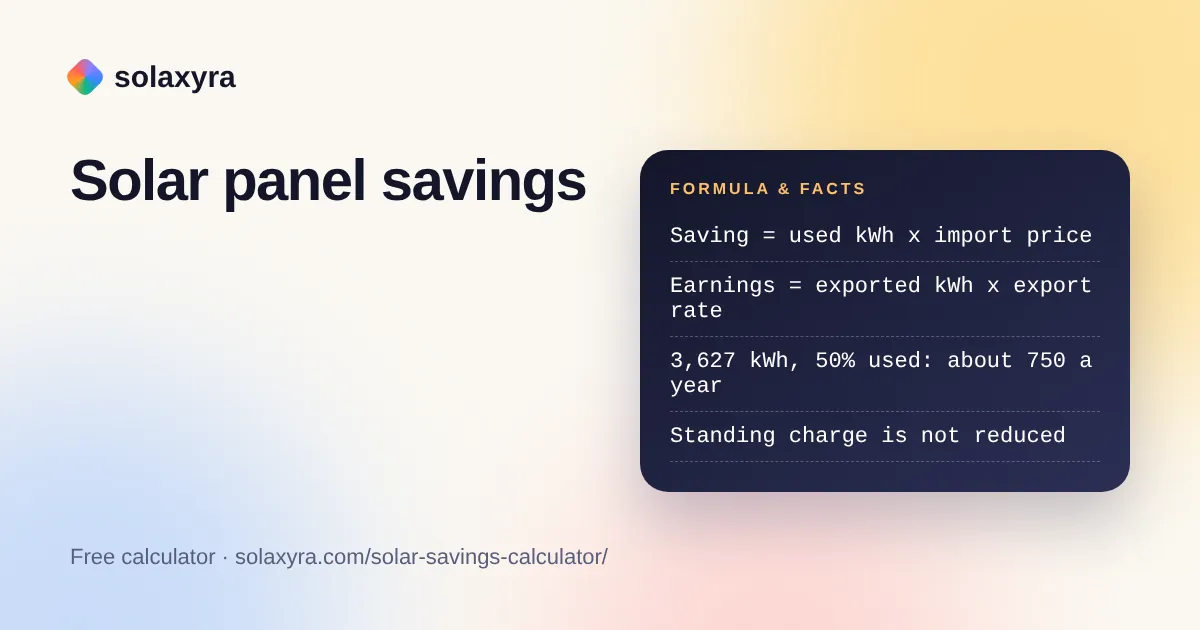
Quick answer: A solar panel savings calculator multiplies the solar electricity you use at home by your unit price and adds exported kWh times your export rate. A 4.5 kWp system making 3,627 kWh, using half at 26.32p and exporting half at an example 15p, saves about 750 pounds a year. Standing charges stay the same.
What Is a Solar Panel Savings Calculator?
A solar panel savings calculator is a tool that converts yearly solar generation into money by valuing self-used electricity at your import price and exported electricity at your export rate. In plain words: first estimate how many kWh the panels produce, then decide what share you use yourself, then price the two shares separately and add them up.
- Generation (kWh) = system size (kWp) x yield (kWh per kWp), or your meter figure.
- Used at home (kWh) = generation x self-consumption %, capped at your household use.
- Exported (kWh) = generation − used at home.
- Yearly benefit = used at home x import price + exported x export rate.
- Simple payback (years) = system cost / yearly benefit.
How Do You Use the Solar Panel Savings Calculator?
- Pick GBP or EUR. Prices are entered in pence or cents per kWh.
- Enter generation: either your system size and a yield in kWh per kWp, or your yearly kWh from a quote or generation meter.
- Set the self-consumption percentage. 50% is an example to start from; change it to match your habits or your monitoring data.
- Check the import price. The default is the Ofgem cap for October to December 2026; use the unit rate on your bill if it differs.
- Enter your export rate from your Smart Export Guarantee or other export tariff. The 15p default is only an example.
- Optionally add your yearly household use and the system cost to see the share of use covered and a simple payback.
How Much Can Solar Panels Save a Year in the UK?
A typical 4.5 kWp home system in the UK is worth roughly 400 to 900 pounds in its first year at today’s prices, with self-consumption and the export rate making most of the difference. The defaults show the middle case: 4.5 kWp, which the Energy Saving Trust gives as a typical home system size, at 806 kWh per kWp, the median measured in the government’s Feed-in Tariff analysis for 2024/25, makes about 3,627 kWh.
For import prices, the Ofgem price cap for 1 October to 31 December 2026 sets the electricity unit rate at 26.32p per kWh for direct debit customers. The table shows how the first-year value of 3,627 kWh changes with the share you use and the export rate you get.
| Self-consumption | Used at home | Exported | Yearly value, export 15p | Yearly value, export 5p |
|---|---|---|---|---|
| 30% | 1,088 kWh | 2,539 kWh | 667 pounds | 413 pounds |
| 50% | 1,814 kWh | 1,814 kWh | 749 pounds | 568 pounds |
| 70% | 2,539 kWh | 1,088 kWh | 831 pounds | 723 pounds |
| 90% | 3,264 kWh | 363 kWh | 914 pounds | 877 pounds |
Import price 26.32p per kWh in every row. The 15p and 5p export rates are examples to show the spread, not quotes from any supplier.
Why Does Self-Consumption Matter So Much?
Each kWh you use yourself saves the full unit price, so whenever your export rate is lower than your import price, raising self-consumption is the cheapest way to increase savings. At 26.32p import and 5p export, moving from 30% to 70% self-consumption is worth over 300 pounds a year from the same panels.
Practical ways to raise it include running the dishwasher, washing machine and immersion heater in sunny hours, charging an electric car at midday, and adding a home battery to shift surplus into the evening. To estimate your share from your daily pattern, use the solar self consumption calculator, and to value a battery, try the home battery savings calculator. Batteries and any changes to home wiring must be installed by a qualified installer; in the UK, electrical work must meet BS 7671.
How Much Do You Earn From Exporting Solar Electricity?
Export earnings are simply exported kWh times your export rate, and in Great Britain that rate comes from a Smart Export Guarantee tariff chosen by you. Under Ofgem’s SEG rules, licensed suppliers taking part set their own rate, contract length and terms, but the rate must always be above zero. Solar PV installations up to 5 MW can qualify.
Because rates and conditions differ from supplier to supplier, enter the rate from the offer you actually have. For a closer look at export income alone, use the Smart Export Guarantee calculator.
How Long Do Solar Panels Take to Pay for Themselves?
Most typical UK home systems pay back in around 9 to 12 years, according to the Energy Saving Trust, which bases this on July 2026 fuel prices and includes export payments. Its figures range from about 9 years in London to 11 or 12 years in Stirling, and it puts the average home system cost at about 7,600 pounds. Panels should last 25 years or more, while the inverter usually needs replacing after around 12 years.
This calculator gives a simple payback: cost divided by first-year value. It ignores future price changes and the slow loss of panel output, so for a year-by-year view use the solar payback calculator.
Does Solar Reduce Your Standing Charge?
No, solar panels reduce the units you buy but not the standing charge, which you pay every day you are connected to the grid. Under the October to December 2026 cap the electricity standing charge is 54.83p a day for direct debit, about 200 pounds a year. That is why this calculator leaves standing charges out, and why even a large system will not take a grid-connected bill to zero.
Worked Example: A Semi-Detached House in Cardiff
Emma in Cardiff has a 4 kWp system. Her generation meter shows 3,350 kWh over the last year, her household uses 3,100 kWh a year, she works from home two days a week, and her app suggests she uses about 45% of her solar. She pays 26.32p per kWh and her export tariff pays 12p. The system cost her 6,800 pounds.
- Used at home: 3,350 x 45% = 1,507.5 kWh. Exported: 1,842.5 kWh.
- Bill saving: 1,507.5 x 0.2632 = 396.77 pounds.
- Export earnings: 1,842.5 x 0.12 = 221.10 pounds.
- Yearly value: 617.87 pounds, or about 51 pounds a month.
- Solar covers 1,507.5 / 3,100 = 49% of her household use.
- Simple payback: 6,800 / 617.87 = 11.0 years.
If Emma moved her washing and dishwasher runs into the middle of the day and lifted self-consumption to 60%, the yearly value would rise to about 690 pounds. Before relying on the generation figure, she can check her system is performing normally with the kWh per kWp calculator: 3,350 kWh from 4 kWp is about 838 kWh per kWp, above the UK median.
Frequently Asked Questions
How much do solar panels save a year in the UK?
It depends mainly on how much solar you use yourself. A 4.5 kWp system making about 3,600 kWh, using half at the October to December 2026 cap rate of 26.32p and exporting half at an example 15p, is worth about 750 pounds in the first year.
Is it better to use solar electricity or export it?
Whenever your export rate is lower than your unit price, using the electricity is worth more, because every kWh you use avoids buying one at the full unit price. Running dishwashers, washing machines and EV charging in sunny hours raises the value of the same panels.
What self-consumption percentage should I enter?
Use your own monitoring data if you have it. Otherwise treat 50% as a starting example and adjust it: households out all day tend to use less of their solar, and a home battery or daytime loads raise the share. The self consumption calculator helps you estimate it.
Does solar reduce my standing charge?
No. The standing charge is a fixed daily fee for being connected, at 54.83p a day under the October to December 2026 price cap for direct debit electricity. Solar only reduces the units you buy, so standing charges are left out of these savings.
How do I get paid for the electricity I export?
In Great Britain you sign up to a Smart Export Guarantee tariff with a licensed supplier. Suppliers set their own rates, contract lengths and terms, but Ofgem requires the rate to be above zero at all times. Compare offers, as rates differ widely.
How long do solar panels take to pay for themselves?
Divide the system cost by the yearly saving for a simple answer. The Energy Saving Trust estimates around 9 to 12 years for a typical home system, based on July 2026 fuel prices and including export payments, depending on location and how much you are home.
Checked October 2026 by the Solaxyra Editorial Team. Sources: Ofgem price cap 1 October to 31 December 2026, Ofgem Smart Export Guarantee, Energy Saving Trust solar panels guide, DESNZ Feed-in Tariff load factor analysis 2024/25.