Bar shows the start and target charge. Times are estimates; the charger and battery management system decide the real profile.
Formula and breakdown
n/a
n/a
n/a
n/a
This battery charging time calculator estimates how long a mains charger, DC-DC charger or inverter-charger takes to bring a leisure, marine, off-grid or home storage battery from one charge level to another, and what that charge costs at UK or European electricity prices. It works with amp-hours or watt-hours, chargers rated in amps or watts, and both lithium and lead-acid batteries.
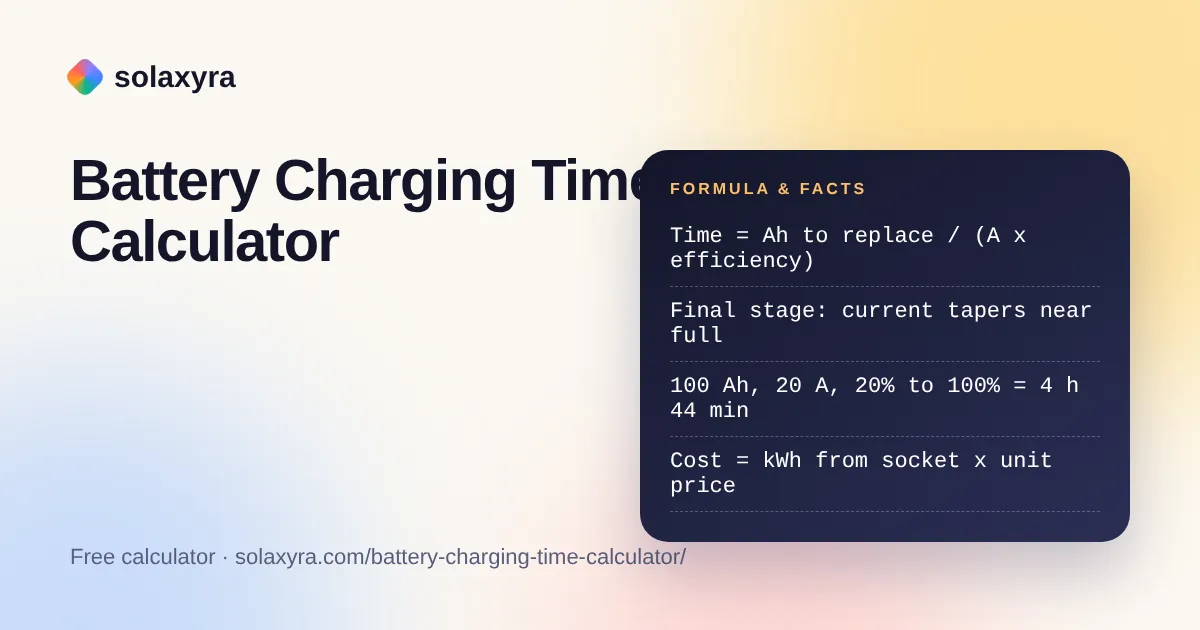
Quick answer: A battery charging time calculator divides the amp-hours you need to replace by the charger current, then corrects for losses and the slower final stage. Charging a 12.8 V 100 Ah lithium battery from 20% to 100% with a 20 A charger takes 4 hours in theory and about 4 hours 45 minutes in practice.
What Is a Battery Charging Time Calculator?
A battery charging time calculator is a tool that predicts the hours needed to recharge a battery from its current state of charge to a target level using a charger of known output. In plain words: charging time equals the charge to put back divided by the effective charging current, with extra time for the stage where the charger slows down near full.
The simple formula, hours = Ah / A, assumes every amp reaches the battery at full rate until the end. Real chargers do not work that way. Most use a constant current stage followed by a constant voltage stage, so the calculator splits the job in two. Up to the point you set (for example 90% for lithium), it divides the amp-hours by charger current times efficiency. Above that point, it assumes the current tapers to an average share of the charger rating, which you can adjust.
How Do You Use the Battery Charging Time Calculator?
- Choose Ah or Wh and enter the battery capacity and nominal voltage.
- Choose amps or watts and enter the charger's rated DC output, not its mains input.
- Select the battery type to fill example efficiency and taper values, or enter your own.
- Set the start and target charge levels. A battery monitor or app gives the most reliable start figure.
- Enter your electricity price per kWh to see the cost of the charge.
- Read the total time, the time in each stage and the energy drawn from the supply, then open the breakdown to check the maths.
How Long Does It Take to Charge a 12V 100Ah Battery?
A 12 V 100 Ah battery takes roughly 10 hours with a 10 A charger in simple theory, and about 8 to 9.5 hours for the partial charges in the table below once losses and tapering are included. The lithium column charges from 20% to 100%; the lead-acid column charges from 50% to 100%, a common working range for that chemistry.
| Charger output | 12.8 V 100 Ah lithium, 20% to 100% | 12 V 100 Ah lead-acid, 50% to 100% |
|---|---|---|
| 5 A | 18 h 57 min | 16 h 28 min |
| 10 A | 9 h 28 min | 8 h 14 min |
| 20 A | 4 h 44 min | 4 h 7 min |
| 30 A | 3 h 9 min | 2 h 45 min |
| 50 A | 1 h 54 min | 1 h 39 min (check the datasheet limit) |
Battery charging time calculator assumptions for this table: lithium 95% efficiency with full current to 90%; lead-acid 85% efficiency with full current to 80%; in both cases the final stage averages 50% of charger current. These are editable example values, not manufacturer data.
Why Does the Last 10 to 20% Take Longer to Charge?
The last part of a charge is slower because the charger switches from constant current to constant voltage, and the current then falls steadily until the battery is full. For lead-acid, the IUoU charging method describes a bulk stage that typically ends at around 70 to 80% of capacity, an absorption stage that continues to about 95%, then a float stage that only replaces self-discharge.
Lithium-ion batteries follow a similar constant current then constant voltage pattern, although lithium iron phosphate usually stays in the fast stage for longer. This is why "Full current until (%)" and "Average current in final stage (%)" are separate inputs. If you only need to reach 80% each day, set the target to 80 and the time drops sharply because the slow stage is skipped. To see how long that charge will then power your appliances, use the battery runtime calculator.
What Size Charger Do You Need for a Battery?
The right charger size is set by the maximum charge current in your battery datasheet; as a safety check, the calculator flags any charger above 0.5C, meaning more amps than half the battery's amp-hour rating. The C-rate shown in the results is charger amps divided by battery amp-hours, so a 20 A charger on a 100 Ah battery is 0.2C.
Use a charger, or charger setting, that the battery manufacturer approves for that chemistry, because lead-acid and lithium batteries need different charge voltages and stages. If the battery is charged from panels rather than the mains, the solar panel battery charging time calculator accounts for sun hours and controller type.
How Much Does It Cost to Charge a Battery?
Charging a 12.8 V 100 Ah lithium battery from 20% to 100% draws about 1.08 kWh from the socket, which costs around 28p at the UK price cap rate. From 1 October to 31 December 2026, Ofgem's price cap sets the direct debit electricity unit rate at 26.32p per kWh. Enter your own tariff, or a cheaper off-peak rate, in the price box of the battery charging time calculator. The calculator divides the energy stored by the charging efficiency, so a less efficient charger costs more as well as taking longer.
Is It Safe to Charge a Battery in the Cold?
Do not charge most lithium batteries below 0 °C unless the product is built for it, because many lithium-ion cells can plate lithium metal on the anode in the cold, which may cause internal short circuits. Some batteries include a low-temperature charge cut-off or a heater; check the manual before winter use in a van, boat or outbuilding.
Charge in a ventilated space away from flammable materials, use the charger designed for your battery and never bypass a battery management system. Fixed home batteries and inverter-chargers wired into a property must be installed or checked by a qualified electrician: in the UK a registered electrician working to BS 7671, with fire safety guidance in BSI's PAS 63100:2024; elsewhere in Europe, your national wiring rules.
Worked Example: Priya's Campervan in Bristol
Priya in Bristol has a 12 V 105 Ah AGM leisure battery in her campervan. After a weekend away her battery monitor shows 50%, and she has a 10 A mains charger on her driveway hook-up.
- Charge to put back: 105 Ah x (100% minus 50%) = 52.5 Ah.
- Full current stage, 50% to 80%: 31.5 Ah / (10 A x 85%) = 3.71 hours.
- Slower final stage, 80% to 100%: 21 Ah / (10 A x 85% x 50%) = 4.94 hours.
- Total: about 8.65 hours, or 8 h 39 min.
- Energy from the socket: 52.5 Ah x 12 V / 0.85 = 741 Wh, which costs about 19.5p at 26.32p per kWh.
The simple Ah / A formula would have said 5 h 15 min. Because the battery charging time calculator includes losses and the slow final stage, Priya knows to leave the charger on overnight rather than for an afternoon. To compare her battery's capacity in kilowatt-hours with a portable power station, she can use the Ah to kWh calculator.
Frequently Asked Questions
How do I calculate battery charging time?
Multiply the battery's amp-hours by the share you need to replace, then divide by the charger current times its efficiency. Add extra time for the final constant voltage stage. For 80 Ah at 20 A and 95% efficiency that gives about 4.2 hours before any allowance for tapering.
How long does a 10 amp charger take to charge a 100Ah battery?
From flat to full in theory 10 hours, but in practice longer. Allowing for charging losses and the slower final stage, a 100 Ah battery charged from 20% to 100% with a 10 A charger takes about 9.5 hours for lithium and more for lead-acid.
Can I enter a charger rated in watts?
Yes. Switch the charger unit to watts and enter the rated output. The calculator divides watts by the nominal battery voltage to get charging current, so a 300 W output into a 12.8 V battery gives about 23.4 A before efficiency losses are applied.
Why does my charger show 100% before the battery is full?
Some chargers and apps estimate charge from voltage, which rises quickly during the constant voltage stage. A shunt-based battery monitor that counts amp-hours in and out is more reliable. Leave the charger connected until it switches to float or stops on its own.
Is it better to charge a lithium battery to 100% every time?
Follow the manufacturer's advice. Limiting the regular charge window can extend cycle life, and some lithium iron phosphate systems are run between about 15% and 85% charge for that reason. Setting a lower target in the calculator also shows how much faster partial charging is.
Does charging efficiency change the electricity cost?
Yes. Energy lost as heat in the charger and battery still comes from the supply. At 85% efficiency, storing 1 kWh draws about 1.18 kWh from the socket, so both charging time and cost rise compared with a 95% efficient system.
Checked October 2026 by the Solaxyra Editorial Team. Sources: Wikipedia: IUoU battery charging, Wikipedia: Lithium-ion battery, Ofgem: Energy price cap 1 October to 31 December 2026, BSI PAS 63100:2024 overview.