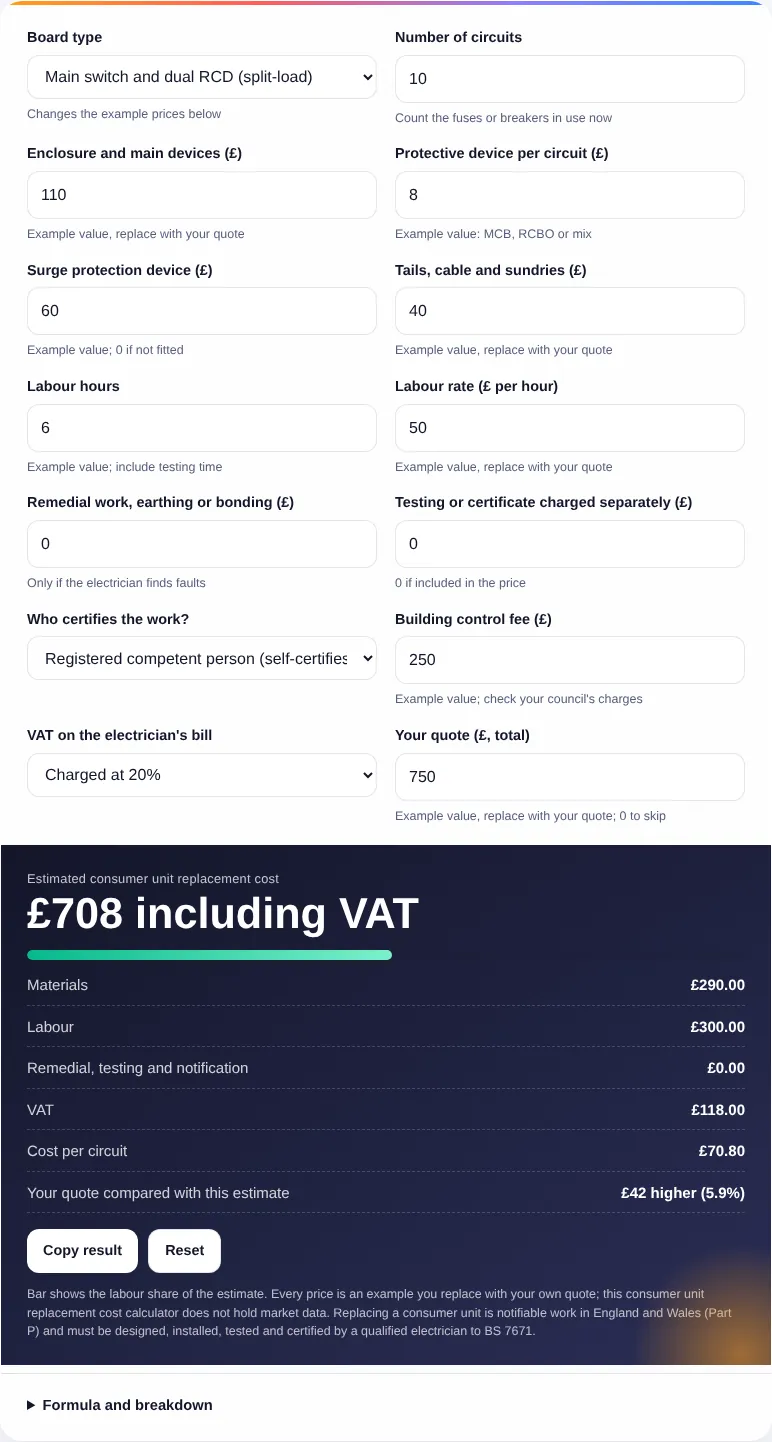
Bar shows the labour share of the estimate. Every price is an example you replace with your own quote; this consumer unit replacement cost calculator does not hold market data. Replacing a consumer unit is notifiable work in England and Wales (Part P) and must be designed, installed, tested and certified by a qualified electrician to BS 7671.
Formula and breakdown
n/a
n/a
n/a
This consumer unit replacement cost calculator builds the price of a new fuse box line by line, for UK homeowners and landlords who have a quote in hand or want to know what a fair quote should contain. You enter the board type, the number of circuits, labour, any remedial work and VAT, and the tool shows the total, the cost per circuit and how your quote compares.
Quick answer: A consumer unit replacement cost calculator adds the board and its protective devices, labour, any remedial earthing or bonding, testing, notification and VAT. RCBO boards cost more per circuit than dual RCD boards. Replacing a consumer unit is notifiable under Part P in England and Wales, so a registered electrician should certify the work.
What Is a Consumer Unit Replacement Cost Calculator?
A consumer unit replacement cost calculator is a tool that estimates the full price of swapping an old fuse box for a new consumer unit by adding materials, labour, extras and VAT. In plain words: total equals the enclosure and main devices, plus the number of circuits times the device cost per circuit, plus surge protection and sundries, plus labour hours times the hourly rate, plus remedial work, separate testing and any building control fee, plus VAT on the electrician’s part of the bill.
No regulator or government body publishes a national price list for this job, and the trade price guides that rank in search give ranges that often disagree with each other. For that reason every price field in the tool is an example you overwrite with figures from your own quotes. The value of the tool is the structure: it shows which line makes one quote higher than another.
How Do You Use the Consumer Unit Replacement Cost Calculator?
- Pick the board type your electrician is quoting for. The example device prices change to match.
- Enter the number of circuits. Count the fuses or breakers in use in your current board.
- Replace the example enclosure, device, surge protection and sundries prices with the figures on your quote, if it is itemised.
- Enter the labour hours and hourly rate, including the time needed to test every circuit.
- Add any remedial work the electrician has flagged, such as earthing or bonding upgrades.
- Say who certifies the work and whether the electrician charges VAT, then type your quoted total to see the difference.
What Makes a New Consumer Unit Cost More or Less?
The two biggest drivers are the number of circuits and the type of protection on each one, because both multiply the device cost. A board where every circuit has its own RCBO needs one device per circuit, while a dual RCD split-load board shares two RCDs across groups of circuits fitted with cheaper MCBs.
| Cost line | What it covers | What pushes it up |
|---|---|---|
| Enclosure and main devices | The metal case, main switch and any RCDs | Larger boards, high integrity layouts with extra RCDs |
| Devices per circuit | MCB or RCBO for each circuit | More circuits, RCBO on every circuit, arc fault devices if specified |
| Surge protection | A surge protection device (SPD) fitted in the board | Included when the electrician’s design calls for one |
| Tails and sundries | Meter tails, glands, labels, fixings | Upgraded tails, an isolator, relocating the board |
| Labour | Removal, installation, testing and paperwork | Poor access, many circuits, fault finding |
| Remedial work | Earthing, main bonding to gas and water, faulty circuits | Older installations, faults that stop a new RCD holding in |
| Notification | Building control fee | Only when the installer is not a registered competent person |
| VAT | 20% on the electrician’s bill | Applies when the trader is VAT registered |
Remedial work is the line most likely to change after the job starts. A new board with RCD protection can expose existing faults, for example a circuit with poor insulation that trips the RCD. A careful quote states what happens if faults are found and at what rate; add that sum to the remedial line of the consumer unit replacement cost calculator once it is known. Our rewiring cost estimate covers the case where the wiring itself needs replacing.
Is Replacing a Consumer Unit Notifiable Under Part P?
Yes. Approved Document P, the statutory guidance on electrical safety in dwellings, lists three kinds of notifiable work under regulation 12(6A) of the Building Regulations: the installation of a new circuit, the replacement of a consumer unit, and any addition or alteration to existing circuits in a special location such as a room with a bath or shower. You can read it in the Approved Document P publication on GOV.UK.
Paragraph 3.1 of the same document gives three ways to meet the rule: use an installer registered with a competent person scheme who self-certifies the work, appoint a registered third-party certifier before work starts, or notify a building control body before work starts. Paragraph 3.3 says a registered installer should complete a BS 7671 Electrical Installation Certificate for every job. Part P applies in England and Wales; Scotland and Northern Ireland run their own building rules.
This is why the tool adds a building control fee only when the work is not self-certified. Councils set their own fees, so the figure in the tool is an example. In every case the work must be designed, installed, tested and certified by a qualified electrician to BS 7671.
RCBO or Dual RCD: Which Board Should You Price?
An RCBO board costs more per circuit but limits a fault to one circuit, while a dual RCD board is cheaper but one fault can switch off half the house. The Wikipedia article on distribution boards describes both layouts and notes that modern consumer units are now required to be metal, which is why plastic boards are no longer fitted.
Use the board type switch in the consumer unit replacement cost calculator to see the difference for your circuit count. With the example prices, a 10-circuit board costs £190 in enclosure and devices as a dual RCD layout and £370 with an RCBO on every circuit. The gap grows with every extra circuit. A high integrity board sits between the two. Your electrician chooses the design, so treat the switch as a way to understand quotes, not as a design decision.
Do You Need an EICR Before Replacing a Consumer Unit?
Not always, but the electrician must test the existing circuits before connecting them to a new board, and a full condition report is the clearest way to find faults first. If you already have a recent report, share it with the electrician. If not, the EICR cost estimate helps you budget for one.
A new board is also a good moment to check how much load the house will carry. If you plan an electric shower, an EV charger or a heat pump, the electrician may suggest spare ways. You can estimate current draw for a new appliance with the kW to amps converter, and running costs with the electricity cost calculator.
Should a Consumer Unit Quote Include VAT?
A VAT registered electrician must add the standard rate of 20%, while a trader below the £90,000 VAT registration threshold does not have to charge it. Both figures come from GOV.UK. When one quote includes VAT and another does not, compare them on the same basis by switching the VAT option in the tool. The tool applies VAT to materials, labour, remedial work and separate testing, but not to a building control fee you pay directly.
Worked Example: Pricing a 12-Circuit RCBO Board
Example: a three-bedroom house has 12 circuits and the electrician quotes £1,200 including VAT for an RCBO board. The quote lists a £70 enclosure, £30 per RCBO, a £60 surge protection device, £40 of sundries, 8 hours at £50 an hour and £150 to upgrade main bonding. The electrician is registered and VAT registered.
- Materials: £70 + 12 x £30 + £60 + £40 = £530.
- Labour: 8 x £50 = £400.
- Extras: £150 remedial bonding, no separate testing, no building control fee because the installer self-certifies.
- VAT: (£530 + £400 + £150) x 20% = £216.
- Total: £530 + £400 + £150 + £216 = £1,296, or £108 per circuit.
The quote of £1,200 is £96 lower, about 7.4% below the build-up, so the electrician is pricing some lines below the example figures. The useful step is to ask what each quote includes: surge protection, bonding, testing and the certificate.
How Do You Check a Quote With the Consumer Unit Replacement Cost Calculator?
Enter the quote total and compare cost per circuit, not just the headline price. Two quotes can differ by hundreds of pounds because one includes surge protection, remedial bonding and VAT and the other does not. Ask each electrician for an itemised price, enter the lines, and the consumer unit replacement cost calculator shows where the difference sits. Also confirm the installer’s competent person scheme registration, the certificate you will receive, and how faults found during the work will be priced.
Frequently Asked Questions
How much does it cost to replace a fuse box?
It depends on the board type, the number of circuits, labour time, any remedial work and VAT. No official body publishes a national price, so build the estimate from your own quotes in the calculator, then compare quotes on cost per circuit and on what each one includes.
Is replacing a consumer unit notifiable under Part P?
Yes, in England and Wales. Approved Document P lists the replacement of a consumer unit as notifiable work under regulation 12(6A). A registered competent person can self-certify it; otherwise a building control body must be notified before work starts. Scotland and Northern Ireland have their own building rules.
Is an RCBO board more expensive than a dual RCD board?
Usually, because every circuit gets its own RCBO instead of sharing one of two RCDs, so the device cost rises with each circuit. The benefit is that a fault trips only its own circuit. Switch the board type in the calculator to see how the gap grows as circuits are added.
Do electricians charge VAT on a consumer unit replacement?
A VAT registered electrician charges the standard rate of 20% on the bill. A trader whose taxable turnover is under the £90,000 registration threshold does not have to register, so may not charge VAT. Ask whether a quote includes VAT before comparing it with another.
What certificate should I get after a new consumer unit?
Approved Document P says a registered competent person should complete a BS 7671 Electrical Installation Certificate for every job and send a building regulations compliance certificate within 30 days. Keep both with your home documents, as buyers and insurers may ask for them.
Can I replace a consumer unit myself?
Do not attempt it. The work involves the incoming supply, earthing and testing every circuit, and it is notifiable building work. It must be designed, installed, tested and certified by a qualified electrician to BS 7671, with Part P applying in England and Wales.
Checked October 2026 by the Solaxyra Editorial Team. Sources: GOV.UK: Approved Document P, Approved Document P, 2013 edition (PDF), GOV.UK: VAT rates, GOV.UK: Register for VAT, Wikipedia: Distribution board.