Costs use the unit rate only. The daily standing charge is paid whether or not the appliance runs, so it is left out.
Formula and breakdown
…
This watts to kWh calculator converts an appliance’s power rating into the energy it uses per day, per chosen period and per year, then prices that energy at your unit rate, with the current UK price cap rate set as the default and a euro option for Ireland and the rest of Europe. It also runs in reverse, turning a kWh reading from a meter or plug-in monitor into the average watts a device drew.
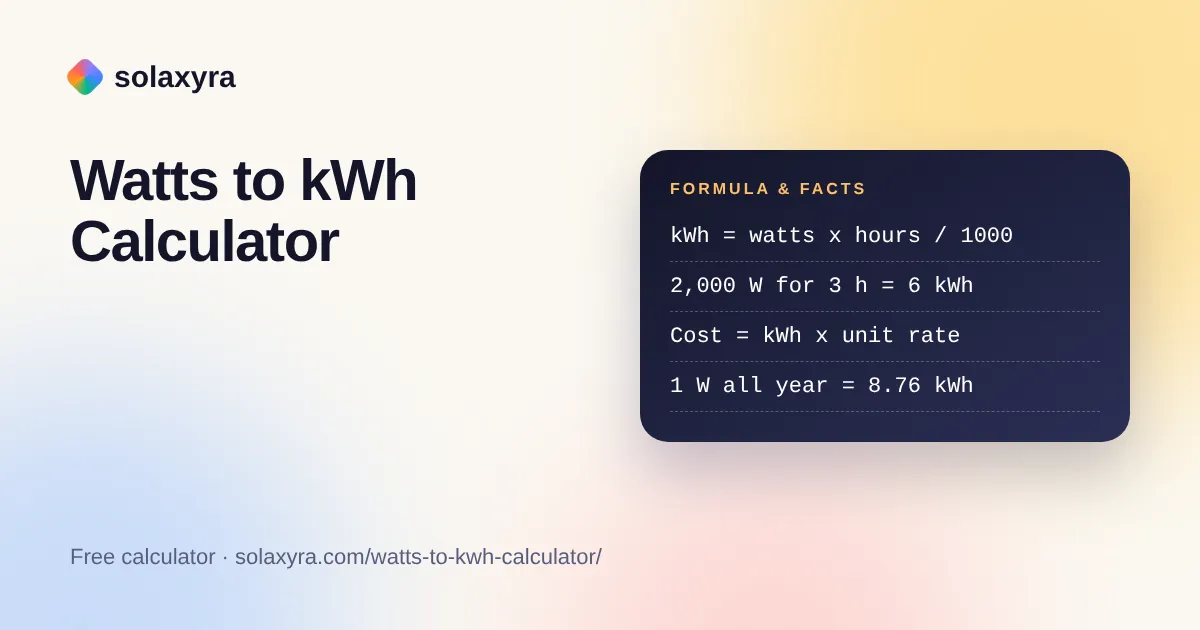
Quick answer: To convert watts to kWh, multiply the power in watts by the hours of use and divide by 1,000. A 2,000 W heater used for 3 hours a day uses 6 kWh a day and 180 kWh over 30 days. This watts to kWh calculator then multiplies kWh by your unit rate to give the cost.
What Is a Watts to kWh Calculator?
A watts to kWh calculator is a converter that changes power, measured in watts, into energy, measured in kilowatt-hours, by taking account of how long the power is used. In plain words: kWh equals watts multiplied by hours, divided by 1,000, because one kilowatt-hour is 1,000 watts sustained for one hour.
The kilowatt-hour is the unit on every UK and European electricity bill, so once you have the kWh figure the cost is a single multiplication by your unit rate. The tool adds two refinements that most converters skip: a minutes field for short daily use, and a percentage for appliances that only draw power part of the time.
How Do You Use the Watts to kWh Calculator?
- Leave the direction on Watts to kWh, or switch to kWh to average watts if you already have an energy reading.
- Enter the power from the rating plate and choose W or kW.
- Enter the hours per day, and extra minutes if needed. Ten minutes a day for a kettle is 0 hours and 10 minutes.
- Enter the number of days: 7 for a week, 30 for a month, 365 for a year.
- Lower the share of time drawing power for appliances with a thermostat or compressor. Leave it at 100% for a kettle, lamp or charger in constant use.
- Check the unit price. It starts at 26.32p per kWh, the UK cap rate for direct debit customers; switch to euro and type the rate from your bill if you live elsewhere.
- Read kWh and cost for the period, per day and per year, and open the breakdown to see each step.
What Is the Difference Between Watts and kWh?
Watts measure how fast energy is used at one moment, while kWh measure how much energy has been used over time; a 1,000 W appliance running for one hour uses 1 kWh. Think of watts as the speed of a car and kWh as the distance travelled. Your supplier bills you for kWh, not watts, which is why a powerful kettle used for three minutes can cost less than a small fridge that runs all day.
How Much Does 1,000 Watts Cost per Hour in the UK?
Running 1,000 W for one hour uses 1 kWh, which costs 26.32p at the UK price cap rate for 1 October to 31 December 2026 when paying by direct debit. That figure comes from the Ofgem price cap announcement, which also notes that the government has removed VAT from electricity bills from 1 October 2026 to 31 March 2027, so the rate shown carries no VAT on electricity. The cap is an average across England, Scotland and Wales; your own tariff may be higher or lower, so replace the default with the unit rate on your bill.
The fixed daily standing charge, 54.83p a day under the same cap, is not included. You pay it whether an appliance runs or not, so it does not belong in the cost of using one device. To total the cost of every appliance in a home, the energy consumption calculator lets you add several rows.
How Do You Work Out kWh for Appliances That Cycle On and Off?
Multiply the rated watts by the hours and by the share of time the appliance actually draws power; a 2 kW radiator whose thermostat keeps it on 60 percent of the time uses 1.2 kWh per hour, not 2 kWh. Fridges, freezers, dehumidifiers, oil-filled radiators and storage water heaters all behave this way.
The share is hard to guess, so the most reliable method is a plug-in energy monitor left in place for a few days. Enter its kWh reading in reverse mode with the hours covered, and the calculator returns the true average power, which you can then use in forward mode for any period.
How Many kWh Does a Device Use on Standby?
Every watt drawn continuously adds up to 8.76 kWh a year, because a year has 8,760 hours; at 26.32p per kWh that is about £2.31 per watt each year. A set-top box drawing 10 W around the clock therefore costs roughly £23 a year before you watch anything. The Energy Saving Trust estimates that a household in Great Britain can save about £45 a year by switching appliances off standby.
Watts to kWh Conversion Table
Energy figures are exact conversions. Costs use the UK cap unit rate of 26.32p per kWh and are rounded.
| Power | kWh per hour | kWh in 8 hours | kWh per year if always on | Cost per hour | Cost per year if always on |
|---|---|---|---|---|---|
| 1 W | 0.001 | 0.008 | 8.76 | 0.03p | £2.31 |
| 10 W | 0.01 | 0.08 | 87.6 | 0.26p | £23.06 |
| 60 W | 0.06 | 0.48 | 525.6 | 1.58p | £138.34 |
| 100 W | 0.1 | 0.8 | 876 | 2.63p | £230.56 |
| 500 W | 0.5 | 4 | 4,380 | 13.16p | £1,152.82 |
| 1,000 W | 1 | 8 | 8,760 | 26.32p | £2,305.63 |
| 2,000 W | 2 | 16 | 17,520 | 52.64p | £4,611.26 |
| 3,000 W | 3 | 24 | 26,280 | 78.96p | £6,916.90 |
Worked Example: An Oil-Filled Radiator in Leeds
Priya in Leeds uses a 2,000 W oil-filled radiator in her home office for 5 hours a day through a 90-day winter. Its thermostat clicks off once the room is warm, and a plug-in monitor shows it draws power about 60 percent of the time.
- Energy per day: 2,000 W x 5 h x 60% / 1,000 = 6 kWh.
- Energy over 90 days: 6 x 90 = 540 kWh.
- Cost at 26.32p: 540 x 0.2632 = £142.13.
- Without the thermostat adjustment she would have estimated 900 kWh and £236.88, an overestimate of about £95.
If Priya later fits solar panels, she can see how much of that load daytime generation could cover with the appliance solar panel calculator. For a deeper look at heater types and thermostat settings, the electric heater running cost calculator goes further.
Frequently Asked Questions
How many kWh is 1,000 watts?
1,000 watts is 1 kW, so it uses 1 kWh for every hour it runs. Run it for 30 minutes and it uses 0.5 kWh; run it for 8 hours and it uses 8 kWh. At the UK cap rate of 26.32p per kWh, each hour costs about 26p.
Is a watt the same as a watt-hour?
No. A watt measures power, the rate at which energy is used at a given moment. A watt-hour measures energy, the amount used over time. A 100 W lamp is always 100 W, but it uses 100 Wh in one hour and 1 kWh in ten hours.
How do I find the wattage of an appliance?
Look at the rating plate or label, usually on the back or base, or in the manual. It shows the maximum power in W or kW. For appliances whose draw varies, a plug-in energy monitor gives the real average, which is often lower than the rated figure.
Why is my measured kWh lower than watts times hours?
Many appliances do not draw their full rating all the time. Fridges, freezers and thermostat-controlled heaters switch on and off, and washing machines heat only in part of the cycle. Use the share of time drawing power field, or a plug-in monitor reading, to reflect this.
How do I convert kWh back to watts?
Divide the kWh by the running hours and multiply by 1,000. If a dehumidifier used 9 kWh over 30 hours of running, its average power was 9 x 1,000 / 30 = 300 W. Switch the calculator to kWh to average watts to do this.
Does the cost include the standing charge?
No. The calculator uses only the unit rate, because the standing charge is a fixed daily fee you pay regardless of how long any appliance runs. From 1 October to 31 December 2026 the UK cap standing charge for electricity paid by direct debit is 54.83p per day.
Checked October 2026 by the Solaxyra Editorial Team. Sources: Ofgem price cap, October to December 2026, Energy Saving Trust quick tips.