Comparison rows use your power factor. Not a cable or breaker sizing result.
Formula and breakdown
n/a
n/a
This tool converts kilowatts into amps for heat pumps, EV chargers, showers, cookers, motors and battery systems, using UK and European supplies (230 V single-phase and 400 V three-phase) as the starting point, with 120 V, 240 V and DC also covered. Enter the power once and the kW to amps calculator shows the current on your supply and, side by side, what the same load would draw on the other common voltages.
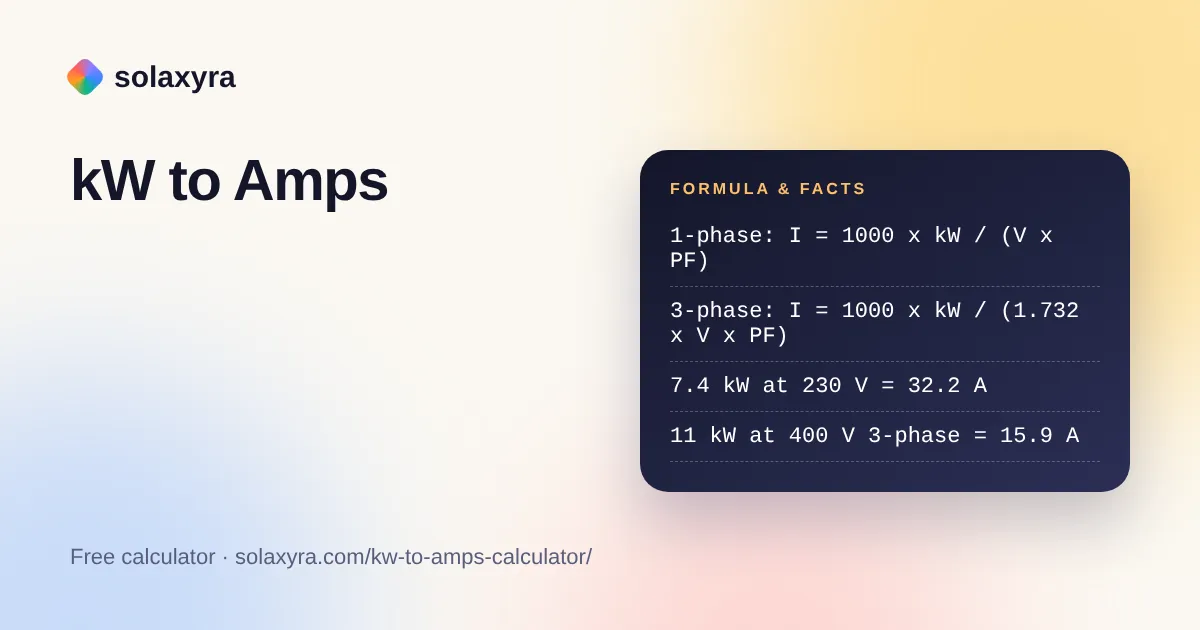
Quick answer: A kW to amps calculator multiplies kilowatts by 1,000 and divides by voltage and power factor. Single-phase: I = 1,000 x kW / (V x PF). Three-phase: I = 1,000 x kW / (1.732 x V x PF). A 7.4 kW load at 230 V draws 32.2 A; an 11 kW load on 400 V three-phase draws 15.9 A per line.
What Is a kW to Amps Calculator?
A kW to amps calculator is a tool that turns a power rating in kilowatts into the current, in amperes, that a load draws from a supply of a given voltage and phase. In plain words: multiply the kilowatts by 1,000 to get watts, then divide by the voltage and the power factor; on three-phase supplies divide by 1.732 as well, because the load is shared between three lines.
Kilowatts are how most larger equipment is labelled in Europe, from electric showers to car chargers and heat pumps, while circuits, fuses and cables are rated in amps. The calculator bridges the two so you can talk to an installer with the right numbers.
How Do You Use the kW to Amps Calculator?
- Pick the supply: single-phase AC (the usual home supply), three-phase AC (commercial premises and some homes), or DC.
- Enter the real power in kW from the rating plate or datasheet.
- Choose the voltage: 230 V, 240 V, 120 V, 400 V or another value. For three-phase, the voltage is the line to line value.
- Enter the power factor. Use 1 for resistive heating; for motors and compressors use the rating plate value.
- Read the current. The rows underneath repeat the sum for 230 V single-phase, 400 V three-phase, 120 V and 240 V, so you can compare options at a glance.
The tool warns you if you pick 400 V on a single-phase setting or a voltage below 300 V on three-phase, two of the most common input mistakes.
How Many Amps Is 1 kW?
1 kW draws 4.35 A at 230 V single-phase, 4.17 A at 240 V, 8.33 A at 120 V and 1.44 A per line on a 400 V three-phase supply, all at a power factor of 1. Because the relationship is linear, you can scale these numbers: 3 kW is three times 4.35 A, or about 13 A at 230 V.
| Power (kW) | 230 V 1-phase (A) | 240 V 1-phase (A) | 120 V 1-phase (A) | 400 V 3-phase, PF 1 (A per line) | 400 V 3-phase, PF 0.85 (A per line) |
|---|---|---|---|---|---|
| 1 | 4.3 | 4.2 | 8.3 | 1.4 | 1.7 |
| 2 | 8.7 | 8.3 | 16.7 | 2.9 | 3.4 |
| 3 | 13.0 | 12.5 | 25.0 | 4.3 | 5.1 |
| 5 | 21.7 | 20.8 | 41.7 | 7.2 | 8.5 |
| 7.4 | 32.2 | 30.8 | 61.7 | 10.7 | 12.6 |
| 11 | 47.8 | 45.8 | 91.7 | 15.9 | 18.7 |
| 15 | 65.2 | 62.5 | 125.0 | 21.7 | 25.5 |
| 22 | 95.7 | 91.7 | 183.3 | 31.8 | 37.4 |
The last column shows how a power factor of 0.85, used here as an example motor rating, raises the current by about 18% compared with the PF 1 column.
Why Does Three-Phase Draw Less Current for the Same kW?
A balanced three-phase load splits its power across three lines, so each line carries about a third of the current a single-phase 230 V supply would need for the same kW. An 11 kW load needs 47.8 A on 230 V single-phase but only 15.9 A in each line at 400 V three-phase.
The figure is a third, not a 1.732th, because the comparison is with 230 V single-phase. In the European 230/400 V system, 230 V is measured from each phase to neutral and 400 V between phases, the relationship set out in the three-phase electric power reference. Dividing 11,000 W by 1.732 x 400 V gives the same 15.9 A as dividing by 3 x 230 V. For full three-phase work including kVA and kVAr, use the three-phase power calculator.
Do kW and kVA Give the Same Current?
Only when the power factor is 1. kW is real power and kVA is apparent power; current follows kVA, so for a given kW a lower power factor means more amps. A 4 kW motor at 230 V and PF 0.8 has an apparent power of 5 kVA and draws 21.7 A, compared with 17.4 A for a 4 kW heater.
The power factor is the ratio of real power to apparent power; resistive loads such as heaters sit at almost 1, while motors and transformers can be well below. If your equipment is rated in kVA rather than kW, convert it first with the kVA to kW calculator, or go straight to amps with the kVA figure and a power factor of 1 in this tool.
Is the Current From kW Enough to Choose a Cable or Breaker?
No: the current is only the starting point, because cable and protective device selection also depends on cable length, installation method, grouping, ambient temperature, voltage drop and the type of load. A 7.4 kW EV charger at 32.2 A, for example, is a design question about the whole circuit, not just the current.
In the UK, new circuits for showers, EV chargers, heat pumps and cookers must meet BS 7671 and should be designed and installed by a registered electrician, who will also check whether your supply and main fuse can take the extra load. Elsewhere in Europe, follow national wiring rules and use a qualified installer. To see how much voltage a long cable run loses at your current, try the voltage drop calculator before you speak to them.
Worked Example: Niamh Chooses an EV Charger in Dublin
Niamh is comparing two home chargers. Her house in Dublin has a 230 V single-phase supply, and her neighbour, who runs a small workshop, has a 400 V three-phase supply. She assumes a power factor of 1 for both chargers and plans to confirm it from the datasheets.
- 7.4 kW charger on single-phase: I = 1,000 x 7.4 / (230 x 1) = 32.2 A.
- 11 kW charger on three-phase: I = 1,000 x 11 / (1.732 x 400 x 1) = 15.9 A in each line.
- 11 kW charger on her single-phase supply: I = 1,000 x 11 / 230 = 47.8 A, nearly half as much again as the 7.4 kW option.
Niamh concludes that on her single-phase supply the 7.4 kW charger is the realistic option, while the 11 kW model only makes sense on three-phase. She notes the 32.2 A figure for her electrician, who will check the supply capacity and design the circuit. To estimate how much of her charging solar could cover, she then opens the solar EV charging calculator.
Frequently Asked Questions
How many amps is 10 kW?
10 kW draws 43.5 A at 230 V single-phase, 41.7 A at 240 V and 83.3 A at 120 V with a power factor of 1. On a 400 V three-phase supply it draws 14.4 A per line. Divide by your power factor if it is below 1.
How do I convert kW to amps for three-phase?
Multiply kW by 1,000, then divide by 1.732, the line to line voltage and the power factor. For 15 kW at 400 V and PF 0.9: 15,000 / (1.732 x 400 x 0.9) = 24.1 A per line. Use 3 times the phase voltage instead if you only know the 230 V figure.
Can I convert kW to amps for a DC battery system?
Yes. For DC there is no power factor, so amps equal 1,000 times kW divided by the battery voltage. A 3 kW inverter load on a 48 V battery draws about 62.5 A before inverter losses, and more once its efficiency is included.
Why is my measured current different from the calculated value?
Real supply voltage varies from the 230 V nominal value, many appliances cycle on and off, and the real power factor may differ from the label. Motors also draw a brief surge when they start. Treat the calculator result as the steady running current at the stated voltage.
What is the difference between kW and kWh?
kW is power, the rate of energy use at a moment. kWh is energy, power multiplied by time. A 2 kW heater running for three hours uses 6 kWh. Amps relate to kW, not kWh, so convert power to current and energy to cost separately.
Should I use 230 V or 240 V for UK calculations?
Use 230 V. The UK and the rest of Europe adopted a harmonised 230/400 V standard in place of the old 240/415 V and 220/380 V values. Using 240 V gives a current about 4% lower, which is not the cautious direction.
Checked October 2026 by the Solaxyra Editorial Team. Sources: Wikipedia, Three-phase electric power, Wikipedia, Power factor, Wikipedia, Mains electricity by country.