Bar shows how much of the usable roof the panels take.
Formula and breakdown
n/a
n/a
n/a
This solar panel calculator works out how many solar panels, and what system size in kWp, you need to cover a chosen share of your yearly electricity use, for homes in the UK, Ireland and Europe. It uses long-term yield data for your region, adjusts for the direction your roof faces and then checks whether the panels will physically fit on the roof area you have.
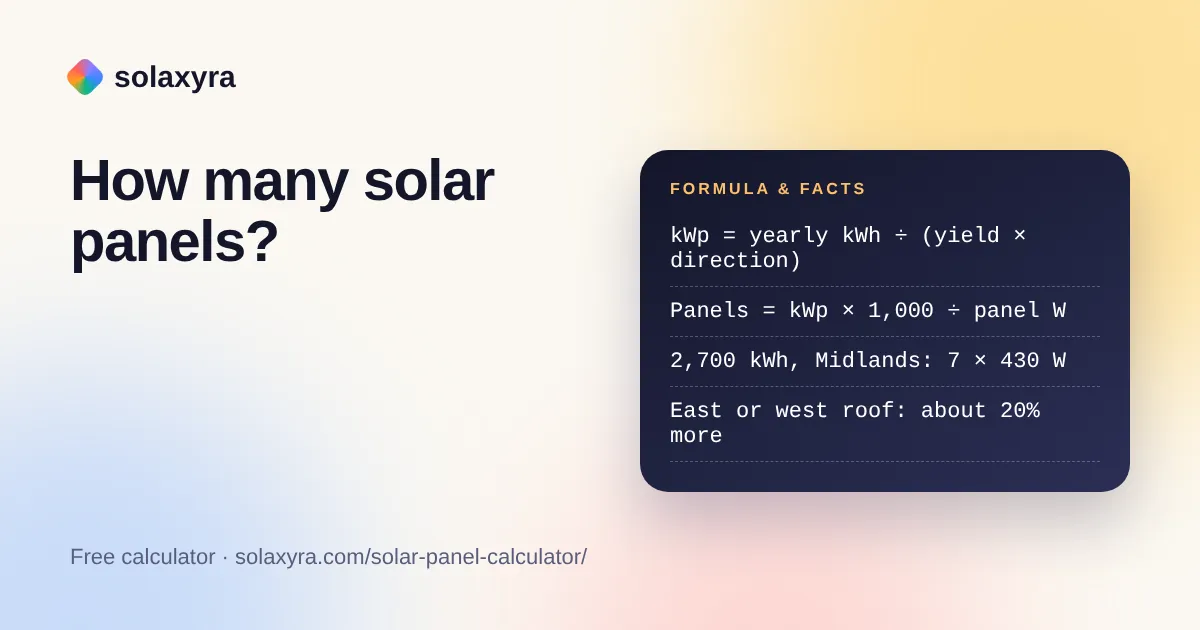
Quick answer: A solar panel calculator divides your yearly kWh use by the kWh each kWp of panels produces where you live. A Midlands home using 2,700 kWh a year needs about 2.77 kWp on a south roof, which is 7 panels of 430 W, generating about 2,938 kWh a year and needing about 14 m² of roof.
What Is a Solar Panel Calculator?
A solar panel calculator is a sizing tool that converts your annual electricity use into the number of panels and the system size needed to generate the same amount, or a chosen share of it, over a year. In plain words: system size in kWp equals yearly use times the share you want to cover, divided by local yield times a roof direction factor. The panel count is that size divided by the wattage of one panel, rounded up.
Yield, also called specific yield, is the number of kWh that 1 kWp of panels produces in a year. Our regional defaults come from the World Bank Global Solar Atlas, which publishes long-term averages for a typical crystalline silicon system at the best fixed angle. They range from about 915 kWh per kWp in Edinburgh to about 1,655 in Madrid. You can overwrite the box with a figure from an installer quote or from the EU's PVGIS tool if you have one.
How Do You Use the Solar Panel Calculator?
- Choose whether you know your use per year or per month, then enter the kWh figure from your bill or annual statement.
- Set the share of that use you want the panels to cover. 100% means yearly generation equals yearly use.
- Pick your region. The yield box fills in automatically, and you can edit it.
- Choose the direction your roof faces, and add a percentage for shading from chimneys, trees or neighbouring buildings.
- Enter the wattage and size of the panel you are considering. Both are on the datasheet.
- Enter the usable roof area after leaving clear margins. The roof check tells you whether the panels fit, and the bar shows how much of the roof they fill.
How Many Solar Panels Do You Need for a Typical House?
A UK home using 2,700 kWh a year needs about 7 panels of 430 W, or roughly 2.6 to 3 kWp, on an unshaded south-facing roof. Larger homes using 3,500 kWh need 8 or 9 panels, and homes using 4,500 kWh need 11 or 12. Northern regions need slightly more panels than the south because each kWp produces less.
The table shows panel counts for 430 W panels on a south-facing roof with no shading, rounded up to whole panels, aiming to cover 100% of yearly use.
| Region (yield, kWh per kWp) | 2,000 kWh a year | 2,700 kWh a year | 3,500 kWh a year | 4,500 kWh a year |
|---|---|---|---|---|
| London (1,029) | 5 panels | 7 panels | 8 panels | 11 panels |
| Midlands (976) | 5 panels | 7 panels | 9 panels | 11 panels |
| Manchester (920) | 6 panels | 7 panels | 9 panels | 12 panels |
| Edinburgh (915) | 6 panels | 7 panels | 9 panels | 12 panels |
| Dublin (967) | 5 panels | 7 panels | 9 panels | 11 panels |
| Frankfurt (1,105) | 5 panels | 6 panels | 8 panels | 10 panels |
| Paris (1,141) | 5 panels | 6 panels | 8 panels | 10 panels |
| Madrid (1,655) | 3 panels | 4 panels | 5 panels | 7 panels |
How Much Does Roof Direction Change the Number of Panels?
An east or west roof needs about 20% more panels than a south roof for the same yearly output, because it receives roughly 83% of the sunlight. South east and south west roofs lose only about 5%, while north-facing roofs lose more than a third. The factors in the calculator come from our own sunlight model for a 35° pitch in central Europe, built on Global Solar Atlas monthly data:
- South: 100%
- South east or south west: 95%
- East or west, or a split east and west array: 83%
- North east or north west: 69%
- North: 64%
- Flat roof with panels on 10° frames facing south: 94%
- Flat roof with panels laid flat: 89%
If your roof pitch is very steep or very shallow, the solar panel orientation calculator gives a factor for your exact angle and direction.
Should You Size Solar Panels to Cover 100% of Your Use?
Covering 100% of yearly use is a sensible starting point, but it does not mean you stop buying electricity. Panels produce most in summer and very little in December, and they only produce during the day, so a home with a system matched to its yearly use still imports power on winter days and every evening. The surplus on sunny afternoons goes to the grid unless you have a battery.
That is why some households choose a smaller system that they use almost entirely themselves, while others oversize slightly if they have a good export tariff or plan to add a heat pump or electric car. Try 70%, 100% and 130% in the calculator, then compare the returns with the solar savings calculator, which separates the value of electricity used at home from electricity exported.
How Much Roof Space Do Solar Panels Need?
A typical 430 W panel covers about 1.9 to 2 m², so a 7-panel system needs about 14 m² and a 12-panel system about 23 m², before edge margins. Measure only the clear, usable part of the roof: leave space around the edges, and avoid vents, roof windows and areas shaded by chimneys or dormers. If the calculator says the system is too big, it shows the largest system that fits, so you can see how much of your target a smaller array would cover. Our solar panel roof area calculator works out the layout in more detail, including portrait and landscape rows.
Roof-mounted solar is fixed to the building structure and wired into your consumer unit, so it must be designed and installed by a qualified installer, and the electrical work must be done by a registered electrician to BS 7671 in the UK, or to local wiring rules elsewhere. In the UK, payments for exported electricity normally require an MCS-certified installation.
Worked Example: James in Coventry
James lives in a semi-detached house in Coventry and used 3,800 kWh of electricity last year, according to his annual statement. His roof faces east and west, with about 12 m² of clear space on each side, so 24 m² in total. He is looking at 430 W panels measuring about 1.95 m² each and wants to generate as much as he uses over a year.
- Usable yield: 976 kWh per kWp (Midlands) × 83% for an east and west roof = about 810 kWh per kWp.
- Size needed: 3,800 kWh ÷ 810 = 4.69 kWp.
- Panels: 4.69 kWp × 1,000 ÷ 430 W = 10.9, rounded up to 11 panels, or 4.73 kWp.
- Generation: 4.73 kWp × 810 = about 3,832 kWh a year.
- Roof check: 11 × 1.95 m² = 21.45 m², which fits within his 24 m², with room for 12 panels in total.
If James had a south-facing roof, 10 panels would do the same job. His installer will confirm the final layout after a survey.
Frequently Asked Questions
How many solar panels do I need to power my house?
Divide your yearly kWh use by your local yield per kWp to get the system size, then divide by the panel wattage. In the UK Midlands, 2,700 kWh a year needs about 2.77 kWp, which is 7 panels of 430 W on a south roof. East or west roofs need about a fifth more.
How many kWh does one solar panel produce a year?
A 430 W panel on a south-facing roof produces about 395 to 445 kWh a year in most of the UK, using yields of 920 to 1,030 kWh per kWp. The same panel produces about 710 kWh a year in Madrid. Shading and poor orientation reduce these figures.
What size solar system do I need for 3,000 kWh a year?
In the UK you need roughly 2.9 to 3.3 kWp on a south roof to generate 3,000 kWh a year, depending on region. With 430 W panels that is 7 or 8 panels. On an east or west roof, plan for about 3.5 to 4 kWp.
Does the calculator include losses?
Yes. The regional yields already include typical system losses from heat, cables, the inverter and dirt, so you do not need to subtract them again. Add a shading or extra loss percentage only for shade from trees, chimneys or buildings, or for an unusually hot or poorly ventilated roof.
Can I use a figure from PVGIS or my installer instead?
Yes. Type any yield in kWh per kWp per year into the yield box and the calculator uses it in place of the regional default. If your figure is for your actual roof angle and direction, set the roof direction to South (100%) so that orientation is not counted twice.
Do bigger panels mean fewer panels?
Yes. The number of panels falls as panel wattage rises, but the system size in kWp needed stays the same. Higher wattage panels are usually physically larger, so check the roof area result: the total area needed changes much less than the panel count.
Checked October 2026 by the Solaxyra Editorial Team. Sources: Global Solar Atlas (World Bank), EU Joint Research Centre PVGIS, Energy Saving Trust.