Yearly balance only. Winter output is far lower than summer, and the car must be plugged in while the sun shines to use the solar directly.
Formula and breakdown
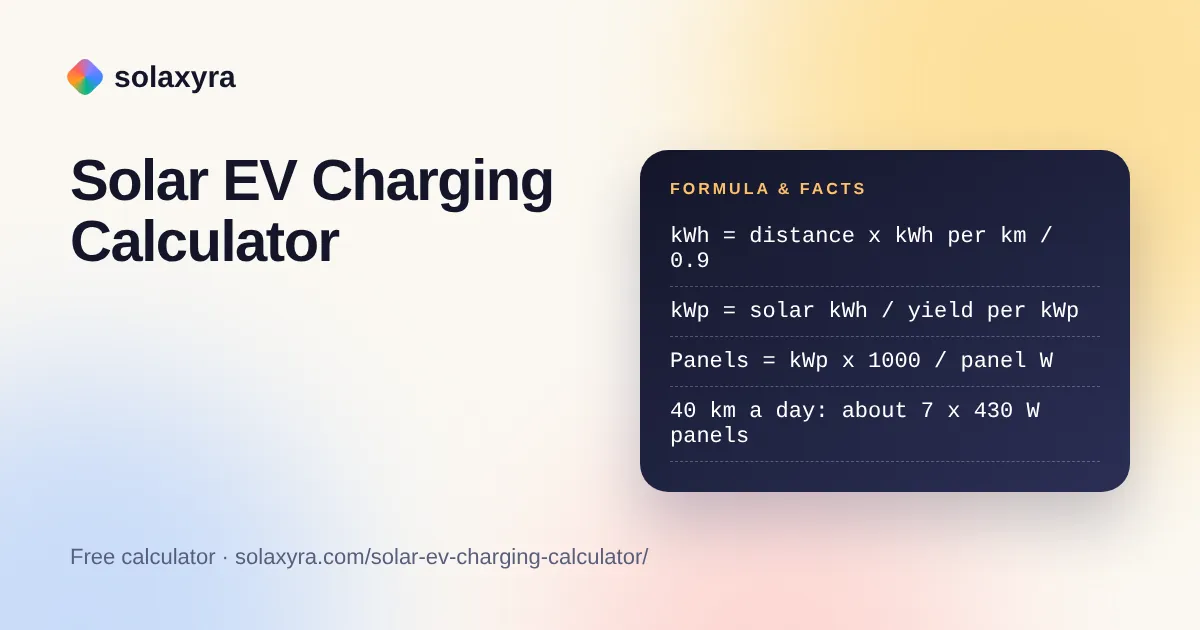
Charging energy = distance x consumption / (1 − losses)
Array kWp = solar share of energy / yield
Panels = kWp x 1000 / panel watts, rounded up
Saving = solar kWh x grid price
This solar EV charging calculator shows how many solar panels you need to cover your electric car's charging, and how much that solar electricity is worth, for drivers in the UK, Ireland and the rest of Europe. Enter your daily distance in kilometres or miles, your car's efficiency and your local solar yield, and it returns the charging energy, the array size in kWp, the panel count and the yearly saving against grid charging.
Quick answer: A solar EV charging calculator turns your driving into yearly charging energy and divides it by solar yield. Driving 40 km a day at 17 kWh per 100 km with 10% charging losses needs about 2,760 kWh a year, or 2.9 kWp of panels: seven 430 W panels at an example yield of 950 kWh per kWp.
What Is a Solar EV Charging Calculator?
A solar EV charging calculator is a tool that matches the electricity your car uses in a year with the output of a solar array, so you can size panels for your driving. The formula in plain words: distance multiplied by consumption per kilometre gives the energy the battery needs; dividing by the charging efficiency adds the energy lost at the charger; dividing that yearly total by the yield of one kWp of panels gives the array size; dividing the array size by the rating of one panel gives the panel count.
Specific yield is the key local number. It is the kWh that one kilowatt peak of panels produces in a year at your site, and it varies with latitude, orientation, tilt and shading. The free PVGIS service from the European Commission's Joint Research Centre gives a figure for almost any address. The default of 950 kWh per kWp is only an example, so replace it.
How Do You Use the Solar EV Charging Calculator?
- Choose kilometres or miles. The distance and efficiency fields convert when you switch.
- Enter your average daily distance: your yearly mileage divided by 365 works well.
- Enter the car's efficiency from its trip computer, in kWh per 100 km or miles per kWh.
- Set charging losses. The example of 10% covers energy lost between the socket and the battery.
- Choose what share of your charging you want solar to cover across the year.
- Enter your local solar yield and the rating of the panels you are considering.
- Check the electricity price you would otherwise pay to charge, then read the panel count, kWp and saving.
How Many Solar Panels Do You Need to Charge an Electric Car?
A driver covering 40 km a day in a car using 17 kWh per 100 km needs about 2.9 kWp of panels, which is seven 430 W panels, at a yield of 950 kWh per kWp. That driver uses about 7.6 kWh a day once charging losses are added, or about 2,758 kWh a year. The table shows how the solar EV charging calculator answer scales with distance using the same example values.
| Average distance per day | Charging energy per year | Array needed | 430 W panels | Grid cost at 26.32p |
|---|---|---|---|---|
| 20 km (12 miles) | 1,379 kWh | 1.45 kWp | 4 | £362.92 |
| 40 km (25 miles) | 2,758 kWh | 2.90 kWp | 7 | £725.85 |
| 60 km (37 miles) | 4,137 kWh | 4.35 kWp | 11 | £1,088.77 |
| 80 km (50 miles) | 5,516 kWh | 5.81 kWp | 14 | £1,451.69 |
Example values: 17 kWh per 100 km, 10% charging losses, 950 kWh per kWp, 430 W panels. Change them in the calculator for your car and site.
For context, the Energy Saving Trust puts the average home solar system at around 4.5 kWp, typically about 12 panels. So a typical commuter's charging, measured over a year, can be similar in size to a whole household array. If you are still sizing the system for the house itself, start with the solar panel calculator and add the car's yearly kWh to your household use.
Can Solar Panels Charge an Electric Car in Winter?
Only partly, because a fixed array in the UK or northern Europe produces far less in midwinter than in midsummer, when days are short and the sun is low. The solar EV charging calculator balances energy over a whole year: summer surplus makes up for the winter shortfall on paper, but in practice winter charging will still come mostly from the grid. An off-peak tariff for winter nights and solar for summer days is a common combination. To see monthly figures for your array, use the solar panel output calculator.
How Much Money Does Charging an EV With Solar Save?
Each kWh of solar that goes into the battery saves the price of a grid kWh, so 2,758 kWh at the 26.32p cap rate is worth about £726 a year. That rate is the October to December 2026 direct debit electricity price in the Ofgem price cap. Two things reduce the real saving. First, the car has to be at home and plugged in while the sun shines, which suits home workers and retired drivers better than commuters. Second, many EV drivers already charge on a cheap overnight tariff, so solar replaces a lower price than the standard rate. Enter that off-peak price instead to see the more realistic value. The solar self-consumption calculator helps estimate how much of your generation you can use at home.
Worked Example: Priya Plans Panels for Her Commute in Norwich
Priya in Norwich drives 25 miles a day on average. Her car's trip computer shows 3.5 miles per kWh and she allows 10% for charging losses. She wants to know how many 430 W panels would cover her charging over a year, using an example yield of 950 kWh per kWp.
- Energy per day: 25 / 3.5 = 7.14 kWh at the battery, divided by 0.9 = 7.94 kWh from the socket.
- Energy per year: 7.94 x 365 = 2,897 kWh.
- Array: 2,897 / 950 = 3.05 kWp.
- Panels: 3,050 W / 430 W = 7.09, rounded up to 8 panels.
- Value at 26.32p: 2,897 x £0.2632 = about £762 a year.
Priya works from home two days a week, so she expects solar to supply about 60% of her charging. Setting the solar share to 60% gives 1.83 kWp, five panels, and a saving of about £457 a year.
Can a Plug-in Solar Kit Charge an Electric Car?
A plug-in kit can add a small top-up but cannot cover a daily commute, because UK kits are limited to 800 W of output. The government confirmed in its announcement on plug-in solar that these kits became legal on 27 August 2026. At 800 W the most a kit can supply is 0.8 kWh in each hour of full output, and most of that is usually used by the fridge, router and other appliances already running. For balcony or socket systems, the plug-in solar calculator is the better tool.
Frequently Asked Questions
How many solar panels do I need to charge an electric car?
Most drivers covering 20 to 60 km a day need about 1.5 to 4.4 kWp of panels, or 4 to 11 panels of 430 W, at an example yield of 950 kWh per kWp a year. Enter your own distance, efficiency and local yield for a precise figure.
Can I charge my EV directly from solar panels?
Yes. When the car is plugged in while the panels are generating, the home uses solar power first and takes only the shortfall from the grid. If the car is away during the day, most of the solar output goes to other appliances or is exported instead.
How much can I save by charging my EV with solar?
Every kWh of solar that goes into the car saves the grid price you would otherwise pay. At 26.32p per kWh, covering 2,758 kWh a year saves about £726. Real savings are lower when the car is away while the panels generate.
Will solar panels charge my car in winter?
Only partly. Panels produce much less in winter because days are short and the sun is low, so most UK and northern European drivers rely on grid or off-peak charging for much of the winter. The calculator works on a yearly balance, not month by month.
Can a plug-in solar kit charge an electric car?
Only a little. UK plug-in kits allowed from 27 August 2026 are limited to 800 W of output, so they supply at most 0.8 kWh in each hour of full sun, and other appliances usually use much of it. That suits a small top-up, not a daily commute.
How do I convert miles per kWh to kWh per 100 km?
Divide 100 by the miles per kWh figure multiplied by 1.609. For example, 3.5 miles per kWh equals 100 divided by 5.63, which is about 17.8 kWh per 100 km. The calculator converts automatically when you switch units.
Checked October 2026 by the Solaxyra Editorial Team. Sources: Ofgem energy price cap October to December 2026, Energy Saving Trust solar panels, GOV.UK plug-in solar announcement, European Commission JRC PVGIS.