Laundry comparison runs the dehumidifier at full power for the drying time. Unit cost only; the standing charge is paid regardless.
Formula and breakdown
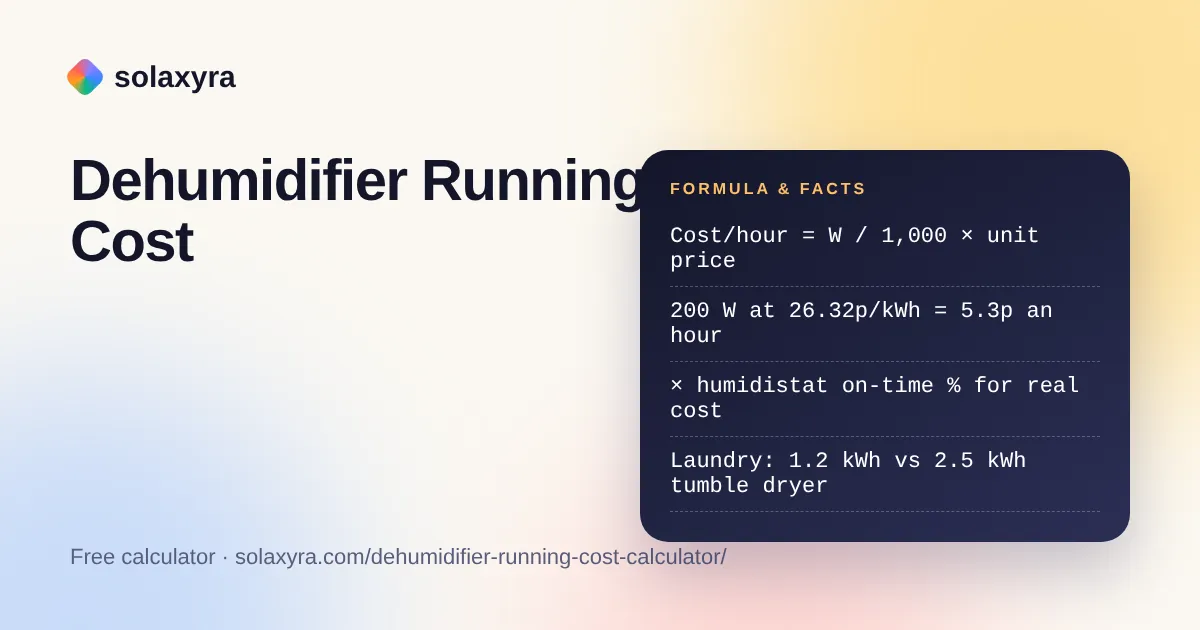
Cost = W / 1,000 × on-time % × hours × unit price
This dehumidifier running cost calculator works out what a compressor or desiccant dehumidifier costs to run per hour, day, week and year, and compares drying a load of washing with it against a tumble dryer. It is built for homes in the UK, Ireland and Europe, starts with the current Ofgem price cap unit rate, and accepts your own tariff in pounds, euros or dollars.
Quick answer: Multiply the dehumidifier’s power in kW by your unit rate. At the Ofgem cap of 26.32p per kWh for October to December 2026, a 200 W compressor model costs about 5.3p an hour and a 600 W desiccant model about 15.8p. A humidistat that switches the unit off when the air is dry lowers the real cost.
What Is a Dehumidifier Running Cost Calculator?
A dehumidifier running cost calculator is a tool that converts a dehumidifier’s rated power, the hours it is switched on and the share of that time it actually runs into kilowatt-hours and money. In plain words: watts divided by 1,000, multiplied by on-time percentage and hours, gives kWh, and kWh multiplied by your unit price gives the cost.
- Cost per hour at full power = W / 1,000 × unit price
- Cost per day = cost per hour × humidistat on-time % × hours switched on
- Cost per year = cost per day × days per week × weeks of use
- Laundry load = W / 1,000 × drying hours × unit price, against tumble dryer kWh per load × unit price
How Do You Use the Dehumidifier Running Cost Calculator?
- Choose compressor or desiccant. The power box fills with a labelled example; replace it with the wattage on your unit’s rating label or in its manual.
- Set the humidistat on-time. If the unit has a humidity setting it stops when the room reaches the target, so it runs for only part of each hour. Use 100% for continuous or laundry mode.
- Enter hours switched on per day, days per week and weeks of use per year.
- Check the unit price. The UK default is the cap rate; for euros or dollars, enter the rate on your bill.
- For laundry, enter how long a load takes to dry with the dehumidifier and your tumble dryer’s kWh per load.
- Read the daily cost, the weekly, monthly and yearly figures and the laundry comparison. Open Formula and breakdown to see each step.
How Much Does It Cost to Run a Dehumidifier Per Hour?
A dehumidifier costs its power in kW multiplied by your unit rate per hour of running: at 26.32p per kWh, that is 3.9p for a 150 W unit, 5.3p for 200 W and 15.8p for 600 W. Over an 8-hour day at full power, the same units cost 32p, 42p and £1.26.
| Dehumidifier power | Cost per hour | Cost per 8-hour day | Cost per 30 days at 8 hours a day |
|---|---|---|---|
| 150 W | 3.9p | 32p | £9.48 |
| 200 W | 5.3p | 42p | £12.63 |
| 300 W | 7.9p | 63p | £18.95 |
| 450 W | 11.8p | 95p | £28.43 |
| 600 W | 15.8p | £1.26 | £37.90 |
| 700 W | 18.4p | £1.47 | £44.22 |
All figures assume full power at 26.32p per kWh, the average direct debit rate in Ofgem’s price cap for 1 October to 31 December 2026. With a humidistat, real costs are lower. The standing charge is paid whether the dehumidifier runs or not, so it is not included.
Compressor or Desiccant: Which Is Cheaper to Run?
In a room above about 20 °C, a compressor dehumidifier is usually the cheaper choice, because it works at its best there and needs no heater to release the water it collects; in a cold room, such as an unheated garage or a home kept cool in winter, a desiccant model keeps working where a compressor model struggles.
- Compressor (refrigerant) models pull air over a cold coil so moisture condenses, then reheat the air. According to the description of how dehumidifiers work, they perform best above 20 °C and 45% relative humidity and become less effective in the cold.
- Desiccant models absorb moisture into a drying material and release it with heat, so they do not need a cold coil and work well in cool, damp conditions. They are often lighter and quieter, but the heating step adds to their power use, so compare rating labels.
Both types release the electricity they use into the room as heat, so a dehumidifier gently warms the space it runs in. With a desiccant model that warmth is more noticeable, which can be welcome in a cold room in winter and partly offsets other heating. Compare running costs by wattage and hours, not by type alone: a small desiccant unit can cost less than a large compressor unit.
Is a Dehumidifier Cheaper Than a Tumble Dryer?
Usually yes: drying a load indoors with a 200 W compressor dehumidifier for 6 hours uses 1.2 kWh, about 31.6p at the cap rate, while a tumble dryer that uses 2.5 kWh per load costs 65.8p. The gap is wider with a vented or condenser dryer that uses more energy per load, and narrower with a heat pump dryer.
Dryers vary widely, so use your own figure. The energy label on a tumble dryer shows its annual consumption in kWh, as the SEAI guide to tumble dryer labels explains, and the manual often gives energy per programme. A plug-in energy monitor on one full load gives the most accurate number. For a full dryer breakdown by type and loads per week, use the tumble dryer running cost calculator.
Drying indoors works best with the dehumidifier and washing in a small room with the door and windows closed, so the unit is not trying to dry the rest of the house or the outside air.
How Long Should You Run a Dehumidifier Each Day?
Run it for as long as it takes to bring the room to your target humidity, and let the humidistat switch it off after that; there is no fixed number of hours, so the calculator uses hours switched on multiplied by an on-time percentage. A damp room after a shower or while drying washing may need hours of continuous running, while a room that is already dry may only need short top-ups.
Cost grows in direct proportion to running time, so closing doors and windows, emptying or draining the tank so the unit does not stop and restart, and cleaning the filter all help it do the job in fewer hours. If you are costing several appliances together, the electricity cost calculator uses the same method for any device.
Worked Example: Damp Bedroom and Laundry in Manchester
Olivia in Manchester runs a 210 W compressor dehumidifier in a damp back bedroom for 8 hours a day, every day, from October to March (26 weeks). Her plug-in monitor shows the humidistat keeps the compressor running 85% of the time. She pays the cap rate of 26.32p per kWh.
- Cost per hour at full power: 0.21 kW × 26.32p = 5.5p.
- Per day: 5.5p × 85% × 8 hours = 37.6p, which is 1.43 kWh.
- Per week: £2.63. For the 26-week season: £68.40 for 259.9 kWh.
- Laundry: a load dries in 6 hours with the unit on laundry mode at full power, using 1.26 kWh, so it costs 33.2p. Her vented tumble dryer measured 4.2 kWh for the same load, costing £1.11.
- At three loads a week, drying with the dehumidifier saves her 77.4p a load, or about £120 over a year.
Olivia keeps the tumble dryer for days when she needs clothes dry in a couple of hours, and uses the dehumidifier for everything else.
Frequently Asked Questions
How much does it cost to run a dehumidifier for 24 hours?
Multiply the power in kW by 24 hours and your unit rate. A 200 W dehumidifier running nonstop uses 4.8 kWh, costing about £1.26 a day at 26.32p per kWh. With a humidistat switching it off part of the time, the real cost is lower.
Do dehumidifiers use a lot of electricity?
It depends on the wattage on the rating label. A 200 W unit uses 0.2 kWh per hour, costing about 5.3p at the October 2026 cap rate, while a 2,000 W electric heater uses ten times as much in the same hour.
Is a desiccant dehumidifier more expensive to run?
Often per hour, because desiccant models use heat to release moisture from the drying material, which adds to their power use. In cold rooms, though, they keep removing moisture when compressor models slow down, so the cost per litre removed can be competitive.
Can I dry clothes with a dehumidifier instead of a tumble dryer?
Yes. Put the washing and the dehumidifier in a small closed room and use laundry or continuous mode. It takes several hours rather than one or two, but costs less per load than most tumble dryers because it uses fewer kWh.
Does a dehumidifier help heat a room?
A little. All the electricity a dehumidifier uses ends up as heat in the room, and desiccant models in particular blow out noticeably warm air. It is not a substitute for a heater, but in a cold, damp room the extra warmth helps.
Should I leave my dehumidifier on all the time?
Leave it switched on with the humidistat set to your target, rather than in continuous mode, so it only runs when the air is damp. Continuous mode is useful for drying laundry or a flooded room but costs more because the unit never rests.
Checked October 2026 by the Solaxyra Editorial Team. Sources: Ofgem, energy price cap 1 October to 31 December 2026, Wikipedia, Dehumidifier, SEAI, Understanding the label on tumble dryers.