Do not rely on a power station alone for life-support or medical equipment; ask the device maker or your clinician about a backup plan.
Formula and breakdown
n/a
n/a
n/a
This power station runtime calculator estimates how many hours a portable power station will run a laptop, fridge, router, CPAP or any other device, for campers, van owners and households in the UK and Europe planning for power cuts.
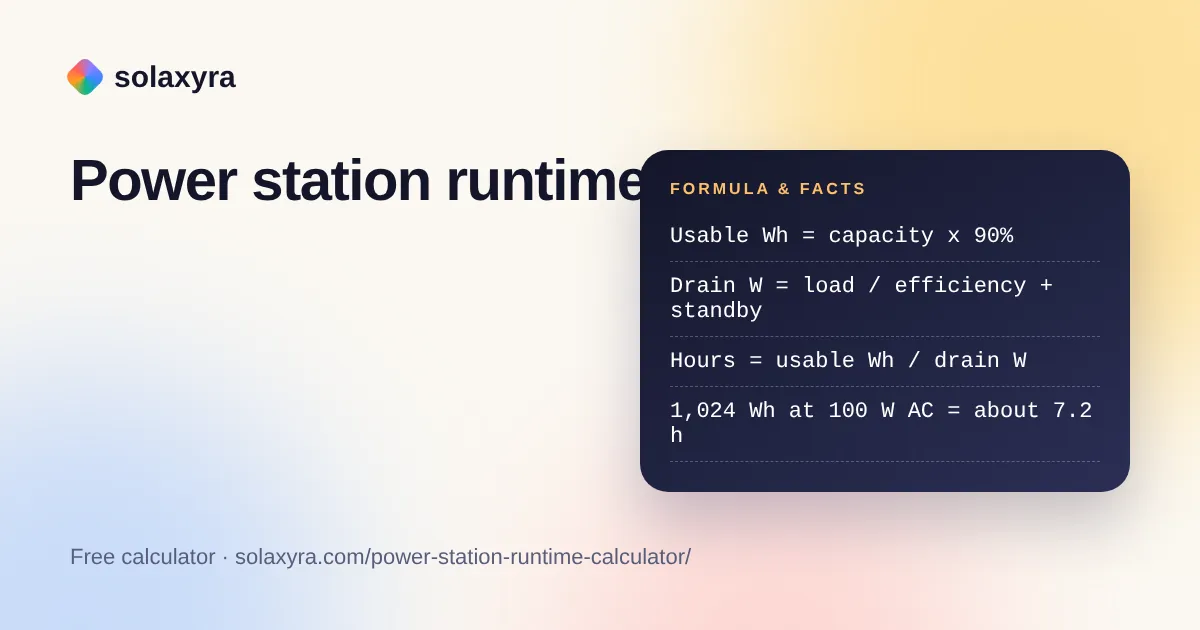
Quick answer: A power station runtime calculator multiplies the rated watt-hours by the usable share (about 90%), then divides by the battery-side drain: device watts divided by inverter efficiency plus standby draw. A 1,024 Wh unit running a 100 W device on AC lasts about 7 hours; on DC outputs it lasts longer.
What Is a Power Station Runtime Calculator?
A power station runtime calculator is a tool that converts a portable battery’s watt-hour capacity and a device’s power draw into an estimated running time. In plain words: runtime in hours equals usable energy in watt-hours divided by the power the battery actually supplies, which is the device’s watts plus the losses in the built-in inverter or DC converter.
Watts measure how fast energy is used; watt-hours measure how much is stored. One watt-hour is one watt for one hour, as the kilowatt-hour definition sets out, so a 1,000 Wh battery could in theory run a 100 W device for 10 hours. Real units deliver less, and this tool shows where the difference goes.
How Do You Use the Power Station Runtime Calculator?
- Enter the capacity in Wh and the rated continuous AC output in W from the spec sheet.
- Choose a device preset or type your own wattage, then set how many of that device you will run.
- Pick AC socket or DC output. The tool sets an example efficiency and standby draw; replace them with your model’s figures if the manual gives them.
- Set the usable share. 90% allows for the low-battery cut-off and some ageing.
- Read the runtime in hours, the usable energy and the drain on the battery, and open the breakdown to see the sum.
For several different devices, add their watts together and enter the total as one device.
Why Is the Runtime Shorter Than Wh Divided by Watts?
Expect roughly 70% to 80% of the simple Wh divided by W figure for AC loads of 100 W or more, and much less for very small loads, because the inverter loses energy turning battery DC into 230 V AC and draws power just by being switched on. The calculator models both: it divides the load by the conversion efficiency, then adds the standby draw.
As a reference point, one inverter maker’s datasheet for 250 to 1,600 VA inverters lists maximum efficiencies of 87% to 92% and zero-load power of about 4 to 12 W. Maximum efficiency only applies near the best load point, so the calculator’s example of 85% and 10 W is a cautious middle. Standby draw matters most at low loads. A 10 W router on AC with 10 W of inverter standby uses about twice the energy you might expect, which is why the same router lasts far longer on a 12 V DC output if it has a suitable lead. The usable share covers the battery management system’s cut-off and the capacity a battery loses as it ages.
How Long Will a Power Station Run Common Devices?
A 1,024 Wh station runs a 100 W load for about 7 hours on AC, a 50 W load for about 13 hours and a 1,000 W load for under an hour, using the example settings of 90% usable, 85% efficiency and 10 W standby.
| AC load | 512 Wh station | 1,024 Wh station | 2,048 Wh station |
|---|---|---|---|
| 10 W | 21.2 h | 42.3 h | 84.7 h |
| 50 W | 6.7 h | 13.4 h | 26.8 h |
| 100 W | 3.6 h | 7.2 h | 14.4 h |
| 300 W | 1.3 h | 2.5 h | 5.1 h |
| 1,000 W | 23 min | 47 min | 1.6 h |
Device wattages vary widely between models, so the presets in the tool are examples only. A plug-in energy monitor gives the real figure, and for a fridge it shows the average over a day, which is the number to enter because the compressor cycles on and off. To turn appliance watts into daily energy and cost, use the watts to kWh calculator.
Can a Power Station Run a Kettle or Heater?
Only if the load is below the station’s rated continuous AC output, and even then a 2,000 W kettle would empty a 1,024 Wh unit in well under half an hour. The calculator blocks the result and shows a warning when the load is above the rated output, because the unit will shut down or refuse to start the device.
Motors in fridges, pumps and power tools draw a short surge several times their running watts when they start. Check that the station’s surge or peak rating covers it. The solar inverter size calculator estimates that start-up peak for a mix of loads.
How Long Does It Take to Recharge a Power Station?
Recharge time is roughly the energy to put back divided by the charging power after losses, so a 1,024 Wh unit takes several hours from a 200 W solar panel and far less from a fast mains charger. Solar input is reduced by cloud, panel angle and temperature, so a nominal 200 W panel rarely delivers 200 W into the station. Our battery charging time calculator works this out with your charger rating and efficiency.
Worked Example: Priya’s Power Cut in Bristol
Priya in Bristol keeps a 1,024 Wh power station for power cuts. She wants to know how long it will keep her fridge freezer and broadband router going.
- Her energy monitor shows the fridge freezer averages 60 W over a day, and the router uses 12 W. Both plug into AC, so the load is 72 W.
- Usable energy: 1,024 Wh x 90% = 922 Wh.
- Battery drain: 72 W divided by 0.85 is 84.7 W, plus 10 W standby, gives 94.7 W.
- Runtime: 922 Wh divided by 94.7 W is about 9.7 hours.
- If she unplugs the fridge freezer and runs only the router from a 12 V DC lead at 95% efficiency with no inverter standby, the same unit lasts about 73 hours.
She keeps the fridge door shut to stretch the time further and recharges from a solar panel on the patio during long outages.
Frequently Asked Questions
How do I calculate power station runtime?
Multiply the capacity in watt-hours by the usable share, about 90%, then divide by the device watts divided by inverter efficiency, plus any standby draw. For 1,024 Wh and a 100 W AC load at 85% efficiency with 10 W standby, the result is about 7.2 hours.
Is it better to use the DC or AC output?
DC outputs such as USB-C and the 12 V socket avoid inverter losses and standby draw, so the same device usually runs longer on DC. Use AC only for devices that need a 230 V plug, and switch the inverter off when nothing is using it.
How long will a power station run a fridge?
Use the fridge’s average draw, not its running watts, because the compressor switches on and off. A fridge averaging 60 W on AC runs for about 11 hours from a 1,024 Wh station with the example settings, less in a warm room or with frequent door opening.
Why does my power station run out sooner than the calculator says?
Cold temperatures, an ageing battery, a higher real load than the label, and devices that charge their own batteries at the same time all shorten runtime. Measure the actual load with a plug-in meter and lower the usable share for an older unit.
Can I run a CPAP machine from a power station?
Many people do, often from a DC adaptor and with the humidifier off to cut the load. Check the CPAP maker’s guidance, measure the real draw, and do not rely on a single power station for life-support equipment without a backup plan agreed with your clinician.
Does a bigger inverter rating mean longer runtime?
No. Rated output in watts sets which devices can run, while capacity in watt-hours sets how long they run. A larger inverter can even shorten runtime slightly at low loads if its standby draw is higher, so check both figures on the spec sheet.
Checked October 2026 by the Solaxyra Editorial Team. Sources: Kilowatt-hour, Wikipedia, Inverter VE.Direct 250 to 1600 VA datasheet, Victron Energy.