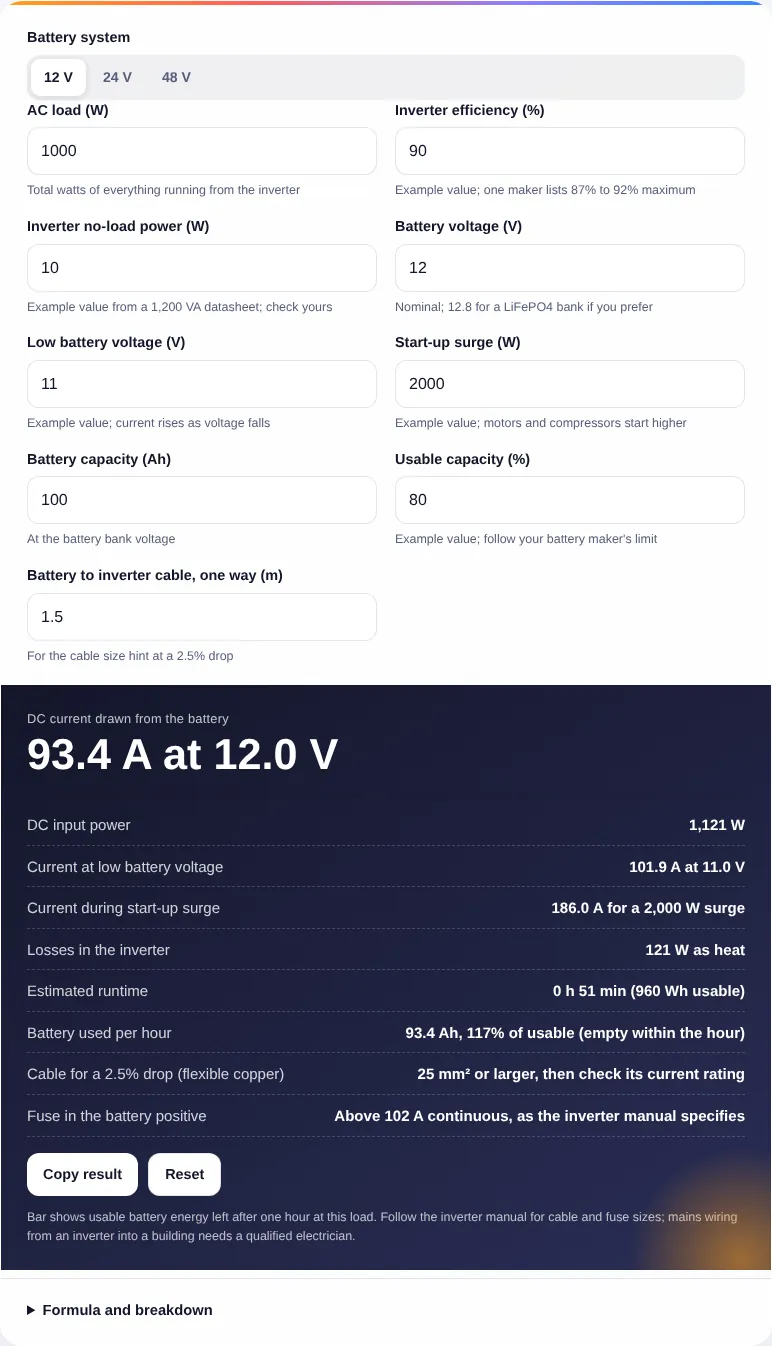
Bar shows usable battery energy left after one hour at this load. Follow the inverter manual for cable and fuse sizes; mains wiring from an inverter into a building needs a qualified electrician.
Formula and breakdown
n/a
n/a
n/a
This inverter amp draw calculator works out how much DC current an inverter pulls from a 12 V, 24 V or 48 V battery to run a mains appliance, including inverter losses, the no-load draw, the extra current as the battery voltage falls and the spike during start-up. It is for campervan, boat, caravan, cabin and backup power owners in the UK, Europe and elsewhere, and it also estimates runtime and the cable and fuse you will need to plan for.
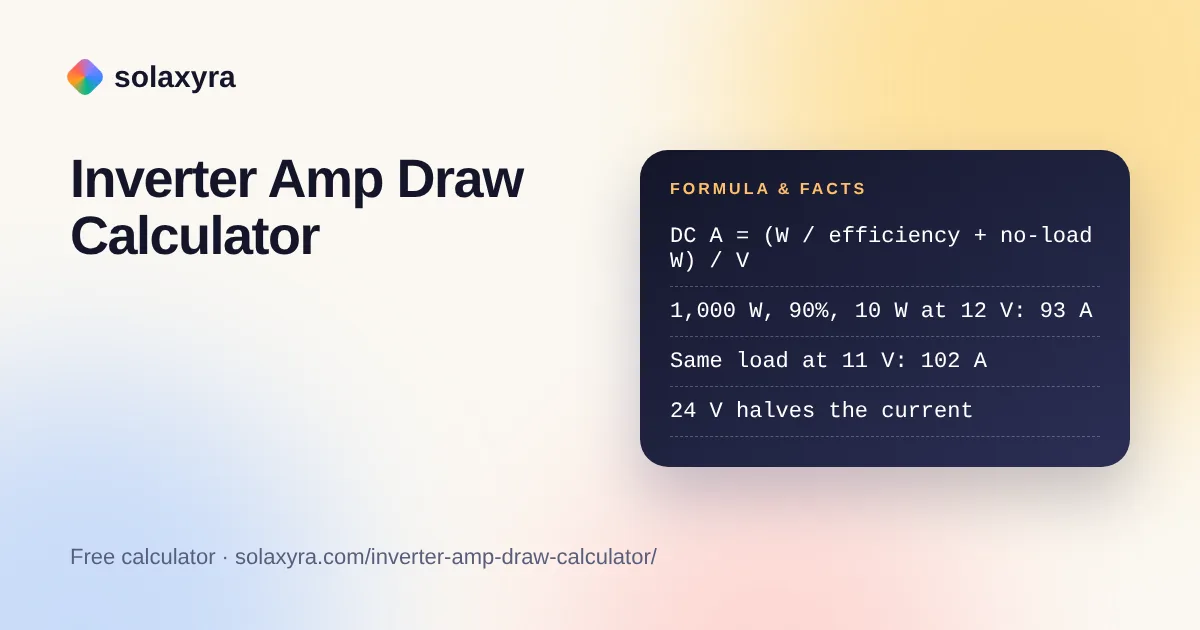
Quick answer: An inverter amp draw calculator divides the AC load by the inverter efficiency, adds the no-load power and divides by the battery voltage. A 1,000 W load on a 12 V battery through a 90% efficient inverter with a 10 W no-load draw takes about 93 A, rising to about 102 A at 11 V.
What Is an Inverter Amp Draw Calculator?
An inverter amp draw calculator is a tool that converts the watts an appliance uses on the AC side of an inverter into the amps drawn from the battery on the DC side. In plain words: DC current = (AC watts / efficiency + no-load watts) / battery volts. The efficiency term accounts for the heat the inverter makes while converting, and the no-load term is the power the inverter uses just by being switched on.
The result is always much larger than the mains current, because the battery voltage is so low. A 1,000 W kettle-sized load draws about 4.3 A from a 230 V socket, but over 90 A from a 12 V battery. That current decides the battery size, the cable size and the fuse, so it is the first number to get right.
How Do You Use the Inverter Amp Draw Calculator?
- Choose a 12 V, 24 V or 48 V battery system. The voltage and low-voltage fields fill in, and you can type exact values.
- Enter the AC load in watts: add up everything that will run at the same time.
- Enter the inverter efficiency and no-load power from its datasheet; the defaults are example values.
- Enter the start-up surge in watts if the load has a motor or compressor.
- Enter the battery capacity in Ah and the share you can use.
- Enter the one-way cable length from battery to inverter, then read the current, surge current, runtime and cable and fuse hints.
How Many Amps Does an Inverter Draw From a 12V Battery?
At 90% efficiency with a 10 W no-load draw, an inverter takes about 10 A from a 12 V battery for a 100 W load, 47 A for 500 W, 93 A for 1,000 W and 186 A for 2,000 W. At 24 V the current halves, and at 48 V it is a quarter.
| AC load (W) | DC input power (W) | 12 V battery (A) | 24 V battery (A) | 48 V battery (A) |
|---|---|---|---|---|
| 100 | 121 | 10.1 | 5.0 | 2.5 |
| 300 | 343 | 28.6 | 14.3 | 7.2 |
| 500 | 566 | 47.1 | 23.6 | 11.8 |
| 1,000 | 1,121 | 93.4 | 46.7 | 23.4 |
| 1,500 | 1,677 | 139.7 | 69.9 | 34.9 |
| 2,000 | 2,232 | 186.0 | 93.0 | 46.5 |
| 3,000 | 3,343 | 278.6 | 139.3 | 69.7 |
The table uses the same example values as the inverter amp draw calculator: 90% efficiency and 10 W no-load power at nominal voltage. Your inverter's figures may differ, so treat the table as a guide and enter your own datasheet values above.
What Efficiency and No-Load Power Should I Use?
Use the figures on your inverter's datasheet. Victron's Phoenix Inverter VE.Direct datasheet, for example, lists maximum efficiency from 87% for the 12/250 model to 92% for the 12/1600, and zero-load power from 4.2 W to 12 W, with lower figures in eco mode.
Maximum efficiency is a best case at a favourable load, so real efficiency at very low or very high loads is usually lower. The no-load power matters most for small loads left on for hours: a 10 W standby draw adds 240 Wh a day even with nothing plugged in. If you want to see how efficiency alone changes the DC power, the inverter efficiency calculator isolates that step. The inverter amp draw calculator includes both terms in every result.
Why Does the Current Rise as the Battery Voltage Falls?
An inverter supplying a steady AC load draws roughly constant power from the battery, so when the battery voltage falls the current rises in proportion: the same 1,121 W that is 93 A at 12 V becomes 102 A at 11 V. Cables, fuses and battery management systems must cope with the higher figure.
The low battery voltage field is an example value; set it to the lowest voltage you expect under load before the inverter's own low-voltage cut-out. The Victron datasheet above gives an input range down to 9.2 V for its 12 V models. The inverter amp draw calculator uses the low-voltage current for the cable and fuse hints, because that is the worst steady case.
How Much Current Does an Inverter Draw at Start-Up?
Motors, compressors and pumps can draw several times their running power for a moment when they start, and the battery has to supply that surge too. A 2,000 W surge on a 12 V system at 90% efficiency is about 186 A for that instant.
Inverters are rated for a short peak above their continuous output; the Victron 12/1200, for example, lists 1,000 W continuous at 25 °C and a 2,200 W peak. Check that both the continuous load and the surge sit within your inverter's ratings, and size the inverter with the solar inverter size calculator if you are still choosing one. The surge is too brief to matter for runtime, but the battery and its management system must allow it.
How Long Will My Battery Run the Inverter?
Runtime is usable battery energy divided by DC input power: a 100 Ah 12 V battery with 80% usable holds 960 Wh, which runs a 1,000 W load (1,121 W from the battery) for about 51 minutes. The usable share is an example value; follow your battery maker's limit.
The inverter amp draw calculator does not model the reduction in available capacity that some batteries show at high discharge rates, known as the Peukert effect, which varies with battery chemistry. For that, and for loads that come and go, the battery runtime calculator and the Peukert calculator go further. Portable units with a built-in inverter are covered by the power station runtime calculator.
What Cable and Fuse Does an Inverter Need?
The battery to inverter cable must keep volt drop low at the highest steady current, and Victron advises aiming below 2.5% on DC cables. For 102 A over a 1.5 m one-way run at 12 V, that means at least 25 mm² of flexible copper cable, before checking its current rating.
A fuse belongs in the positive cable close to the battery, rated above the inverter's maximum continuous DC current and within the cable's rating. Many inverter manuals state the cable size and fuse to use, and the manual takes priority over any rule of thumb. The Victron Wiring Unlimited DC wiring guide covers fuse placement and why contact resistance matters at these currents. Our 12V cable size calculator sizes the cable for any length and drop. Connecting an inverter's AC output to a building's wiring needs a qualified electrician, and in the UK that work must meet BS 7671.
Worked Example: 1,000 W Load on a 12V Inverter
Example: a campervan runs a 1,000 W appliance through a 12 V inverter with 90% efficiency and 10 W no-load power, from a 100 Ah battery with 80% usable. The battery to inverter cable is 1.5 m one way.
- DC input power: 1,000 / 0.90 + 10 = 1,121 W, of which 121 W is lost as heat in the inverter.
- DC current at 12 V: 1,121 / 12 = 93.4 A. At 11 V: 1,121 / 11 = 101.9 A.
- Surge of 2,000 W: (2,000 / 0.90 + 10) / 12 = 186.0 A for a moment.
- Runtime: 100 Ah x 12 V x 80% = 960 Wh; 960 / 1,121 = 0.856 h, about 51 minutes.
- Cable: 2.5% of 12 V is 0.3 V; 0.3 / 101.9 A = 0.00294 Ω over 3 m of conductor, 0.981 Ω/km, so 25 mm² flexible cable (0.78 Ω/km) or larger.
- Fuse: above 102 A continuous, to the rating in the inverter manual and within the cable's current rating.
Switching the inverter amp draw calculator to a 24 V system shows the same appliance at half the current, about 47 A, which allows thinner cable and a smaller fuse.
Frequently Asked Questions
How many amps does a 1000W inverter draw at 12V?
At full 1,000 W output with 90% efficiency and 10 W no-load power, about 93 A at 12 V and about 102 A as the battery falls to 11 V. A lighter load draws proportionally less, because current follows the load rather than the inverter's rating.
How many amps does a 2000W inverter draw?
Running a full 2,000 W load at 90% efficiency with a 10 W no-load draw, it takes about 186 A from a 12 V battery, 93 A from 24 V and 46.5 A from 48 V. That is why larger inverters are usually paired with 24 V or 48 V banks.
Does an inverter draw power with nothing plugged in?
Yes. The no-load or zero-load power keeps the inverter ready to supply power. One maker's datasheet lists 4.2 W to 12 W for 250 VA to 1,600 VA models, with lower figures in eco mode. Over 24 hours, 10 W uses 240 Wh.
What is the formula for inverter current?
DC current equals AC load in watts divided by efficiency, plus no-load watts, all divided by battery voltage. For 500 W at 90% and 10 W no-load on 12 V: (500 / 0.9 + 10) / 12 = 47.1 A.
Why use the low battery voltage for cable sizing?
Because the inverter draws roughly constant power, current rises as voltage falls. The cable and fuse must handle the highest steady current, which happens near the bottom of the battery's voltage range, just before the inverter's low-voltage cut-out.
Is this inverter amp draw calculator accurate enough to buy cable and fuses?
It is a planning estimate. Use the inverter manual's specified cable size and fuse rating where given, check the cable maker's current rating, and have mains connections to any building made by a qualified electrician to BS 7671 in the UK.
Checked October 2026 by the Solaxyra Editorial Team. Sources: Victron Energy: Phoenix Inverter VE.Direct 250VA to 1600VA datasheet, Victron Energy: Wiring Unlimited, DC wiring, REDARC: how much power does an inverter draw, Bayka: conductor resistance.