n/a
Formula and breakdown
n/a
n/a
n/a
This solar inverter size calculator recommends an inverter rating for grid-tied solar from your array size and DC/AC ratio, and for off-grid or backup systems from your running load and motor start-up surge, with a UK check on whether the inverter falls under the G98 or G99 connection route.
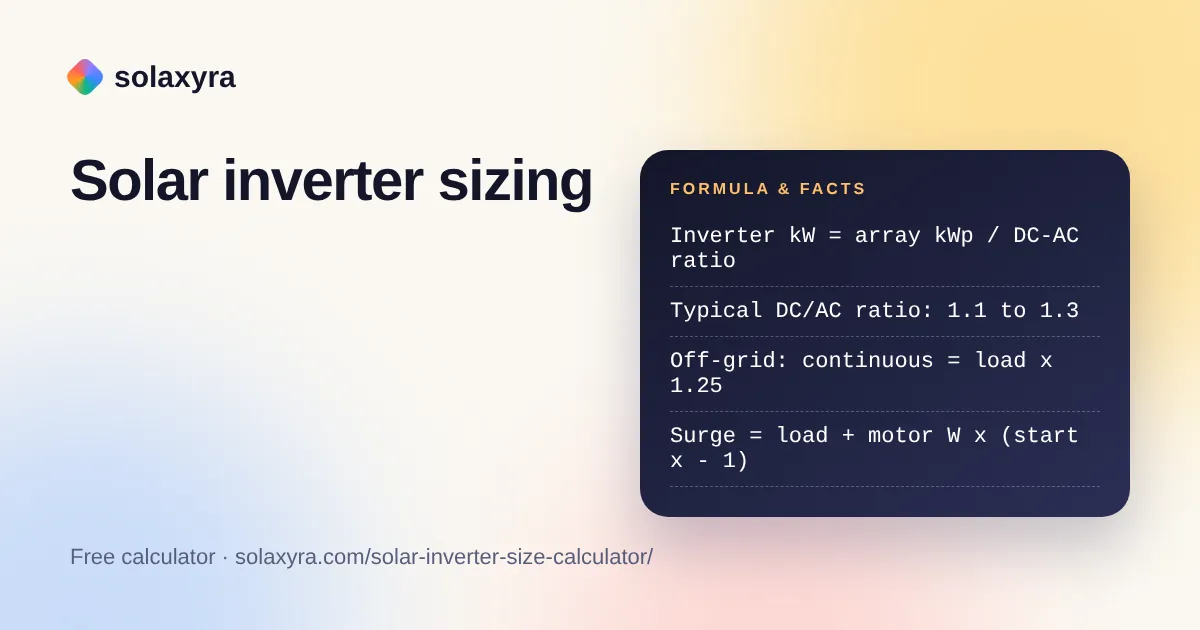
Quick answer: A solar inverter size calculator divides the array’s DC rating by a DC/AC ratio, typically 1.1 to 1.3, so a 4.3 kWp array suits an inverter of about 3.3 to 3.9 kW. For off-grid use, size the continuous rating about 25% above the total running load and the surge rating above the largest motor start.
What Is a Solar Inverter Size Calculator?
A solar inverter size calculator is a tool that matches an inverter’s AC power rating to a solar array or to the appliances it must supply. For grid-tied solar the formula in plain words is: inverter AC kW equals array kWp divided by the chosen DC/AC ratio. For off-grid and backup systems it is: continuous rating equals the total load that can run at once plus headroom, and surge rating equals that load plus the extra a motor draws as it starts.
The two cases are different problems. A grid-tied inverter only has to pass the energy the panels make, and any shortfall comes from the grid. An off-grid inverter has to supply every appliance on its own, including the brief surge when a fridge or pump starts.
How Do You Use the Solar Inverter Size Calculator?
- Choose grid-tied solar or off-grid and backup loads.
- For grid-tied: enter the number of panels and their rated watts, then a target DC/AC ratio. Optionally enter an inverter you are considering to see its ratio and the GB connection route.
- For off-grid: enter the total running watts of everything that can be on together, the running watts of the largest motor load, and its start-up multiple from the maker’s data.
- Set headroom, battery voltage and inverter efficiency to see the continuous rating, surge rating and battery current.
- Open the formula breakdown to check each step.
What DC/AC Ratio Should a Solar Inverter Have?
Most grid-tied designs use a DC/AC ratio between 1.1 and 1.3, meaning the array is 10% to 30% larger than the inverter’s AC rating. A Northumbria University study of UK conditions found the best inverter size was 0.725 to 0.9 times the array capacity, depending on the inverter type, which is a ratio of about 1.1 to 1.4. Panels rarely produce their full STC rating in real conditions because of heat, haze and sun angle, so a slightly smaller inverter runs closer to its efficient range for more of the day.
When the panels do produce more than the inverter can pass, the inverter limits its output, known as clipping. How much energy clipping costs depends on your site, tilt and orientation, so model it rather than guess; east and west split arrays peak at different times, which changes the picture. Above about 1.3, check the inverter’s maximum DC input power and current in its datasheet, since every model has hard limits. To estimate the yearly energy you will lose or gain, use the solar panel output calculator.
| Array size | Inverter at ratio 1.1 | Inverter at ratio 1.2 | Inverter at ratio 1.3 |
|---|---|---|---|
| 3.0 kWp | 2.73 kW | 2.50 kW | 2.31 kW |
| 4.3 kWp | 3.91 kW | 3.58 kW | 3.31 kW |
| 6.0 kWp | 5.45 kW | 5.00 kW | 4.62 kW |
| 8.0 kWp | 7.27 kW | 6.67 kW | 6.15 kW |
| 10.0 kWp | 9.09 kW | 8.33 kW | 7.69 kW |
Does Inverter Size Affect Grid Connection in the UK?
Yes. In Great Britain, generation up to 16 A per phase, which is 3.68 kW on a single-phase 230 V supply, follows the ENA G98 route where the installer connects and then notifies the network operator; larger systems follow G99, which needs an application to the network operator before connection. This is one reason 3.6 kW and 3.68 kW inverters are a common choice for UK homes with around 4 kWp of panels.
National Grid’s G98 micro generation guidance describes the fit and notify basis, with notification within 28 days of commissioning, and states that installations above 16 A per phase must comply with G99. Outside Great Britain, your national grid code and network operator set the limits.
What Size Inverter Do You Need for Off-Grid or Backup Loads?
Pick a continuous rating about 25% above the total load that can run at once, and a surge rating at least equal to that load plus the extra drawn by the largest motor while it starts. For 1,200 W of running load including a 150 W fridge that starts at three times its running watts, that means 1,500 W continuous and 1,500 W of surge.
Only the largest motor is counted for surge because two motors rarely start in the same second; if they can, add both. The battery current at full load is the continuous rating divided by battery voltage and efficiency, about 69 A for 1,500 W at 24 V and 90%. That current sets the cable and fuse between battery and inverter, which is why larger off-grid inverters run at 48 V. The off grid solar calculator sizes the array and battery around the same loads, and the solar cable size calculator checks voltage drop on the battery cables.
Is a Bigger Inverter Always Better?
No: an oversized grid-tied inverter costs more, may need G99 approval, and runs at low output where its efficiency is lower for much of the day. An oversized off-grid inverter also draws more standby power, which can matter when the battery is small. Size for the load and array you have, with sensible headroom, and choose a hybrid model if you may add a battery later.
Worked Example: James in Norwich Picks an Inverter
James in Norwich has quotes for ten 430 W panels on a south-facing roof, a 4.3 kWp array, on a single-phase supply.
- At a DC/AC ratio of 1.2 the calculator suggests 4.3 divided by 1.2, about 3.58 kW.
- He compares a 3.68 kW inverter: 4.3 divided by 3.68 gives a ratio of 1.17, inside the usual band.
- Because 3.68 kW is within 16 A per phase, his installer can use the G98 connect and notify route.
- A 5 kW inverter would give a ratio of 0.86 and would need a G99 application, with little extra energy from the same panels.
His installer, certified for solar work and registered for electrical work, confirms the string voltages fit the inverter’s MPPT window and installs the AC side to BS 7671.
Frequently Asked Questions
Can my solar array be bigger than my inverter?
Yes, and it usually is. A DC/AC ratio of 1.1 to 1.3 is common because panels seldom reach their full rating. Stay within the inverter’s stated maximum DC input power, voltage and current, which are listed on its datasheet.
What size inverter do I need for a 4 kW solar system?
A 4 kWp array suits an inverter of roughly 3.1 to 3.6 kW at a DC/AC ratio of 1.1 to 1.3. In Great Britain a 3.68 kW single-phase inverter keeps the system within the G98 connect and notify route.
What is inverter clipping?
Clipping happens when the panels could produce more DC power than the inverter can convert, so the inverter caps its output at its AC rating. A small amount of clipping on the brightest days is normal with a DC/AC ratio above 1.
How do I size an inverter for a fridge or pump?
Find the running watts and the start-up surge from the label or manual. The inverter’s surge rating must exceed the total running load plus the extra the motor draws when starting, and its continuous rating should sit about 25% above the running load.
Does the inverter size limit how much solar I can export?
The inverter’s AC rating caps the power it can deliver at any moment, so it also caps export. Your network operator may set a lower export limit under G99, which the inverter can enforce through its settings.
Who should install a solar inverter?
Grid-connected inverters should be fitted by a certified solar installer, who also handles the network operator notification or application. In the UK the AC connection must meet BS 7671, and off-grid inverters wired into a building also need a qualified electrician.
Checked October 2026 by the Solaxyra Editorial Team. Sources: Micro generation single (G98), National Grid, Generation (G99), National Grid, Optimal sizing of inverters for grid connected PV systems, Northumbria University.