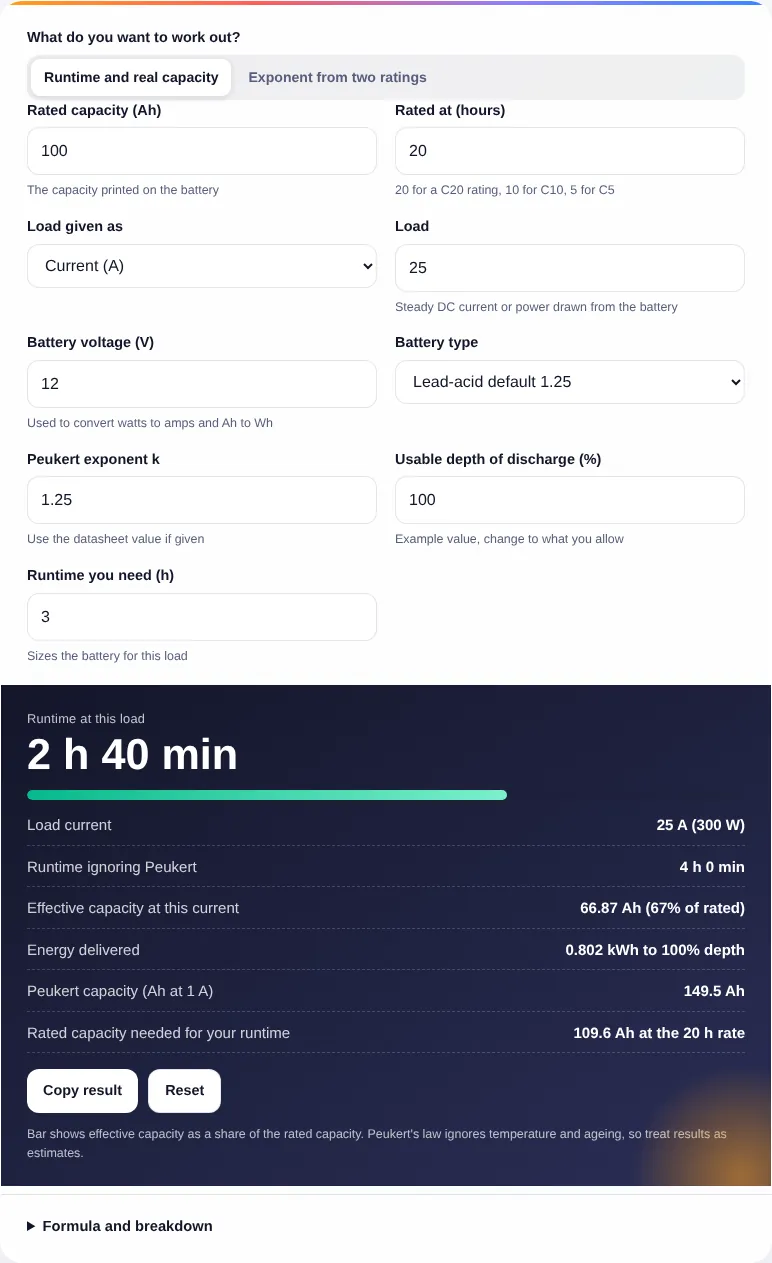
Bar shows effective capacity as a share of the rated capacity. Peukert’s law ignores temperature and ageing, so treat results as estimates.
Formula and breakdown
n/a
n/a
n/a
This Peukert calculator estimates how long a lead-acid battery really lasts at a given load, how many amp-hours it actually delivers at that current, and what rated capacity you need for a target runtime, for campervan, boat, off-grid and backup users in the UK, Europe and beyond. A second mode works out the Peukert exponent from two capacity ratings on a datasheet.
Quick answer: A Peukert calculator applies t = H x (C / (I x H))^k, where C is rated capacity, H the rating time and k the exponent. A 100 Ah battery rated over 20 hours with k = 1.25 runs a 25 A load for about 2 h 40 min, not 4 hours, delivering roughly 67 Ah.

What Is a Peukert Calculator?
A Peukert calculator is a tool that corrects a battery's rated capacity for the current actually drawn, using Peukert's law to show that higher currents give fewer usable amp-hours. In plain words: runtime equals the rating time multiplied by the ratio of rated capacity to (load current times rating time), raised to the power of the Peukert exponent.
The Wikipedia article on Peukert's law gives the formula as t = H (C / (I H))^k and explains that k is 1 for an ideal battery and higher for real ones. With k above 1, every increase in current shortens runtime by more than the simple capacity divided by current figure suggests. The effective capacity at any current is simply the load current multiplied by that runtime.
How Do You Use the Peukert Calculator?
- Enter the rated capacity in Ah and the hours it is rated at. Most leisure and deep-cycle lead-acid batteries quote a 20-hour (C20) figure.
- Enter the load as a current in amps, or as power in watts together with the battery voltage.
- Pick the battery type to load a typical exponent, or type the exponent from the datasheet.
- Set the depth of discharge you allow, so the runtime stops where you would stop.
- Add the runtime you need to see the rated capacity required for that load.
- If the datasheet lists two capacities, such as C20 and C5, switch to the exponent mode to calculate k yourself.
What Is a Typical Peukert Exponent?
Most lead-acid batteries have a Peukert exponent between 1.1 and 1.3, with AGM types at about 1.05 to 1.15, gel at 1.1 to 1.25 and flooded batteries at 1.2 to 1.6, according to the Wikipedia summary of published values. The higher the number, the more capacity the battery loses at high current.
Victron Energy's SmartShunt manual section on the Peukert exponent uses 1.25 as the default in its battery monitors, describing it as an acceptable average for most lead-acid batteries, and recommends changing it only for lithium batteries. The same manual notes that an ideal battery has an exponent of 1.00 and a fixed capacity at any current. The peukert calculator's battery type list uses these published ranges; your own datasheet figure always takes priority.
How Much Capacity Does a Battery Lose at High Current?
A 100 Ah battery rated over 20 hours with an exponent of 1.25 delivers only about 67 Ah at 25 A and 56 Ah at 50 A. The table shows the effective capacity of that battery at four loads for four exponents. At the rated current of 5 A every column gives the full 100 Ah, because that is the point the rating describes.
| Load current | k = 1.10 (AGM) | k = 1.18 (gel) | k = 1.25 (lead-acid default) | k = 1.40 (flooded) |
|---|---|---|---|---|
| 5 A (rated current) | 100 Ah | 100 Ah | 100 Ah | 100 Ah |
| 10 A | 93.3 Ah | 88.3 Ah | 84.1 Ah | 75.8 Ah |
| 25 A | 85.1 Ah | 74.8 Ah | 66.9 Ah | 52.5 Ah |
| 50 A | 79.4 Ah | 66.1 Ah | 56.2 Ah | 39.8 Ah |
The flip side is sizing. To run 25 A for 3 hours, an ideal battery would need 75 Ah. With k = 1.10 you need about 89 Ah at the 20-hour rating, with k = 1.25 about 110 Ah, and with k = 1.40 about 129 Ah. The battery bank size calculator handles days of autonomy and series or parallel layouts once you know the corrected capacity.
How Do You Calculate the Peukert Exponent From a Datasheet?
Take two capacity ratings at different discharge times and use k = (log t2 minus log t1) / (log I1 minus log I2), where each current is the capacity divided by its rating time. A battery rated 100 Ah over 20 hours (5 A) and 75 Ah over 5 hours (15 A) gives k = log 4 / log 3 = 1.262.
The Victron manual describes the same method using two ratings such as the 20-hour and 5-hour figures. The ratings should come from the same datasheet and the same temperature. If the result is below 1, the two figures have probably been swapped; if it is far above 1.6, check the units.
Does Peukert's Law Apply to Lithium Batteries?
Peukert's law was developed for lead-acid batteries, and lithium batteries lose far less capacity at higher currents, so an exponent close to 1 is normal for them. Victron advises changing its monitors' default exponent for lithium batteries, and some LiFePO4 makers publish a figure of about 1.05 for their own products. Use the manufacturer's value if it exists; otherwise leave lithium at or near 1.00 and rely on the datasheet discharge curves.
If you only need to know what a current means relative to battery size, the C-rate calculator is the simpler tool. For general runtime planning that includes inverter losses, use the battery runtime calculator, and enter the effective capacity from this page.
When Is Peukert's Law Not Accurate?
Peukert's law is an approximation that ignores temperature and battery age, and Wikipedia notes that the exponent generally rises as a battery ages. It also overstates capacity when the load is below the rated current, because it ignores self-discharge, so the peukert calculator warns you in that case and you should plan on the rated capacity at most.
Loads that switch on and off, such as a compressor fridge, are better described by their average current over the period, but short heavy peaks still pull the voltage down. Cold batteries deliver less than the formula predicts. Home battery systems and any fixed wiring to mains inverters should be designed and installed by a qualified electrician; in the UK the installation must meet BS 7671.
Worked Example: Running a 500 W Load From a 110 Ah Leisure Battery
Example: a campervan has a 12 V, 110 Ah AGM leisure battery rated over 20 hours, with an exponent taken as 1.10 for this example. An inverter supplies a 500 W load, and the owner stops at 50% depth of discharge. Inverter losses are left out to keep the arithmetic clear.
- Current: 500 W / 12 V = 41.7 A.
- Runtime to empty: 20 x (110 / (41.7 x 20))^1.10 = 2.16 h.
- Runtime to 50% depth: 2.16 x 0.5 = 1.08 h, about 1 h 5 min.
- Without the Peukert correction: 110 x 0.5 / 41.7 = 1.32 h, about 1 h 19 min, so the simple figure overstates runtime by about 15 minutes.
- Effective capacity at 41.7 A: 41.7 x 2.16 = 89.8 Ah, about 82% of the label figure.
- For a full hour to 50% depth, the battery would need about 103 Ah at the 20-hour rate, so the 110 Ah battery just covers it.
The campervan solar calculator then shows how much panel power refills that battery on a typical day.
Frequently Asked Questions
What is Peukert's law in simple terms?
Peukert's law says a battery delivers fewer amp-hours when you draw a higher current. Runtime equals the rating time multiplied by rated capacity divided by current times rating time, raised to the Peukert exponent. With an exponent of 1 the battery behaves ideally; real lead-acid batteries sit around 1.1 to 1.3.
What Peukert exponent should I use?
Use the figure on the battery datasheet if there is one. Otherwise published ranges are 1.05 to 1.15 for AGM, 1.1 to 1.25 for gel and 1.2 to 1.6 for flooded lead-acid. Victron battery monitors default to 1.25 as an average for lead-acid batteries.
How do I find the Peukert exponent from C20 and C5 ratings?
Divide each capacity by its hours to get two currents, then use k = (log t2 minus log t1) / (log I1 minus log I2). For 100 Ah at 20 hours and 75 Ah at 5 hours, the currents are 5 A and 15 A and k is log 4 divided by log 3, which is 1.262.
Why does my battery give less than its rated Ah?
The rated figure applies only at the rating current, usually the 20-hour rate. At higher currents a lead-acid battery delivers less, as Peukert's law describes, and cold weather and ageing reduce it further. A 100 Ah battery with k = 1.25 gives about 67 Ah at 25 A.
Is the Peukert effect important for LiFePO4 batteries?
Much less than for lead-acid. Lithium iron phosphate batteries keep most of their capacity at higher currents, so their exponent is close to 1, and some makers quote about 1.05. Use the manufacturer's figure and the discharge curves, and switch the battery monitor's exponent setting accordingly.
Can Peukert's law give more capacity than the rating?
Mathematically yes, when the load is below the rated current, but real batteries rarely deliver it because the law ignores self-discharge. Treat the rated capacity as the upper limit for very small loads. The peukert calculator shows a warning when your load is below the rated current.
Checked October 2026 by the Solaxyra Editorial Team. Sources: Wikipedia: Peukert's law, Victron Energy: SmartShunt manual, battery capacity and Peukert exponent, Battle Born Batteries: Peukert effect (manufacturer LiFePO4 exponent).