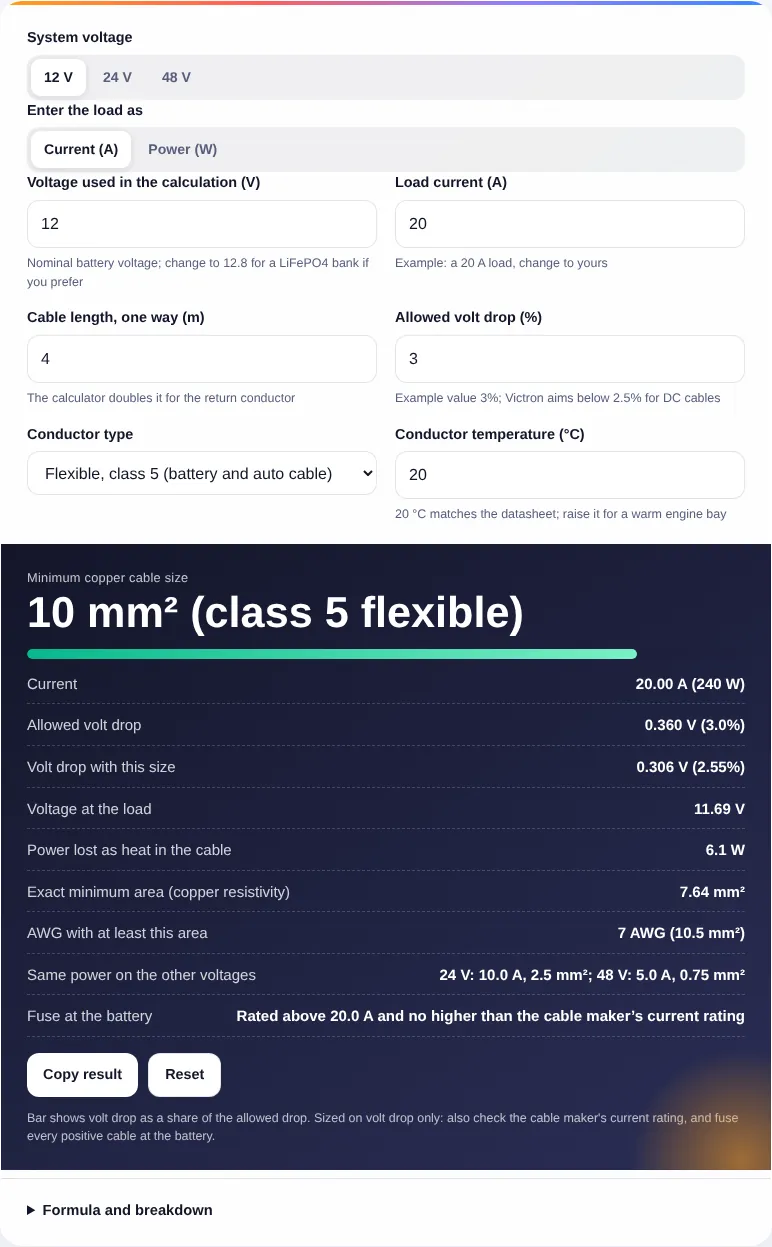
Bar shows volt drop as a share of the allowed drop. Sized on volt drop only: also check the cable maker’s current rating, and fuse every positive cable at the battery.
Formula and breakdown
n/a
n/a
n/a
This 12V cable size calculator finds the smallest copper cable that keeps volt drop within your limit on a 12 V, 24 V or 48 V DC circuit, for campervans, caravans, boats, sheds and battery-to-inverter runs in the UK, Europe and beyond. It uses real conductor resistances for flexible and fixed-wiring cable, doubles the length for the return wire automatically, and shows the nearest AWG size for imported kit.
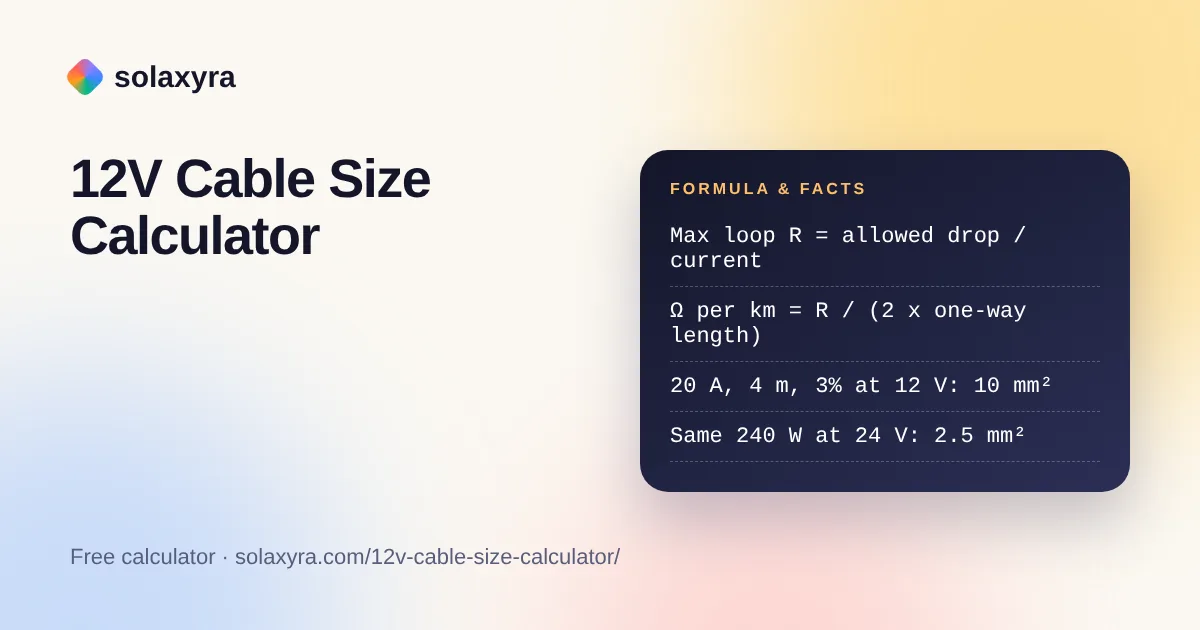
Quick answer: A 12V cable size calculator divides the allowed volt drop by the current to get the maximum loop resistance, then picks the first cable size whose resistance over twice the one-way length is lower. A 20 A load 4 m from a 12 V battery with a 3% limit needs 10 mm² flexible copper cable.
What Is a 12V Cable Size Calculator?
A 12V cable size calculator is a tool that works out the minimum conductor cross-section, in mm², for a low-voltage DC circuit so that the voltage arriving at the load stays close to the battery voltage. In plain words: the current flows out along the positive cable and back along the negative, so the total cable resistance over both lengths, multiplied by the current, is the volts lost, and that loss must stay below a chosen percentage of the system voltage.
Low-voltage circuits are far more sensitive to cable size than mains wiring. Losing 0.36 V is only 0.16% at 230 V but a full 3% at 12 V, and the same appliance draws about 19 times as much current at 12 V as at 230 V. That is why a 12 V fridge or inverter needs cable that looks oversized to anyone used to house wiring.
How Do You Use the 12V Cable Size Calculator?
- Choose 12 V, 24 V or 48 V. You can also type an exact voltage, such as 12.8 V for a lithium bank.
- Enter the load as a current in amps, or as power in watts and let the tool divide by the voltage.
- Enter the cable length one way, from the battery or fuse box to the appliance. Do not double it yourself.
- Set the allowed volt drop. The default is 3% as an example; use a tighter figure for battery-to-inverter cables.
- Choose flexible class 5 cable (typical for battery and automotive cable) or class 1 and 2 cable used in fixed wiring.
- Raise the conductor temperature if the cable runs somewhere hot, then read the size, the volt drop, the voltage at the load and the heat lost in the cable.
How Do You Calculate Cable Size for a 12V System?
Divide the allowed volt drop by the current to get the maximum resistance of the whole loop, then divide by twice the one-way length to get the maximum resistance per kilometre, and choose the first cable size at or below that figure. For 20 A, 4 m and 3% at 12 V: 0.36 V / 20 A = 0.018 Ω, over 8 m that is 2.25 Ω/km, and 10 mm² flexible cable at 1.91 Ω/km is the first to pass.
The 12V cable size calculator uses the maximum conductor resistances at 20 °C that cable maker Bayka publishes for each IEC 60228 size, with separate figures for flexible class 5 and fixed class 1 and 2 conductors. It then corrects for temperature using the coefficient for annealed copper of 0.00393 per degree, from the Wikipedia table of resistivity and conductivity. The exact minimum area from the resistivity of annealed copper, 1.72 x 10^-8 Ω·m, is shown too, but real cable is sold only in standard sizes, so the size you buy is the next one up.
What Volt Drop Is Acceptable on a 12V Circuit?
There is no single legal limit for a leisure or marine 12 V circuit, but inverter maker Victron advises aiming for a voltage drop below 2.5% on DC cables, and many installers use 3% for general loads. The 12V cable size calculator lets you set any value from 0.5% to 15%.
Use a tight figure where the voltage matters: battery-to-inverter cables, chargers and compressor fridges, which can cut out early when the voltage sags. Lighting and short, low-power circuits can tolerate more. The Victron Wiring Unlimited guide to DC wiring also explains that contact resistance at lugs, fuses and switches adds to the loss, so a calculated figure close to the limit leaves little margin for real connections.
How Much Current Can Each Cable Size Carry at 12V?
On volt drop alone, 4 mm² flexible cable can carry about 18 A over a 2 m one-way run at 12 V within 3%, while 16 mm² carries about 74 A over the same distance. The table shows the volt drop limit for common sizes and lengths.
| Size (mm²) | Class 5 resistance at 20 °C (Ω/km) | 1 m one way (A) | 2 m one way (A) | 3 m one way (A) | 5 m one way (A) |
|---|---|---|---|---|---|
| 1.5 | 13.3 | 13.5 | 6.8 | 4.5 | 2.7 |
| 2.5 | 7.98 | 22.6 | 11.3 | 7.5 | 4.5 |
| 4 | 4.95 | 36.4 | 18.2 | 12.1 | 7.3 |
| 6 | 3.3 | 54.5 | 27.3 | 18.2 | 10.9 |
| 10 | 1.91 | 94.2 | 47.1 | 31.4 | 18.8 |
| 16 | 1.21 | 148.8 | 74.4 | 49.6 | 29.8 |
| 25 | 0.78 | 230.8 | 115.4 | 76.9 | 46.2 |
| 35 | 0.554 | 324.9 | 162.5 | 108.3 | 65.0 |
| 50 | 0.386 | 466.3 | 233.2 | 155.4 | 93.3 |
| 70 | 0.272 | 661.8 | 330.9 | 220.6 | 132.4 |
Currents are for a 0.36 V drop (3% of 12 V) at 20 °C. On short runs the volt drop figure can exceed what the cable can carry without overheating, so always check the cable maker's current rating as well; the smaller of the two applies. At 24 V the same cable carries twice the current for the same percentage drop, and at 48 V four times.
Why Does a Higher Voltage Need Thinner Cable?
For the same power, doubling the voltage halves the current and doubles the allowed volt drop in volts, so the cable can have four times the resistance and roughly a quarter of the cross-section. The 12V cable size calculator shows this on every result in the row for the other voltages.
Example: a 240 W load 4 m away needs 10 mm² at 12 V, but only 2.5 mm² at 24 V and 0.75 mm² at 48 V, all within 3%. This is why larger off-grid and van systems often move to 24 V or 48 V for the battery bank. If you are planning a whole system, the campervan solar calculator sizes panels and battery, and the solar cable size calculator handles the panel-to-controller run.
Where Should the Fuse Go on a 12V Cable?
The fuse goes in the positive cable as close to the battery as practical, so that the whole length of cable is protected, and its rating must be above the normal load current but no higher than the cable can safely carry. Victron's guide describes a main battery fuse followed by individual fuses for each consumer.
The 12V cable size calculator reminds you of both limits in its fuse row. Choose the fuse rating from the appliance or inverter manual where it gives one, and check the cable maker's current rating for the size you chose. Our fuse size calculator helps with standard blade fuse ratings. Batteries can deliver very large short-circuit currents, so an unfused positive cable is a fire risk. For a leisure vehicle hook-up or any mains connection, a qualified electrician is needed, and in the UK mains work must meet BS 7671.
Worked Example: 12V Cable for a 20 A Load
Example: a 12 V campervan system feeds a 20 A load 4 m from the battery through flexible cable at 20 °C, with a 3% volt drop limit.
- Allowed drop: 12 V x 3% = 0.36 V.
- Maximum loop resistance: 0.36 V / 20 A = 0.018 Ω.
- Loop length: 2 x 4 m = 8 m, or 0.008 km. Maximum resistance: 0.018 / 0.008 = 2.25 Ω/km.
- 6 mm² class 5 is 3.3 Ω/km (too high); 10 mm² is 1.91 Ω/km (passes).
- Actual drop: 1.91 x 0.008 x 20 = 0.306 V, or 2.55%, leaving 11.69 V at the load. Heat lost in the cable: 20² x 0.01528 = 6.1 W.
- Nearest AWG with at least 10 mm²: 7 AWG (10.5 mm²). Fuse at the battery: above 20 A and within the cable rating.
If the same appliance ran from a 24 V system, it would draw 10 A and need only 2.5 mm². Check the battery side too: the battery runtime calculator shows how long the bank will last at that load.
Frequently Asked Questions
What size cable do I need for 12V 20 amps?
Over a 4 m one-way run with a 3% volt drop limit, 10 mm² flexible copper cable is the minimum. Over 2 m, 4 mm² is enough on volt drop, but check its current rating. Longer runs need larger cable because the loss rises with length.
Do I use one-way or round-trip length?
Enter the one-way length from the battery to the load. The 12V cable size calculator doubles it automatically, because current flows out along the positive and back along the negative cable, and both lose voltage. If the return is through a vehicle chassis, ask an auto electrician.
What is the maximum volt drop for 12V?
There is no single legal limit for leisure or marine DC circuits. Victron advises aiming below 2.5% for DC cables, and 3% is a common target for general loads. Battery-to-inverter cables benefit from the lowest practical drop because inverters shut down on low voltage.
How do I convert mm² to AWG for 12V cable?
AWG sizes follow a fixed formula: 36 AWG is 0.127 mm in diameter and each step changes the diameter by the 39th root of 92. The calculator gives the smallest AWG with at least the chosen metric area, for example 7 AWG at 10.5 mm² for a 10 mm² cable.
Does temperature affect DC cable size?
Yes. Copper resistance rises by about 0.39% per degree, so cable at 50 °C has around 12% more resistance than at 20 °C, and more volt drop. Enter a higher conductor temperature for cable in engine bays, lofts or bundles to see the effect.
Is volt drop the only thing to check?
No. A cable must also carry the current without overheating, which depends on its insulation, bundling and surroundings, so check the maker's current rating. It must be fused at the battery, and any mains wiring in a vehicle, boat or building needs a qualified electrician.
Checked October 2026 by the Solaxyra Editorial Team. Sources: Bayka: conductor resistance by size and class, Victron Energy: Wiring Unlimited, DC wiring, Wikipedia: Electrical resistivity and conductivity, Wikipedia: American wire gauge.