This guide explains when Economy 7 cheap electricity starts and ends in Great Britain, why the times differ between homes and seasons, how to find your own off-peak window, and how much of your electricity needs to fall in it before the tariff saves money. Knowing your exact Economy 7 hours matters because the day rate on these tariffs is usually higher than a single rate, so using the wrong hours can cost you more.
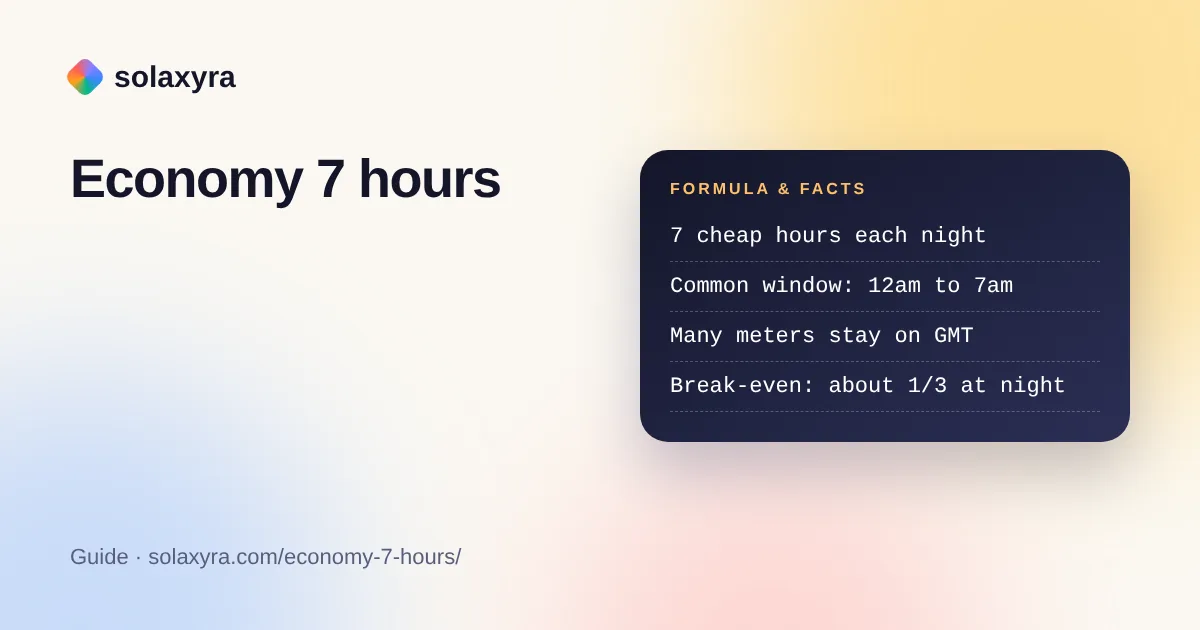
Quick answer: Economy 7 hours are seven hours of cheaper off-peak electricity each night. The window depends on your region, supplier and meter, but a common one is midnight to 7am in winter. Many meter clocks stay on GMT, so in summer the same window shows an hour later. Your bill or supplier confirms your times.
What are Economy 7 hours?
Economy 7 hours are the seven hours each night when a two-rate electricity meter records your use on a cheaper off-peak register, with the other 17 hours charged at a higher day rate. Economy 7 was introduced in Britain in 1978, and it is still used mostly with storage heaters, hot water cylinders and appliances on timers.
The seven hours are not always one continuous block. On some meters the cheap period is split, for example a few hours around midnight and a shorter block later in the night, although the total is still seven hours. Smart Energy GB describes the typical window as 12am to 7am while noting that times vary between suppliers.
What time do Economy 7 hours start and finish?
In the examples published by Smart Energy GB, Wikipedia and OVO Energy, cheap periods start between about 11pm and 1.30am and run for seven hours or more, but there is no single national time. Your window is set by your meter and supplier, and older meters in the same street can be set differently. The table collects the windows published by named sources; use it as a guide, then confirm your own times as shown further down.
| Tariff or area | Off-peak hours | Window quoted | Source |
|---|---|---|---|
| Economy 7, typical | 7 | 12am to 7am | Smart Energy GB |
| Economy 7, example in winter | 7 | From 12.30am GMT | Wikipedia |
| Economy 7, same meter in summer | 7 | From 1.30am BST | Wikipedia |
| Domestic Economy, northern Scotland | 8 | 11.30pm to 7.30am GMT | OVO Energy |
| Southern Scotland off-peak | 8.5 | 11pm to 7.30am GMT | OVO Energy |
| White Meter (Scotland) | 8 | 11.30pm to 7.30am | OVO Energy |
| Economy 10 | 10 | Spread across the 24 hours | Wikipedia, Smart Energy GB |
The Scottish tariffs are close relatives of Economy 7 with longer cheap periods. If you are in Scotland and your bill says Domestic Economy, Heatwise or White Meter, the number of cheap hours may be eight or more rather than seven.
Do Economy 7 hours change when the clocks go forward?
On many older meters, yes: the switching clock stays on Greenwich Mean Time all year, so from late March to late October the cheap period appears one hour later on your kitchen clock. A window of 12.30am to 7.30am GMT, for example, becomes 1.30am to 8.30am British Summer Time.
| Meter time (GMT) | Clock time in winter (GMT) | Clock time in summer (BST) |
|---|---|---|
| 11pm to 6am | 11pm to 6am | 12am to 7am |
| 12am to 7am | 12am to 7am | 1am to 8am |
| 12.30am to 7.30am | 12.30am to 7.30am | 1.30am to 8.30am |
| 1am to 8am | 1am to 8am | 2am to 9am |
Smart meters on Economy 7 may or may not follow the clock change, depending on how the supplier has set them. If your timers for storage heaters, an immersion heater or an EV charger are set to the wall clock, check them each March and October so they still sit inside your Economy 7 hours.
How do you find your own Economy 7 hours?
The quickest way is to look at your bill or online account, which often lists the off-peak times for your meter; if it does not, ask your supplier. These steps cover every type of two-rate meter:
- Check your latest bill or app for “off-peak times”, “night rate times” or similar.
- Look at the meter: a two-rate meter shows two registers, often labelled low and normal, or rate 1 and rate 2. Our guide on how to read an electricity meter explains the displays.
- If you have a smart meter, the in-home display or app may show which rate is active right now.
- Note the reading of both registers late in the evening, then again every hour or so; the register that moves overnight is the off-peak one, and the time it starts moving is your start time.
- If you still cannot tell, phone your supplier and ask for the exact switching times and whether they follow GMT or BST.
Some older meters are switched by a radio teleswitch signal rather than a clock. OVO Energy says support for these radio teleswitched meters is ending, so if your bill mentions RTS, ask your supplier when your meter will be replaced and what your Economy 7 hours will be afterwards.
Is Economy 7 cheaper than a single rate tariff?
Economy 7 is cheaper only if enough of your electricity falls in the off-peak window, because the day rate is normally higher than a standard single rate. Ofgem’s price cap rates page says that on multi-rate tariffs the peak and off-peak rates together cannot be more than the price cap, but it does not mean both rates are lower than the 26.32p single rate.
The break-even share of night use is: (day rate minus single rate) ÷ (day rate minus night rate). Ofgem uses a typical consumption of 3,400 kWh a year for multi-register customers such as Economy 7, compared with 2,500 kWh for single rate electricity, because many of these homes use electric heating or hot water.
Your own rates will differ, so put your actual day and night prices into the Economy 7 calculator, or compare any two rate tariff with the time of use tariff calculator.
Worked example: does Economy 7 pay for this home?
Example: a home uses 3,400 kWh a year, Ofgem’s typical figure for Economy 7. The day rate of 32.00p and night rate of 15.00p per kWh are example values only, so change them to the prices on your bill. The single rate comparison is the October 2026 cap average of 26.32p per kWh, and standing charges are left out.
| Share used in Economy 7 hours | Yearly cost on Economy 7 | Yearly cost on single rate | Difference |
|---|---|---|---|
| 25% | £943.50 | £894.88 | £48.62 more on Economy 7 |
| 33.4% (break-even) | £894.88 | £894.88 | None |
| 40% | £856.80 | £894.88 | £38.08 less on Economy 7 |
| 50% | £799.00 | £894.88 | £95.88 less on Economy 7 |
Break-even here is (32.00 − 26.32) ÷ (32.00 − 15.00) = 0.334, so about a third of all use must fall inside the Economy 7 hours. A home with storage heaters and an immersion heater on a timer will usually pass that easily; a home with gas heating and most use in the evening often will not. Ofgem notes that VAT has been removed from electricity bills from 1 October 2026 to 31 March 2027, which lowers both rates in the same proportion and does not change the break-even share.
What should you run in the off-peak window?
The biggest savings come from loads that are large and can be timed: storage heaters, hot water cylinders with an immersion heater, and electric vehicles. To see how many kWh each one moves into the cheap window, use the energy consumption calculator, and for storage heaters the storage heater running cost calculator splits charging and boost costs.
- Storage heaters: designed to charge in the off-peak hours and release heat the next day; see our guide on how to use storage heaters.
- Immersion heater: set the timer to heat the cylinder inside your Economy 7 hours, leaving a margin at each end for meter and clock differences.
- Electric car: schedule charging in the window; a dedicated EV tariff may be cheaper still.
- Home battery: a battery can charge at the night rate and power the house during the day; the home battery savings calculator estimates the yearly gain.
- Washing machines and dishwashers: use the delay timer only if the appliance manual allows unattended use, and never leave a tumble dryer running overnight or while out.
If your Economy 7 hours rarely line up with your routine, a newer smart time of use tariff with several cheap periods may suit you better; our guide to dynamic electricity tariffs compares the options.
Frequently Asked Questions
Are Economy 7 hours always midnight to 7am?
No. Midnight to 7am is a common window, but the exact Economy 7 hours depend on your region, supplier and meter. Some start around 11pm, some are split into two blocks, and many show an hour later in summer.
Do Economy 7 hours change with British Summer Time?
On many older meters the switching clock stays on GMT, so the cheap period moves one hour later on your wall clock from late March to late October. Some smart meters follow the clock change. Ask your supplier which applies to your meter.
How many hours is Economy 7?
Economy 7 gives seven hours of off-peak electricity in each 24 hours, usually overnight, sometimes split into two blocks. Economy 10 gives ten hours, and some Scottish tariffs such as Domestic Economy give eight or more.
How much night use do I need for Economy 7 to be worth it?
Work out (day rate minus single rate) divided by (day rate minus night rate). With an example day rate of 32p, night rate of 15p and the October 2026 cap rate of 26.32p, you need about a third of your use in the off-peak hours.
Can I have Economy 7 with a smart meter?
Yes. A smart meter can record day and night use separately and run an Economy 7 tariff. Your supplier sets the off-peak times on the meter, and the in-home display or app usually shows which rate is active.
Checked October 2026 by the Solaxyra Editorial Team. Sources: Wikipedia: Economy 7, Smart Energy GB: what is Economy 7, OVO Energy: Economy 7 and off-peak times, Ofgem: price cap unit rates and standing charges, Ofgem: energy price cap 1 October to 31 December 2026, Ofgem: revised typical domestic consumption values.