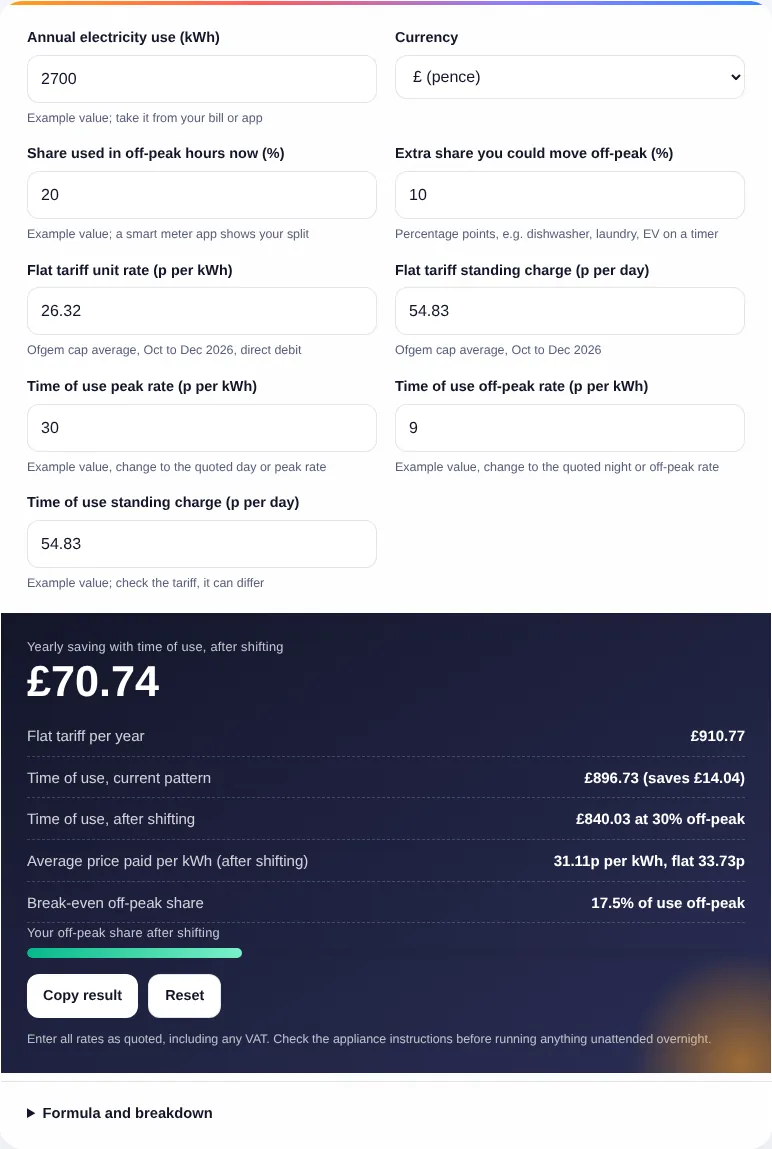
Enter all rates as quoted, including any VAT. Check the appliance instructions before running anything unattended overnight.
Formula and breakdown
n/a
n/a
n/a
This time of use tariff calculator compares what a year of electricity costs on a flat single-rate tariff with a tariff that has a cheaper off-peak rate and a dearer peak rate, for households in Great Britain, Ireland and elsewhere in Europe. It shows the cost with your current usage pattern, the cost after you move some loads into off-peak hours, and the break-even share of use you need off-peak before the switch pays.
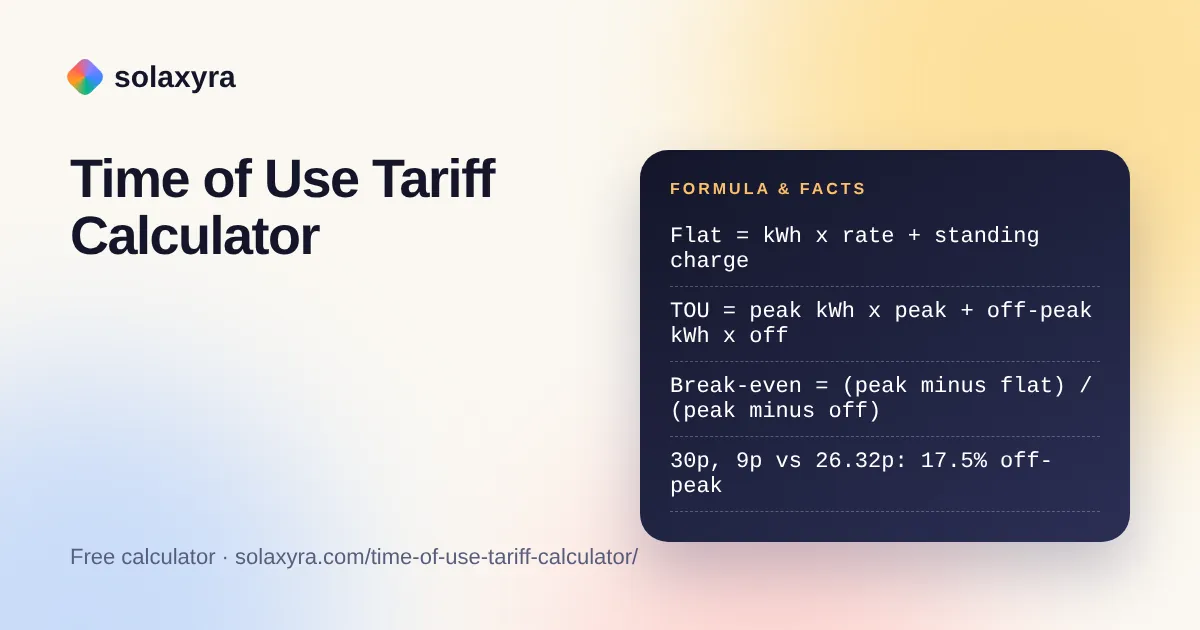
Quick answer: A time of use tariff calculator compares your yearly cost on a flat rate with a peak and off-peak tariff. With the 26.32p Ofgem cap rate, a 30p peak and 9p off-peak, you need about 17.5% of your use off-peak to break even; a 2,700 kWh home at 30% saves about £71 a year.
What Is a Time of Use Tariff Calculator?
A time of use tariff calculator is a tool that prices the same yearly electricity use on two tariffs, one flat and one with different rates at different times of day, and tells you which is cheaper. In plain words: the flat cost is your kWh times the unit rate plus the daily standing charge times 365, and the time of use cost is your peak kWh times the peak rate plus your off-peak kWh times the off-peak rate plus that tariff's standing charge.
Time of use pricing, as the Wikipedia article on time-based pricing describes it, sets prices for fixed periods in advance, so you know the cheap hours and can plan around them. Economy 7, Economy 10 and many EV tariffs are all forms of it, and the time of use tariff calculator handles any tariff with two rates.
How Do You Use the Time of Use Tariff Calculator?
- Enter your annual electricity use in kWh from a bill, your supplier's app or your smart meter display.
- Enter the share you already use in the off-peak hours. If you do not know it, a smart meter app with half-hourly data will show it.
- Enter how many extra percentage points you could move into off-peak hours by using timers, for example on an EV charger or dishwasher.
- Check the flat tariff figures. They default to the Ofgem cap average for October to December 2026; change them to your current tariff.
- Enter the peak rate, off-peak rate and standing charge from the time of use tariff quote.
- Read the yearly saving or extra cost and the break-even off-peak share.
When Is a Time of Use Tariff Cheaper Than a Flat Rate?
A time of use tariff is cheaper once your off-peak share of use is above the break-even share, which is the peak rate minus the flat rate, divided by the peak rate minus the off-peak rate. If the standing charges differ, the time of use tariff calculator adds the yearly difference divided by your kWh to the top line, so a dearer standing charge raises the share you need, and more so for low users.
The table shows the break-even share against the October to December 2026 cap rate of 26.32p per kWh, with equal standing charges. The rate pairs are examples, not supplier quotes.
| Peak rate | Off-peak rate | Break-even off-peak share |
|---|---|---|
| 28p | 10p | 9.3% |
| 30p | 9p | 17.5% |
| 30p | 12p | 20.4% |
| 32p | 8p | 23.7% |
| 34p | 7p | 28.4% |
| 35p | 15p | 43.4% |
The pattern matters more than the off-peak price alone: a very cheap night rate does not help if the day rate is far above the flat rate and most of your use falls in the day.
What Does the Ofgem Price Cap Mean for the Comparison?
The flat tariff defaults come from the Ofgem price cap for 1 October to 31 December 2026: an average of 26.32p per kWh and 54.83p a day for electricity paid by direct debit. Ofgem says VAT is not included in electricity bills for households on the cap in that period, so these figures exclude VAT. Enter any time of use quote on the same basis, or the comparison will be skewed.
The cap is an average across Great Britain and changes every quarter, so recheck both tariffs when it moves. For a full annual bill from your own appliances, the energy consumption calculator builds up your kWh, and the electricity cost calculator prices a single appliance.
Which Loads Are Worth Moving to Off-Peak Hours?
The loads worth moving are large ones that can wait: an electric car, storage heaters, a hot water cylinder and a home battery charged at night move hundreds or thousands of kWh a year. A dishwasher or washing machine on a delay timer moves far less. For EV owners, the solar EV charging calculator shows how much charging solar could cover instead, and the home battery savings calculator values charging a battery off-peak and using it at peak times.
Shifting only pays if it is realistic. Enter the extra share you would really move, not the most you could in theory, and check the appliance instructions before running anything unattended overnight. Home batteries and EV chargers must be installed by a qualified electrician, and in the UK the work must meet BS 7671.
Worked Example: A Low-Use Flat and a Home With an Electric Car
Example: a flat in Glasgow uses 2,700 kWh a year with 10% in off-peak hours and cannot shift more. The time of use quote, for this example, is 30p peak, 9p off-peak and a 60p daily standing charge, against the 26.32p and 54.83p cap rates.
- Flat: 2,700 x 26.32p + 365 x 54.83p = £710.64 + £200.13 = £910.77.
- Time of use: 2,700 x (90% x 30p + 10% x 9p) + 365 x 60p = £753.30 + £219.00 = £972.30.
- Extra cost: £61.53 a year. Break-even share: (30 minus 26.32 + 365 x 5.17 / 2,700) / 21 = 20.9%, so this flat should stay on the flat rate.
Example: a house in Cardiff with an electric car uses 9,000 kWh a year, 40% off-peak now and 70% once the car charges only at night. The example quote is 34p peak, 7p off-peak and 60p a day.
- Flat: 9,000 x 26.32p + £200.13 = £2,568.93.
- Time of use after shifting: 9,000 x (30% x 34p + 70% x 7p) + £219.00 = £1,359.00 + £219.00 = £1,578.00.
- Saving: £990.93 a year, against a break-even share of 29.2%.
Frequently Asked Questions
How do I know if a time of use tariff will save me money?
Work out what share of your electricity you use in the off-peak hours and compare it with the break-even share. The break-even share is the peak rate minus the flat rate, divided by the peak rate minus the off-peak rate. If your share is higher, the tariff saves money.
What share of electricity do I need to use off-peak?
It depends on the rates. With a 30p peak, 9p off-peak and a 26.32p flat rate you need about 17.5%. A smaller gap between flat and peak, or a cheaper off-peak rate, lowers that share; a higher standing charge on the time of use tariff raises it.
Do I need a smart meter for a time of use tariff?
A tariff that charges different prices at different times needs a meter that records when you use electricity. That is usually a smart meter, while older Economy 7 and Economy 10 set-ups use meters with separate registers. Check the requirements with the supplier before you switch.
Which appliances are best to run off-peak?
The biggest savings come from large, flexible loads: charging an electric car, storage heaters, hot water cylinders, and home batteries charged at night. Dishwashers, washing machines and tumble dryers with delay timers help too, though each load is smaller.
Is VAT included in the Ofgem price cap rate?
Ofgem says VAT is not included in electricity bills for households on the price cap between 1 October and 31 December 2026, so the 26.32p rate and 54.83p standing charge exclude it. Enter any tariff quote on the same basis so the comparison is fair.
Can a time of use tariff cost more than a flat rate?
Yes. Peak rates are usually higher than a flat rate, so a household that uses most of its electricity in the evening and little at night can pay more. The calculator shows the extra cost and warns you when your off-peak share is below break-even.
Checked October 2026 by the Solaxyra Editorial Team. Sources: Ofgem: Changes to energy price cap between 1 October and 31 December 2026, Wikipedia: Time-based pricing.