This guide explains how dynamic electricity tariffs work in Great Britain, with a comparison for Ireland and the EU, how the half-hourly prices are set and how to check, with your own smart meter data, whether one would cost you less than the October 2026 price cap. Dynamic electricity tariffs can cut bills sharply for homes that can move their use, such as those with an electric car, a home battery or solar panels, and can cost more for homes that cannot.
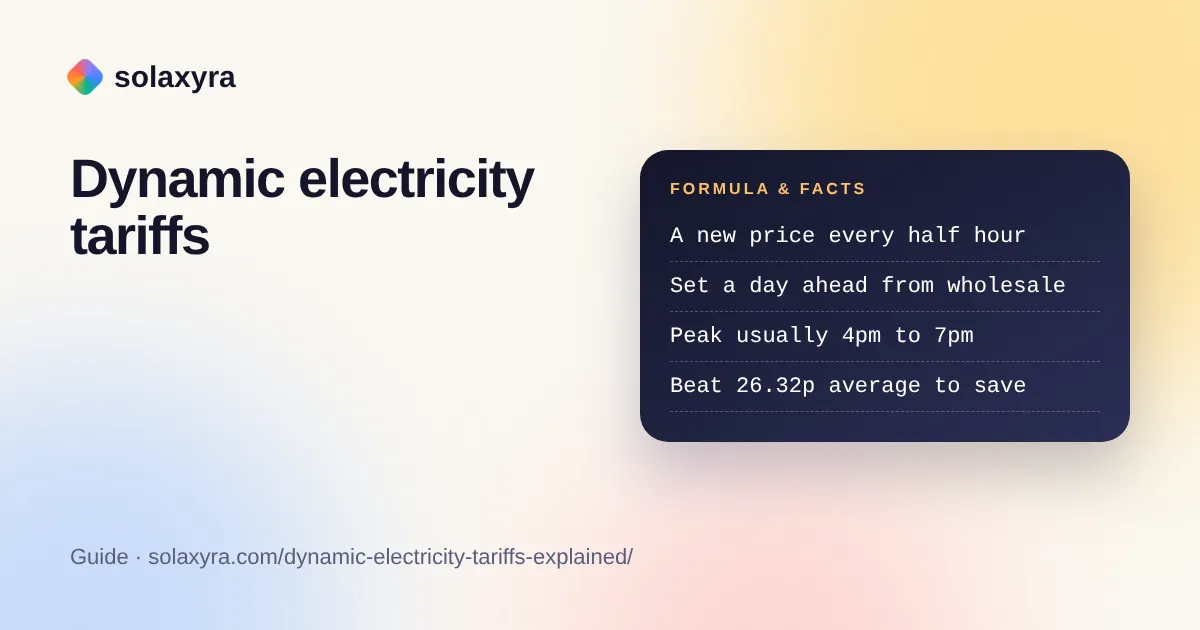
Quick answer: Dynamic electricity tariffs charge a different unit price for every half hour, set a day ahead from wholesale prices. Prices are usually lowest overnight and in windy or sunny spells, and highest from about 4pm to 7pm. You need a smart meter, and you only save if your average price beats your current unit rate.
What is a dynamic electricity tariff?
A dynamic electricity tariff is a tariff whose unit price changes every half hour, following the wholesale electricity market, with each day’s prices published in advance. Wikipedia’s overview of time-based pricing describes this kind of real-time pricing as reflecting the supplier’s cost of buying electricity at the wholesale level, unlike time-of-use pricing, where prices for set periods are fixed in advance and change rarely.
The best-known UK example is Octopus Energy’s Agile tariff. The supplier says its rates for the next 24 hours are published each day between about 4pm and 8pm, based on wholesale prices, and are charged using half-hourly smart meter readings. A daily standing charge still applies on top, just as on any other tariff.
GOV.UK’s guidance on how smart meters work notes that smart meters can record half-hourly consumption data and that smart tariffs let consumers save by using energy away from peak times or when there is excess clean electricity. Dynamic electricity tariffs are the most direct form of that idea.
How is a dynamic tariff different from other tariffs?
A standard variable tariff has one unit rate all day, capped by Ofgem; a static time-of-use tariff has fixed cheap and expensive periods; a dynamic tariff has 48 different prices a day that change every day. The table sets the three side by side.
| Feature | Standard variable tariff | Static time-of-use (for example Economy 7 or an EV tariff) | Dynamic tariff |
|---|---|---|---|
| Unit price | One rate for every hour | Two or more fixed rates for set hours | A new price for each half hour |
| How often prices change | Each quarter, with the price cap | When the tariff terms change | Every day, published a day ahead |
| Ofgem price cap | Yes: October to December 2026 average 26.32p per kWh, 54.83p a day | Depends on tariff type; check terms | Not set by the cap; the supplier sets its own ceiling |
| Meter | Any | Two-rate or smart meter | Smart meter sending half-hourly reads |
| Who it suits | Anyone wanting simplicity | Homes with fixed overnight loads | Homes that can move use day to day |
| Main risk | Paying more than a cheaper deal | Daytime rate higher than standard | Price spikes in the evening peak and cold spells |
Ofgem’s energy price cap explainer says the cap applies to standard variable tariffs and that you are not protected by it if you have agreed a fixed tariff. Dynamic electricity tariffs are separate products with their own terms, so look for the supplier’s own maximum price before you switch. To price a static two-rate tariff instead, see our Economy 7 calculator.
How are dynamic tariff prices calculated?
The supplier takes the wholesale price for each half hour, multiplies it by a regional factor to cover network and other costs, adds a premium in the 4pm to 7pm peak and caps the result. Octopus Energy publishes its Agile formula as the lower of D × W + P and 95p per kWh before VAT (100p including VAT), where W is the wholesale price, D is a regional multiplier between 2.00 and 2.40, and P is a peak premium of 11p to 14p per kWh that applies only from 4pm to 7pm.
The table runs that formula with example values. D is set to 2.2 and P to 12p, both within the supplier’s published ranges; wholesale prices are example values, not today’s market.
| Example wholesale price (W) | Unit price outside 4pm to 7pm (2.2 × W) | Unit price 4pm to 7pm (2.2 × W + 12p) |
|---|---|---|
| Minus 2p (surplus wind or sun) | Minus 4.4p: you are paid to use power | 7.6p |
| 3p | 6.6p | 18.6p |
| 6p | 13.2p | 25.2p |
| 10p | 22.0p | 34.0p |
| 15p | 33.0p | 45.0p |
Two things stand out. Because the wholesale price is multiplied, a small move in the market makes a bigger move in your bill. And the peak premium means the early evening, when most homes cook, wash and heat, is almost always the most expensive time of day. When wholesale prices fall below zero, the formula gives a negative unit price, which the supplier calls plunge pricing: you are credited for the power you use in that half hour.
Will a dynamic tariff save you money?
A dynamic tariff saves money only if the average price you pay, weighted by when you actually use electricity, is lower than the unit rate you pay now, currently 26.32p per kWh on average under the October to December 2026 cap. Because the standing charge is paid whatever the unit price, compare it separately.
The table shows four example households. The price bands are example averages, change them to the prices you see from the supplier: overnight (midnight to 7am) 14p, daytime (7am to 4pm) 22p, peak (4pm to 7pm) 34p and evening (7pm to midnight) 24p. The yearly difference uses an example use of 3,000 kWh.
| Example household | Share of use: overnight, day, peak, evening | Average price paid | Yearly difference vs 26.32p at 3,000 kWh |
|---|---|---|---|
| No changes to habits | 15%, 40%, 20%, 25% | 23.7p | About £79 saved |
| Moves washing and dishwasher out of the peak | 25%, 45%, 5%, 25% | 21.1p | About £157 saved |
| EV and battery charged overnight | 60%, 20%, 5%, 15% | 18.1p | About £247 saved |
| Heavy evening use that cannot move | 10%, 30%, 35%, 25% | 25.9p | About £13 saved, which can become a loss in a cold spell |
With dynamic electricity tariffs, the pattern of use matters more than the exact figures. The formula is: average price = (overnight share × overnight price) + (day share × day price) + (peak share × peak price) + (evening share × evening price). A household that keeps a third of its use in the peak gains almost nothing, and a run of expensive winter evenings can push it above the cap rate. You can add up your appliances and when they run with the energy consumption calculator, then price each block with the electricity cost calculator.
How do you test a dynamic tariff before switching?
Use a few weeks of your own half-hourly smart meter data and the supplier’s published past prices to work out what you would have paid, then compare it with your current unit rate and standing charge. These steps keep the test honest:
- Download your half-hourly consumption from your supplier’s app or account. You control who can access this detailed data, according to GOV.UK.
- Pick at least one winter and one summer month if you can, because evening prices rise in cold, still weather.
- For each half hour, multiply your kWh by the dynamic price for that slot and add them up.
- Divide the total by your kWh to get your weighted average price, and compare it with your current unit rate.
- Add the standing charge for each tariff over the same days, since it is paid regardless of use.
- Check the tariff terms for a price ceiling, exit fees and notice period, and confirm your meter sends half-hourly readings.
- Decide which loads you will actually move, such as EV charging, the dishwasher or battery charging, and rerun the sum with those changes.
Do dynamic electricity tariffs work well with solar panels, batteries and EVs?
Yes, these are the homes that gain most, because a battery or an EV can be charged in the cheapest half hours and run the house through the 4pm to 7pm peak. A battery filled overnight at an example 14p and used in the peak instead of paying an example 34p saves 20p per kWh before losses; over 2,000 kWh a year that is about £400, less round-trip losses. Model your own figures with the home battery savings calculator.
Solar panels add a twist with dynamic electricity tariffs: on sunny days wholesale prices can fall, so the electricity you generate may be worth less as an import saving at midday than on a flat tariff. Using solar output yourself still avoids the import price; check your mix with the self-consumption calculator. For EV owners, the solar EV charging calculator shows how much charging solar can cover before the grid has to. Home batteries and EV chargers are fixed electrical installations and must be fitted by a qualified installer to BS 7671.
Are dynamic electricity tariffs available in Ireland and the EU?
Yes: EU law requires every electricity supplier with more than 200,000 customers to offer a dynamic price contract to customers who have a smart meter and ask for one. This is Article 11 of Directive (EU) 2019/944, which also says suppliers must explain the opportunities, costs and risks first and must get each customer’s consent before switching them. Great Britain is outside this rule and relies on suppliers choosing to offer dynamic electricity tariffs.
In Ireland, the Commission for Regulation of Utilities says dynamic price tariffs became available to eligible customers from June 2026. Prices change every half hour with the wholesale market, suppliers publish the next day’s 48 half-hour prices in advance through apps or online accounts, and prices are capped. The CRU advises reviewing your usage and comparing options before you switch.
| Market | Who must offer a dynamic tariff | Price interval | What you need |
|---|---|---|---|
| Great Britain | No legal duty; offered by some suppliers | Half hour, set a day ahead | Smart meter with half-hourly readings |
| Ireland | Suppliers with over 200,000 customers under the EU rule; available from June 2026 (CRU) | Half hour, 48 prices published the day before | Smart meter |
| EU member states | Every supplier with over 200,000 customers (Directive 2019/944, Article 11) | Set nationally; varies by country | Smart meter and your consent |
The same test applies to dynamic electricity tariffs everywhere: compare the average price you would actually pay, weighted by when you use electricity, with your current unit rate.
Frequently Asked Questions
Do I need a smart meter for a dynamic tariff?
Yes. The supplier needs a reading for every half hour to charge each slot at its own price, so you need a smart meter that sends half-hourly readings. Some suppliers accept only certain meter types, so check before applying.
Are dynamic tariffs covered by the energy price cap?
Ofgem says the price cap applies to standard variable tariffs. A dynamic tariff is a separate product, so its half-hourly prices are not set by the cap. Look for the supplier’s own ceiling, such as 100p per kWh including VAT on one well-known tariff.
Can electricity prices really go negative?
Yes. When wholesale prices fall below zero, usually during strong wind or sun with low demand, a wholesale-linked formula can produce a negative unit price. On tariffs that pass this on, you are credited for electricity used in those half hours.
When is electricity cheapest on a dynamic tariff?
Usually overnight and during windy or sunny periods with low demand. It is almost always most expensive from 4pm to 7pm, when a peak premium is added on top of higher wholesale prices. Check each day’s published prices.
Who should avoid a dynamic tariff?
Homes that use a large share of their electricity in the early evening and cannot move it, such as those relying on electric heating at peak times, may pay more, especially in cold spells. A flat or static time-of-use tariff is simpler and more predictable.
Checked October 2026 by the Solaxyra Editorial Team. Sources: Octopus Energy: Agile pricing explained, Octopus Energy: Agile tariff, Ofgem: energy price cap, Ofgem: price cap October to December 2026, GOV.UK: smart meters, Wikipedia: time-based pricing, CRU: dynamic price tariffs, EUR-Lex: Directive (EU) 2019/944.