This guide shows households in England, Scotland and Wales how much electricity a typical home uses each year, month and day, what that costs at the current price cap, and how to tell whether your own use is high or low. The average electricity usage UK benchmark changed on 1 July 2026, so the 2,700 or 2,900 kWh figures still quoted on many sites are out of date.
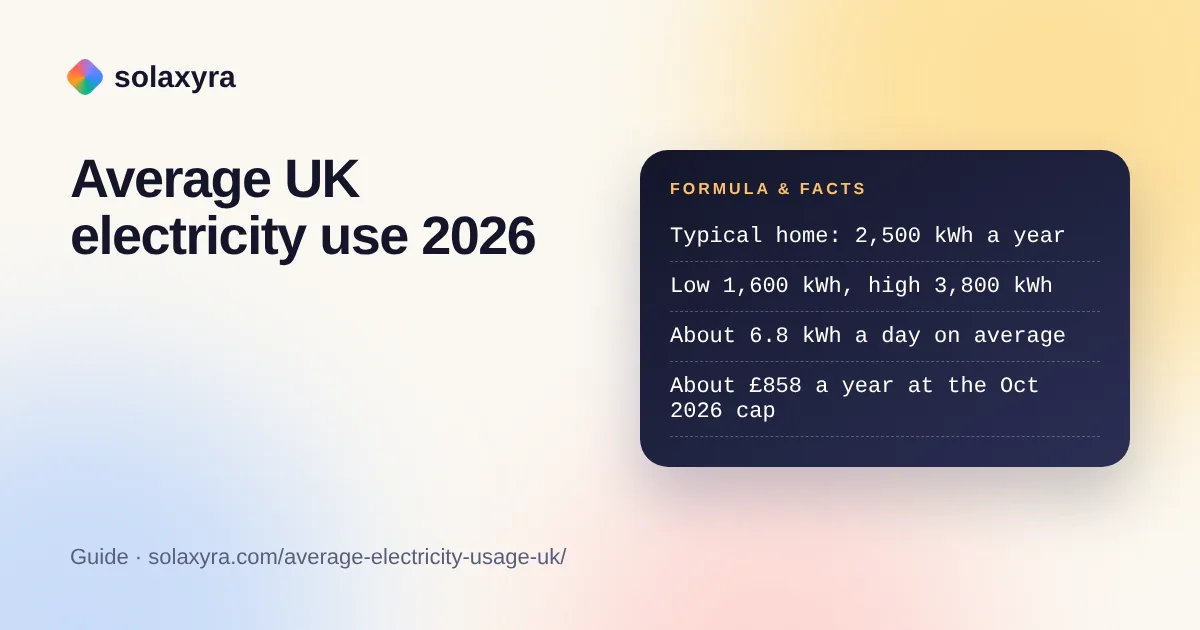
Quick answer: Ofgem’s medium figure for average electricity usage UK homes on a single-rate meter is 2,500 kWh a year from 1 July 2026, about 6.8 kWh a day. Low users are put at 1,600 kWh and high users at 3,800 kWh. At the October to December 2026 cap, 2,500 kWh costs about £858 a year.
What is the average electricity usage UK households have in 2026?
A typical home on a single-rate meter uses 2,500 kWh of electricity a year, according to the typical domestic consumption values (TDCVs) that Ofgem applied from 1 July 2026. The low value is 1,600 kWh and the high value is 3,800 kWh. They replaced the earlier values of 1,800, 2,700 and 4,100 kWh.
Ofgem’s decision on typical domestic consumption values says the medium value is based on the median household, built from the government’s subnational meter data and rounded to the nearest 100 kWh for electricity. The regulator gives four reasons for the fall: long-term energy efficiency improvements, changing patterns of energy use in the home, climatic changes and households cutting use because of affordability pressures.
Ofgem uses these values to turn the price cap into a “typical bill”. The decision also notes that updating them nudged cap unit rates up slightly, by 0.19p per kWh for single-rate electricity, because fixed supply costs are now spread over fewer assumed kWh.
How much electricity does a home use per month and per day?
At the medium average electricity usage UK value of 2,500 kWh a year, a home uses about 208 kWh a month and 6.8 kWh a day. Spread evenly over the 8,760 hours in a year, that is an average power of about 0.29 kW, roughly what three old 100 W bulbs would draw if left on permanently.
| Ofgem band (from 1 July 2026) | kWh per year | kWh per month | kWh per day | Previous value |
|---|---|---|---|---|
| Low | 1,600 | 133 | 4.4 | 1,800 |
| Medium (typical) | 2,500 | 208 | 6.8 | 2,700 |
| High | 3,800 | 317 | 10.4 | 4,100 |
The monthly and daily figures are simple averages. Real use is higher in winter, when lights are on longer and people spend more time indoors, and higher still in homes that heat with electricity.
How much does the average electricity usage UK figure cost at the October 2026 cap?
Using 2,500 kWh a year costs about £858 at the cap for 1 October to 31 December 2026: £658.00 for the electricity plus £200.13 in standing charges. Ofgem’s price cap announcement gives an average direct debit unit rate of 26.32p per kWh and a standing charge of 54.83p a day, and says VAT has been removed from electricity bills from 1 October 2026 to 31 March 2027.
| Usage | kWh per year | Unit cost at 26.32p | Standing charge (365 days at 54.83p) | Total per year | Per month |
|---|---|---|---|---|---|
| Ofgem low | 1,600 | £421.12 | £200.13 | £621.25 | £51.77 |
| Ofgem medium | 2,500 | £658.00 | £200.13 | £858.13 | £71.51 |
| Ofgem high | 3,800 | £1,000.16 | £200.13 | £1,200.29 | £100.02 |
| DESNZ median per meter (2024) | 2,471 | £650.37 | £200.13 | £850.50 | £70.87 |
| DESNZ mean per meter (2024) | 3,323 | £874.61 | £200.13 | £1,074.74 | £89.56 |
These annualised figures use one quarter’s GB average rates; regional rates differ and the cap changes every three months. The electricity cost calculator prices any appliance at your own rate, and the electricity bill calculator works out a full bill.
What is the average usage on an Economy 7 meter?
Homes on Economy 7 or another two-rate meter use more: Ofgem’s typical value for these profile class 2 meters is 3,400 kWh a year, with a low of 1,900 kWh and a high of 6,100 kWh. Two-rate meters are designed for homes that move heavy loads, such as storage heaters or hot water, into the cheaper night period.
| Economy 7 band | kWh per year | Peak share (58%) | Off-peak share (42%) |
|---|---|---|---|
| Low | 1,900 | 1,102 | 798 |
| Medium | 3,400 | 1,972 | 1,428 |
| High | 6,100 | 3,538 | 2,562 |
Ofgem keeps the GB split at 58% peak and 42% off-peak. Day and night rates vary by supplier, so enter your own in the Economy 7 calculator; our guide to Economy 7 hours explains when the cheap period runs.
Why do official figures differ: 2,500, 2,471 or 3,323 kWh?
The difference is median against mean. The government’s subnational electricity consumption statistics for 2024 give a mean of 3,323 kWh per domestic meter and a median of 2,471 kWh. Ofgem works from the median, which rounds to its 2,500 kWh typical value.
The mean is pulled up by a minority of very high users, such as homes with electric heating, a heat pump or an electric car. Ofgem’s decision notes that EV adoption and electrification may widen the gap between mean and median. For comparing your own home, the median based average electricity usage UK benchmark of 2,500 kWh is the fairer yardstick.
Three details help when reading the statistics. Electricity data are not weather corrected, unlike gas. Standard meters are counted from February 2024 to January 2025. And the GB mean per meter is 27.8% lower than in 2005. By region, the South East is about 10% above the GB mean and the North East about 15% below it.
How much does a heat pump or electric car add?
Electrifying heating or transport can double a home’s electricity use. A heat pump replacing a gas boiler adds the home’s heat demand divided by the heat pump’s seasonal efficiency (SCOP); the Energy Saving Trust describes heat pumps as more than three times as efficient as a gas boiler.
- Heat pump example: 8,550 kWh of heat a year (9,500 kWh of gas through a 90% boiler) at an example SCOP of 3 adds 2,850 kWh, about £750 at 26.32p. Total use becomes 5,350 kWh, more than twice the average electricity usage UK benchmark.
- EV example: 7,000 miles a year at an example 3.5 miles per kWh adds 2,000 kWh, about £526 at the cap rate before any cheaper EV tariff. Change both values to your own car and mileage.
The heat pump running cost calculator and the EV charging cost calculator let you enter your own figures. To see how much of that extra demand rooftop panels could cover, try the solar panel calculator.
How do you check your own electricity usage?
Your bill or supplier app shows your annual kWh, and a smart meter gives it day by day. Then compare it with the bands above. If you do not have a smart meter, follow these steps:
- Read your electricity meter today and note the number (two numbers on an Economy 7 meter); our guide on how to read an electricity meter shows how.
- Read it again at the same time one week later.
- Subtract the first reading from the second to get the kWh used that week.
- Multiply by 52 for a rough yearly figure. Repeat in winter and summer, because use changes with the season.
- Compare with Ofgem’s 1,600, 2,500 and 3,800 kWh bands (or 1,900, 3,400 and 6,100 kWh for Economy 7).
If you are well above the average electricity usage UK band for your type of home, list your appliances in the energy consumption calculator to see where the kWh go, and read what uses the most electricity at home. Any change to fixed wiring, such as adding circuits for an EV charger or heat pump, must be done by a qualified electrician to BS 7671. For gas, see our companion page on average gas usage in the UK.
Frequently Asked Questions
What is the average electricity usage for a 3-bedroom house in the UK?
Ofgem does not publish figures by bedroom count. Its medium value of 2,500 kWh a year represents the median single-rate home, which is often linked to a three-bedroom house. A three-bedroom home with electric heating, a heat pump or an EV can use several times that.
Is 10 kWh of electricity a day a lot?
Ten kWh a day is about 3,650 kWh a year, close to Ofgem’s high value of 3,800 kWh and above the 2024 government mean of 3,323 kWh per meter. It is normal for a larger household or one with electric heating, but high for a small flat.
How much electricity does a one-person household use?
Ofgem does not set a figure by number of people. Its low value of 1,600 kWh a year may be a closer comparison for a small home with gas heating than the medium value. It is about 4.4 kWh a day and about £621 a year at the October 2026 cap.
Why did Ofgem lower the typical electricity figure?
Ofgem’s May 2026 decision cut the medium single-rate value from 2,700 to 2,500 kWh from 1 July 2026. It cites better energy efficiency, changing patterns of use at home, climatic changes and households reducing use because of affordability pressures.
How much is the average electricity bill per month in the UK?
At the 1 October to 31 December 2026 cap, Ofgem’s typical 2,500 kWh a year costs about £858 including the standing charge, or about £71.51 a month on average. Winter months cost more than summer months because use is higher.
Checked October 2026 by the Solaxyra Editorial Team. Sources: Ofgem: typical domestic consumption values decision, Ofgem: energy price cap 1 October to 31 December 2026, DESNZ: subnational electricity consumption 2024, Energy Saving Trust: air source heat pumps.