This guide shows households in England, Scotland and Wales how much gas a typical home uses each year, month and day, what that costs at the current price cap, and how to compare your own meter readings with the official figures. The average gas usage UK benchmark changed on 1 July 2026, so older figures of 11,500 or 12,000 kWh you may see quoted elsewhere are now out of date.
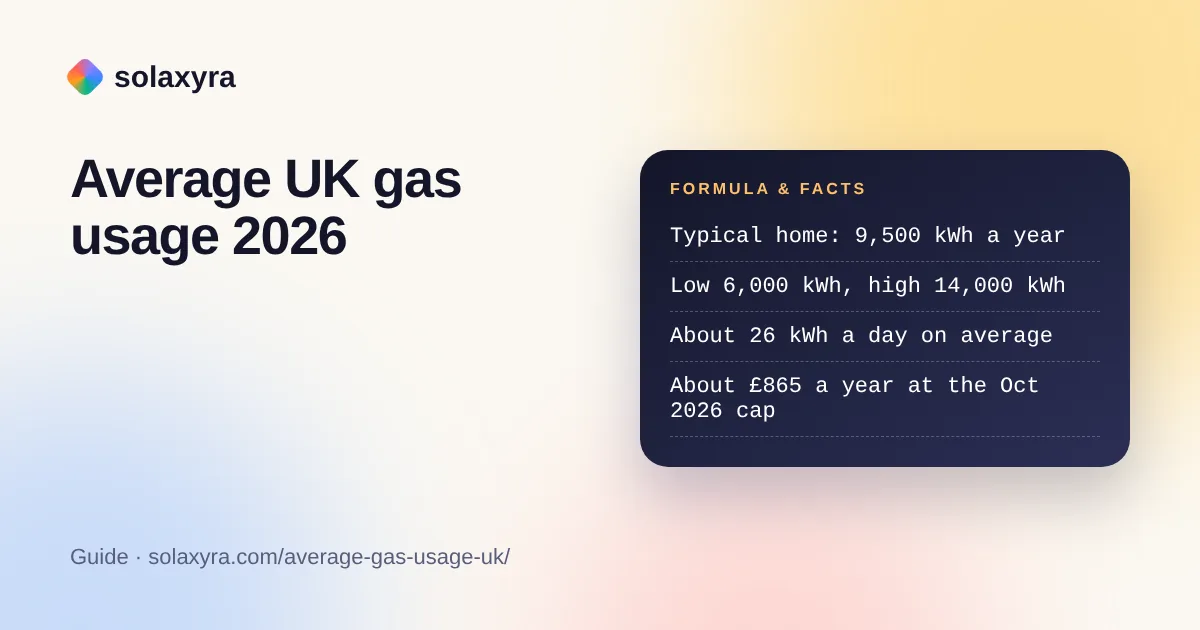
Quick answer: Ofgem’s medium figure for average gas usage UK homes is 9,500 kWh a year from 1 July 2026, about 26 kWh a day. Low users are put at 6,000 kWh and high users at 14,000 kWh. At the October to December 2026 cap, 9,500 kWh costs about £865 a year including the standing charge.
What is the average gas usage UK households have in 2026?
The typical household uses 9,500 kWh of gas a year, according to Ofgem’s typical domestic consumption values (TDCVs) that took effect on 1 July 2026. Ofgem also sets a low value of 6,000 kWh and a high value of 14,000 kWh. These replaced the 2023 values of 7,500, 11,500 and 17,000 kWh, so every band fell by roughly a fifth.
Ofgem’s decision on typical domestic consumption values explains that the medium value represents the median household, built from government meter data, weather adjusted to a normal year and rounded to the nearest 500 kWh. The regulator gives four reasons for the fall: long-term energy efficiency improvements, changes in how energy is used at home, climatic changes and households cutting back because of high prices.
The TDCVs are used to express the price cap as an annual bill for a typical home. They do not change what you pay per kWh. Ofgem says the lower headline “typical bill” reflects revised assumptions about usage rather than a fall in prices, and its decision notes a small knock-on rise in unit rates (about 0.07p per kWh for gas and 0.19p per kWh for electricity).
How much gas does a home use per month and per day?
At the medium average gas usage UK value of 9,500 kWh a year, a home uses about 792 kWh a month and 26 kWh a day on average across the year. In practice, almost all of that is used between October and April, because space heating is the largest gas load in most homes and summer use is mainly hot water and cooking.
That seasonal swing matters when you compare bills. A January bill can be several times higher than a July bill for the same home, so judge your average gas usage UK comparison on a full twelve months, not a single winter quarter.
| Ofgem band (from 1 July 2026) | kWh per year | kWh per month | kWh per day | What it represents |
|---|---|---|---|---|
| Low | 6,000 | 500 | 16.4 | A lower using household |
| Medium (typical) | 9,500 | 792 | 26.0 | The median gas household |
| High | 14,000 | 1,167 | 38.4 | A higher using household |
The monthly and daily columns are simple averages (yearly figure divided by 12 or 365), not actual monthly use, which follows the weather.
How much does the average gas usage UK figure cost at the October 2026 cap?
Using 9,500 kWh a year costs about £865 at the price cap for 1 October to 31 December 2026: £757.15 for the gas itself plus £108.33 in standing charges. Ofgem’s price cap announcement gives an average direct debit unit rate of 7.97p per kWh and a standing charge of 29.68p a day, both including 5% VAT on gas.
| Band | kWh per year | Unit cost at 7.97p | Standing charge (365 days at 29.68p) | Total per year | Per month |
|---|---|---|---|---|---|
| Low | 6,000 | £478.20 | £108.33 | £586.53 | £48.88 |
| Medium | 9,500 | £757.15 | £108.33 | £865.48 | £72.12 |
| High | 14,000 | £1,115.80 | £108.33 | £1,224.13 | £102.01 |
| DESNZ mean per meter (2024) | 11,359 | £905.31 | £108.33 | £1,013.64 | £84.47 |
These are annualised illustrations of the average gas usage UK bands. The cap rate changes every three months and regional rates differ from the average, so use the rates on your own bill for an exact figure. The gas bill calculator works this out for any usage, rate and standing charge.
Why do the official averages disagree: 9,500, 9,859 or 11,359 kWh?
The numbers differ because one is a median and one is a mean. The government’s subnational gas consumption statistics for the 2024 gas year give a mean of 11,359 kWh per domestic meter and a median of 9,859 kWh. Ofgem bases its typical value on the median and rounds it, which gives 9,500 kWh.
The mean is higher because a minority of large or poorly insulated homes use a lot of gas and pull the average up. The median is the middle home: half use less and half use more. For judging your own home, the median is the fairer yardstick, which is why the average gas usage UK benchmark on this page uses Ofgem’s 9,500 kWh.
Two more details help when reading the statistics. First, the government’s gas figures are weather corrected, so a cold winter does not distort the trend. Second, a “gas year” runs from mid May to mid May, so the 2024 figures cover mid May 2024 to mid May 2025. The same report notes that mean domestic gas use per meter is 40.3% lower than in 2005, and that the South West consistently has the lowest mean use, about 12% below the GB average.
How do you work out your own gas usage in kWh?
Take two meter readings, subtract them, and convert the units to kWh with the formula on your bill: cubic metres × 1.02264 × calorific value ÷ 3.6. GOV.UK sets out this method, with all factors fixed by the Gas (Calculation of Thermal Energy) Regulations 1996. Follow these steps:
- Read your gas meter on the same date one year apart, or use the annual usage figure printed on your bill or in your supplier’s app.
- Subtract the earlier reading from the later one to get the units used.
- If your meter shows hundreds of cubic feet (an imperial meter, often labelled ft3), multiply by 2.83 to convert to cubic metres. A metric meter already shows m3.
- Multiply by the volume correction factor 1.02264, which adjusts for temperature and pressure.
- Multiply by the calorific value from your bill in MJ/m3. GOV.UK says it must stay between 38 and 41 MJ/m3; 39.5 is a common example.
- Divide by 3.6 to turn megajoules into kWh.
- Compare the yearly total with the average gas usage UK bands above: 6,000, 9,500 and 14,000 kWh.
Example: a metric meter reads 120 m3 more than a month ago and the bill shows a calorific value of 39.5 MJ/m3. 120 × 1.02264 × 39.5 ÷ 3.6 = 1,346 kWh, which costs about £107 at 7.97p per kWh before the standing charge. For an imperial meter that moved 42 units, 42 × 2.83 = 118.86 m3, which converts to about 1,334 kWh.
The gas meter reading calculator does these steps for you, and the kWh to m3 calculator works backwards: at 39.5 MJ/m3, the typical 9,500 kWh a year is about 847 cubic metres of gas.
What makes a home use more or less gas than average?
Space heating is the biggest driver, so the size of the home, its insulation and how warm you keep it decide most of the difference from the average gas usage UK figure. Other factors are the number of people (more showers and baths), whether the boiler also heats a hot water cylinder, and whether you cook on gas.
- Home size and type: detached homes have more outside wall and roof than flats, so they lose more heat.
- Insulation and glazing: loft, cavity wall and window improvements cut the heat needed. The cavity wall insulation savings calculator estimates one of these.
- Thermostat and hours: a higher setting or longer heating periods raise use; see what temperature to set your thermostat.
- Boiler settings: a condensing boiler runs more efficiently at a lower flow temperature, explained in our guide to boiler flow temperature.
- Occupants and habits: people at home all day heat for longer than a household out at work.
Any work on a gas boiler or gas appliance, including adjusting internal settings beyond the user controls, must be done by a Gas Safe registered engineer.
How does gas compare with switching to a heat pump?
If a heat pump replaced a gas boiler, the heat behind the 9,500 kWh average gas usage UK figure would be supplied by electricity, with the heat pump’s efficiency (its seasonal coefficient of performance) dividing the electricity needed. A boiler turns most of the gas into heat, so you first multiply gas kWh by the boiler efficiency to estimate the heat demand, then divide by the heat pump’s SCOP.
Because electricity costs 26.32p per kWh against 7.97p for gas at the October 2026 cap, the heat pump’s efficiency has to be high for running costs to come out lower. The heat pump running cost calculator lets you enter your own gas use, boiler efficiency, SCOP and tariff, and our heat pump vs gas boiler guide covers the wider decision. To see how your household electricity compares too, use the energy consumption calculator.
Frequently Asked Questions
What is the average gas usage for a 3-bedroom house in the UK?
Ofgem does not publish a figure by bedroom count. Its medium value of 9,500 kWh a year represents the median gas household, which many guides link to a three-bedroom home. A well insulated three-bedroom house can use far less, and a draughty one far more.
Is 12,000 kWh of gas a year high?
It is above Ofgem’s typical value of 9,500 kWh but below its high value of 14,000 kWh. It is close to the government’s 2024 mean of 11,359 kWh per meter, which is pulled up by large and poorly insulated homes. At 7.97p per kWh it costs about £956 before standing charges.
How many kWh of gas per day is normal?
The typical 9,500 kWh a year averages about 26 kWh a day. Real daily use is far from even: on a cold winter day a gas heated home may use several times that, while on a summer day it may use only a few kWh for hot water and cooking.
Why did Ofgem lower the typical gas figure in 2026?
Ofgem’s May 2026 decision cut the medium gas value from 11,500 to 9,500 kWh from 1 July 2026. It points to better energy efficiency, changes in how homes use energy, climatic changes and households reducing use because of high prices. Ofgem notes it nudged unit rates up slightly (about 0.07p per kWh for gas).
How do I convert my gas meter reading to kWh?
Subtract the old reading from the new one. For an imperial meter multiply by 2.83 first. Then multiply by 1.02264, multiply by the calorific value on your bill and divide by 3.6. For example, 100 m3 at 39.5 MJ/m3 is about 1,122 kWh.
Checked October 2026 by the Solaxyra Editorial Team. Sources: Ofgem: typical domestic consumption values decision, Ofgem: energy price cap 1 October to 31 December 2026, DESNZ: subnational gas consumption 2024, GOV.UK: gas meter readings and bill calculation.