This guide explains what an RCD is, how it protects you from electric shock, how it differs from an MCB and an RCBO, when it should be tested and what to do if one keeps tripping. RCDs are among the most important safety devices in a modern UK consumer unit.
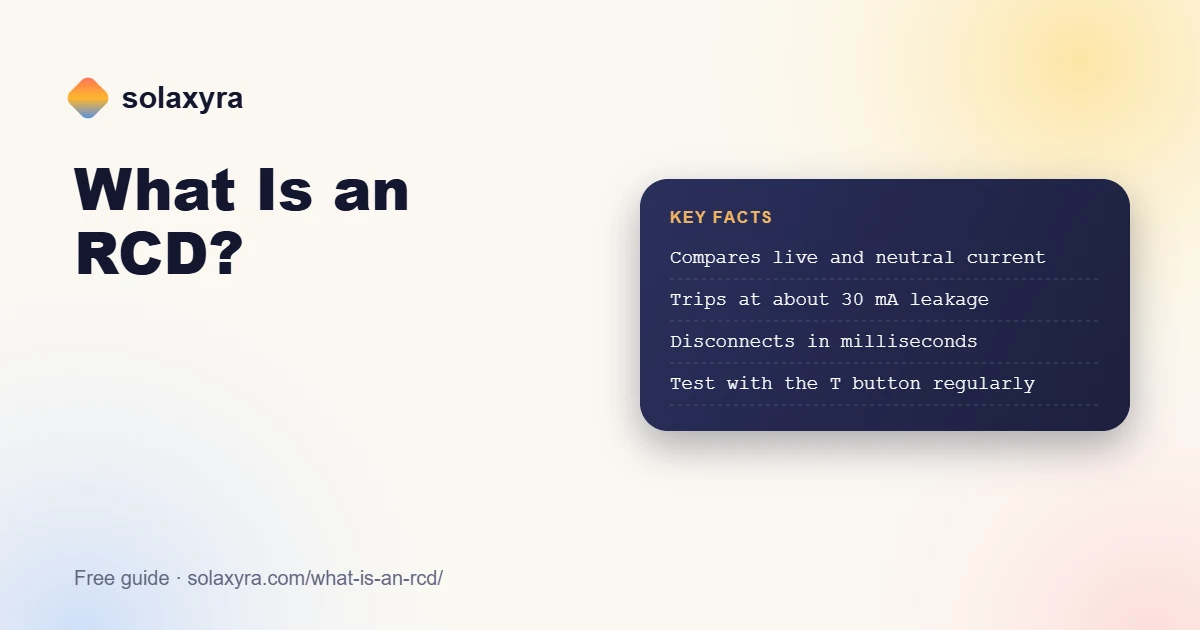
Quick answer: An RCD, or residual current device, compares the current flowing out on the live conductor with the current returning on the neutral. If they differ by more than a set amount, typically 30 mA for personal protection, current is leaking somewhere, possibly through a person, and the RCD switches off the circuit in a fraction of a second.
How does an RCD work?
In a healthy circuit, the current going out on the live wire equals the current coming back on the neutral. An RCD continuously measures both. If some current finds another path to earth, for example through damaged insulation, water or a person touching a live part, the two no longer match. When the difference reaches the RCD’s rating, it trips.
A 30 mA RCD is designed to disconnect quickly enough to greatly reduce the risk of a fatal shock. It does not prevent you from feeling a shock.
RCD, MCB or RCBO?
| Device | Protects against | Where you see it |
|---|---|---|
| MCB (miniature circuit breaker) | Overload and short circuit | One per circuit |
| RCD | Earth leakage and electric shock | Protects a group of circuits |
| RCBO | Both, in one device | One per circuit |
With RCBOs, a fault on one circuit only switches off that circuit, rather than half the house.
Where are RCDs required?
BS 7671, the UK wiring regulations, requires 30 mA RCD protection for most socket outlets rated up to 32 A, for circuits supplying mobile equipment outdoors, for cables buried in walls at certain depths, and for circuits in bathrooms, among other cases. Older consumer units may not have RCDs; an electrician can advise on an upgrade.
How often should you test an RCD?
Press the test button marked T regularly, as recommended by the manufacturer, often every three to six months. The RCD should trip immediately. Switch it back on afterwards. If it does not trip, ask an electrician to check it. Professional testing with an instrument is part of an Electrical Installation Condition Report.
Why does my RCD keep tripping?
- A faulty appliance, often a kettle, washing machine, immersion heater or outdoor equipment.
- Water getting into an outdoor socket, light or junction box.
- Damaged cables, for example from a nail or screw.
- Many appliances on one RCD adding up small leakage currents.
To find the cause, unplug everything, reset the RCD, then plug appliances back in one at a time. If it trips with nothing plugged in, the fault is in the fixed wiring and needs an electrician.
Frequently Asked Questions
What does an RCD do?
It switches off the power when it detects current leaking to earth, protecting against electric shock and fire.
What is the difference between an RCD and a fuse?
A fuse or MCB protects against overload; an RCD protects against earth leakage.
What does 30 mA mean on an RCD?
It is the leakage current at which the RCD is designed to trip.
Should I reset an RCD that keeps tripping?
Not repeatedly; find the faulty appliance or call an electrician.
Checked November 2026 by the Solaxyra Editorial Team. Sources: Electrical Safety First, IET: BS 7671 Requirements for Electrical Installations.