This guide explains what a kWh is, how it differs from a kW, how to work out the kWh any appliance uses, and what a kWh costs under the October to December 2026 price cap. It uses everyday examples so the numbers on your bill make sense.
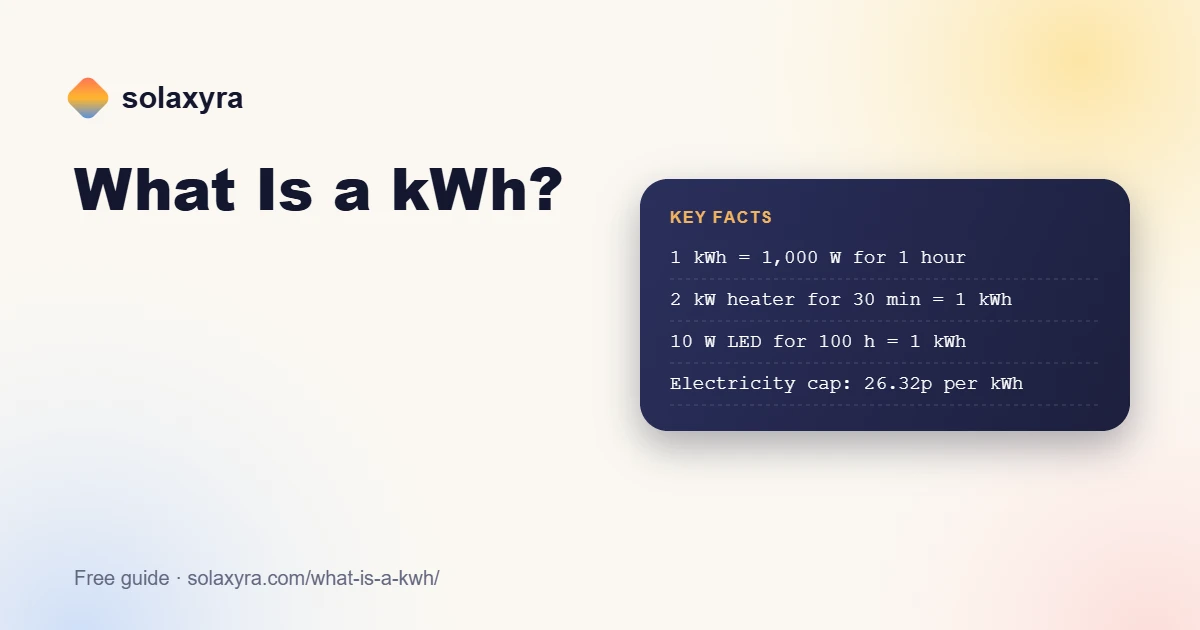
Quick answer: A kWh, or kilowatt-hour, is the energy used by something drawing 1,000 watts for one hour. A 2 kW heater on for 30 minutes uses 1 kWh, and so does a 10 W LED bulb left on for 100 hours. At the October to December 2026 cap, a kWh of electricity costs 26.32p and a kWh of gas 7.97p.
What does kWh mean?
kWh stands for kilowatt-hour. It is a unit of energy: the amount used when a power of one kilowatt runs for one hour. Your electricity and gas bills charge you per kWh, which is why the unit appears on every bill, smart meter display and appliance label.
What is the difference between kW and kWh?
A kW measures power, how fast energy is being used at a moment. A kWh measures energy, how much has been used over time. A useful comparison is speed and distance: kW is like miles per hour, and kWh is like miles travelled.
- A 3 kW kettle draws power quickly but only for a few minutes.
- A 100 W fridge draws much less power but runs all day.
How do you work out kWh?
Multiply the power in kilowatts by the hours of use. Watts are converted to kilowatts by dividing by 1,000.
- Find the wattage on the appliance label, for example 1,500 W.
- Divide by 1,000 to get 1.5 kW.
- Multiply by the hours used, for example 2 hours: 1.5 × 2 = 3 kWh.
- Multiply by your unit rate to get the cost: 3 × 26.32p = 78.96p.
Appliances with thermostats, such as heaters and ovens, switch on and off, so they often use less than the label suggests.
How much does 1 kWh cost in the UK?
Under the Ofgem price cap from 1 October to 31 December 2026, the GB average direct debit rates are 26.32p per kWh for electricity and 7.97p per kWh for gas. You also pay a daily standing charge of 54.83p for electricity and 29.68p for gas, whatever you use.
What uses 1 kWh?
Each of these uses roughly 1 kWh at typical power levels:
| Appliance | Power | Time for 1 kWh | Cost at 26.32p |
|---|---|---|---|
| Electric heater | 2,000 W | 30 minutes | 26.32p |
| Kettle | 3,000 W | 20 minutes of boiling | 26.32p |
| Washing machine | varies | about one cycle at 40°C | about 26p |
| Television | 100 W | 10 hours | 26.32p |
| LED bulb | 10 W | 100 hours | 26.32p |
| Wi-Fi router | 10 W | about 4 days | 26.32p |
How many kWh does a home use?
Ofgem’s typical domestic consumption values, updated from 1 July 2026, put medium electricity use at 2,500 kWh a year, about 6.8 kWh a day. Our guide to average electricity usage in the UK covers the low, medium and high bands in detail.
kWh for gas
Gas meters measure volume in cubic metres or cubic feet, and suppliers convert it to kWh using a calorific value and a correction factor. That is why a gas bill shows both units and kWh. Our gas meter reading calculator does the conversion.
Frequently Asked Questions
What is 1 kWh in simple terms?
The energy used by a 1,000 W appliance running for one hour.
Is kWh the same as a unit of electricity?
Yes. When suppliers talk about a unit, they mean one kWh.
How many watts is 1 kWh?
It is not a number of watts; it is 1,000 watts used for one hour, or any combination that multiplies to the same energy.
How do I lower the kWh I use?
Reduce heating and hot water first, as they use the most energy, then look at appliances that run for long periods.
Checked November 2026 by the Solaxyra Editorial Team. Sources: Ofgem: Energy price cap, 1 October to 31 December 2026, Ofgem: Energy price cap explained.