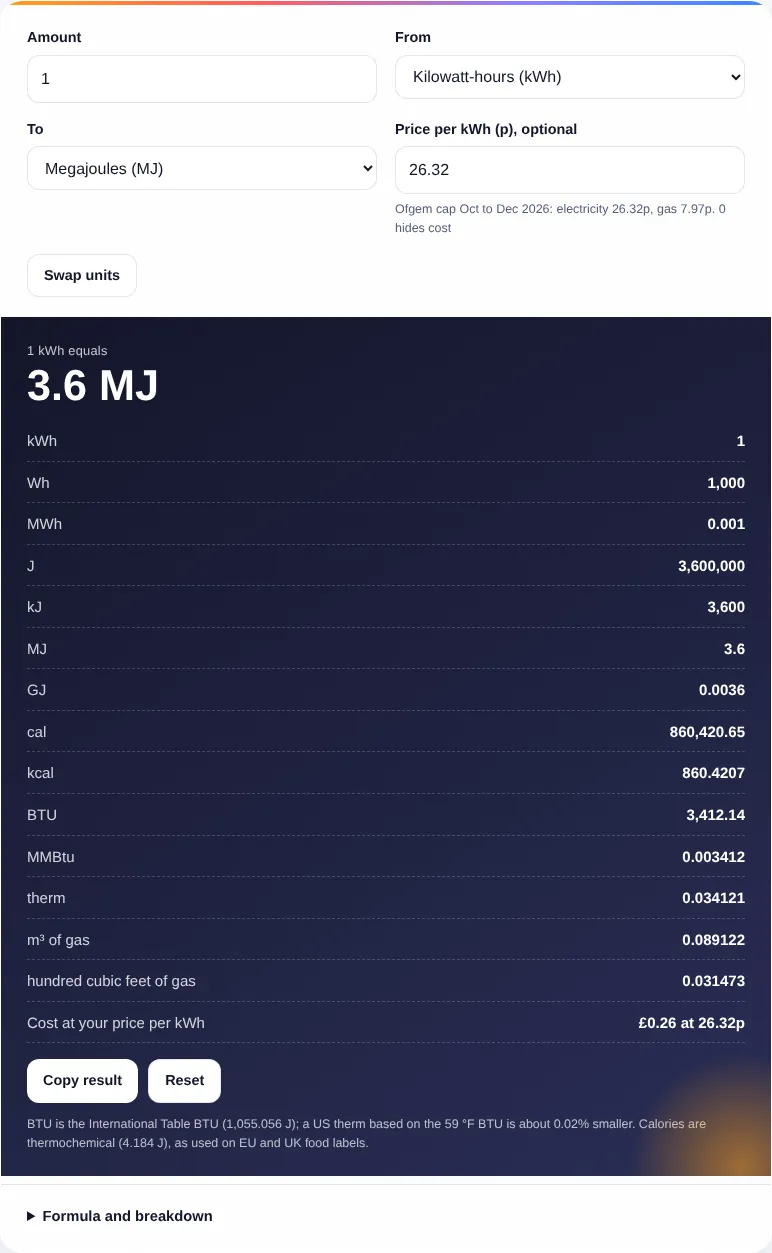
BTU is the International Table BTU (1,055.056 J); a US therm based on the 59 °F BTU is about 0.02% smaller. Calories are thermochemical (4.184 J), as used on EU and UK food labels.
Formula and breakdown
n/a
n/a
This energy unit converter changes amounts of energy between kilowatt-hours, joules, megajoules, British thermal units, therms and calories, and turns gas meter volumes into kWh, for households, students and engineers in the UK, Europe and elsewhere. It shows every unit at once, the cost of the energy at a price you choose, and the arithmetic behind each answer.
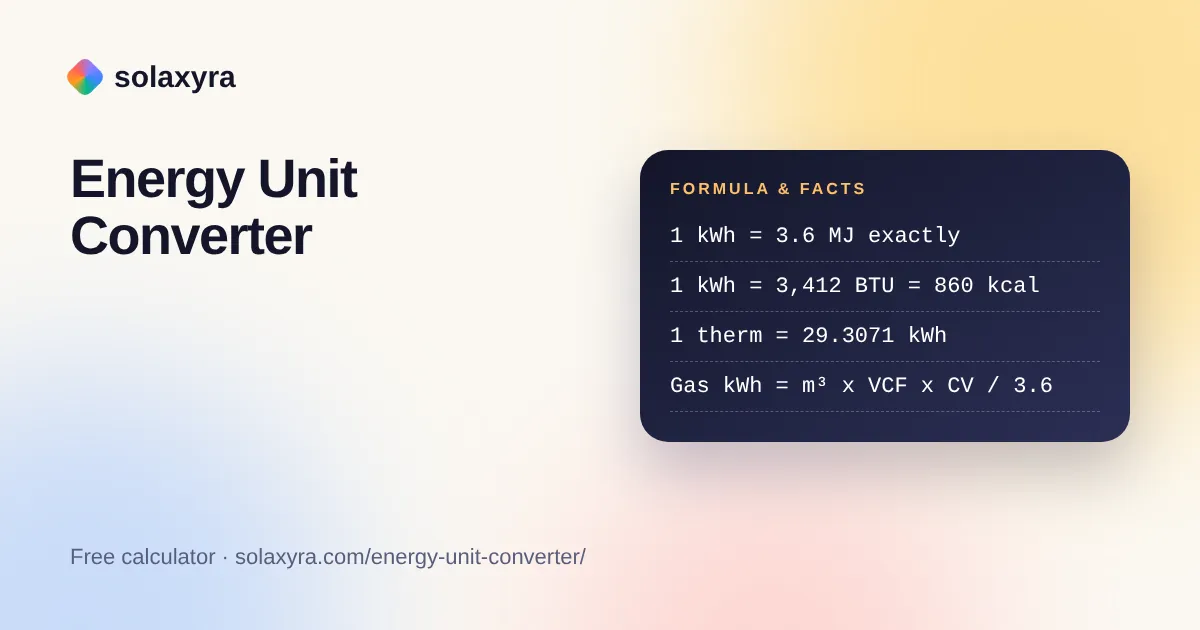
Quick answer: An energy unit converter changes an amount of energy from one unit to another by passing it through joules. One kWh is exactly 3.6 MJ, about 3,412 BTU, 860 kcal or 0.0341 therms. A therm is 29.3071 kWh, and gas meter volumes become kWh using the calorific value on your bill.
What Is an Energy Unit Converter?
An energy unit converter is a tool that expresses the same quantity of energy in a different unit, such as kWh in megajoules or therms in kWh. In plain words: multiply the amount by the number of joules in one of the starting unit, then divide by the number of joules in one of the target unit. Joules are the SI unit of energy, so every other unit is defined as a fixed number of them.
Energy should not be confused with power. A kilowatt is a rate, while a kilowatt-hour is an amount: a 1 kW heater running for one hour uses 1 kWh. To get from power and time to energy, use the watts to kWh calculator first, then convert the result here.
How Do You Use the Energy Unit Converter?
- Enter the amount you want to convert.
- Pick the unit you are converting from and the unit you want.
- For gas meter volumes, enter the calorific value and volume correction factor printed on your gas bill.
- Optionally enter a price per kWh to see what that energy costs.
- Read the main answer, scan the list for every other unit, and use “Swap units” to reverse the conversion.
How Many MJ, BTU and Therms Are in a kWh?
One kWh is exactly 3.6 MJ, about 3,412 BTU and about 0.0341 therms. The 3.6 comes from 1,000 joules a second for 3,600 seconds. The table lists the common energy units against the three that turn up most often in heating, fuel and electricity data.
| One unit of | kWh | MJ | BTU |
|---|---|---|---|
| kWh | 1 | 3.6 | 3,412.14 |
| MJ | 0.2778 | 1 | 947.82 |
| GJ | 277.78 | 1,000 | 947,817 |
| Therm (100,000 BTU) | 29.3071 | 105.506 | 100,000 |
| MMBtu (one million BTU) | 293.071 | 1,055.06 | 1,000,000 |
| BTU | 0.000293 | 0.001055 | 1 |
| kcal (food Calorie) | 0.001162 | 0.004184 | 3.966 |
| m³ of natural gas, example 39.5 MJ per m³ and 1.02264 correction | 11.22 | 40.39 | 38,286 |
The last row depends on the gas itself, so it changes slightly from bill to bill. All other rows are fixed definitions.
Which BTU and Which Calorie Does the Converter Use?
The energy unit converter uses the International Table BTU of 1,055.05585262 joules and the thermochemical calorie of exactly 4.184 joules. The Wikipedia article on the British thermal unit lists other versions, including a thermochemical BTU of about 1,054.35 J and the 59 °F BTU of about 1,054.80 J that defines the US therm. The differences are below 0.1%, so they only matter for contracts and laboratory work.
Calories have the same issue: the International Steam Table calorie is 4.1868 J. The Calorie with a capital C on food labels is a kilocalorie of 4,184 J, and EU and UK labels show it alongside kilojoules.
How Do You Convert a Gas Meter Reading to kWh?
Multiply the volume in cubic metres by the volume correction factor and the calorific value in MJ per m³, then divide by 3.6. The correction factor adjusts the measured volume to standard temperature and pressure, and the calorific value is the energy content of the gas delivered to your area. Both are printed on UK gas bills; copy them from yours instead of relying on the example defaults.
Older imperial meters count hundreds of cubic feet. One hundred cubic feet is 2.8317 m³, so multiply by 2.8317 before using the same formula. To turn the kWh into a bill, enter your price: the Ofgem price cap for October to December 2026 is 7.97p per kWh for gas, including 5% VAT, and 26.32p per kWh for electricity, on which VAT is currently 0% in Great Britain. Standing charges are extra.
Why Are UK Energy Bills in kWh Instead of Therms?
UK regulations replaced therms with joule-based units from 1999, so suppliers now bill gas as well as electricity in kilowatt-hours, according to the Wikipedia article on the therm. That makes gas and electricity prices directly comparable per kWh, which is what you need when you compare a boiler with a heat pump. The heat pump running cost calculator uses exactly that comparison.
Therms and MMBtu are still used in the United States and in wholesale gas trading, so you will meet them in market reports, imported appliance manuals and older documents.
Worked Example: A Quarter’s Gas Use in Every Unit
Example: a home’s gas meter moves by 150 m³ over a quarter, and the bill shows a calorific value of 39.5 MJ per m³ and a volume correction factor of 1.02264.
- Energy per m³: 1.02264 x 39.5 = 40.394 MJ.
- Total: 150 x 40.394 = 6,059 MJ, which is 6,059.1 / 3.6 = 1,683.1 kWh.
- In therms: 1,683.1 / 29.3071 = 57.43 therms.
- Cost of the gas at 7.97p per kWh: 1,683.1 x 7.97p = £134.14, before standing charges.
As a cross-check in everyday terms, one kWh is about 860 kcal, so that quarter’s gas holds roughly the same energy as 1.45 million food Calories.
Frequently Asked Questions
How many MJ are in a kWh?
One kilowatt-hour is exactly 3.6 megajoules. A kilowatt is 1,000 joules every second and an hour has 3,600 seconds, so 1,000 x 3,600 gives 3.6 million joules. Going the other way, 1 MJ is 0.2778 kWh.
How do I convert therms to kWh?
Multiply therms by 29.3071. A therm is 100,000 British thermal units, and with the International Table BTU of 1,055.056 joules that is 105.5 MJ, or 29.3071 kWh. So 100 therms are about 2,931 kWh, and 1 kWh is about 0.0341 therms.
How many BTU are in a kWh?
One kWh is about 3,412 BTU using the International Table BTU of 1,055.056 joules. Other BTU definitions differ by less than 0.1%, so 3,412 is accurate enough for heating and cooling. For power, 1 kW equals about 3,412 BTU per hour.
How do you convert gas m³ to kWh?
Multiply the cubic metres by the volume correction factor and the calorific value in MJ per m³, then divide by 3.6. Your gas bill prints both figures. If your meter reads in hundreds of cubic feet, first multiply by 2.83 to get cubic metres.
Is a food Calorie the same as a kilocalorie?
Yes. The Calorie on food labels is a kilocalorie, 4,184 joules, which is 4.184 kJ. EU and UK labels show energy in both kJ and kcal. One kWh is about 860 kcal, so household energy units are much larger than the energy in a meal.
Why do UK energy bills use kWh instead of therms?
UK regulations replaced therms with joule-based units from 1999, and suppliers now bill both gas and electricity in kilowatt-hours. Using one unit makes gas and electricity prices directly comparable. Therms are still common in the United States and in older documents.
Checked October 2026 by the Solaxyra Editorial Team. Sources: Wikipedia, British thermal unit, Wikipedia, Therm, Wikipedia, Calorie, Ofgem price cap, October to December 2026.