The 365-day figure repeats this period’s daily use; winter periods overstate a year and summer periods understate it.
Formula and breakdown
n/a
n/a
n/a
This gas meter reading calculator turns two readings from a metric or imperial gas meter into units used, kWh and the cost for the period, including the standing charge and VAT, for households in England, Scotland and Wales. It also works out your average use per day, scales it to a year, handles a meter that has passed zero, and checks an estimated reading on your bill against the real one so you can see whether you have been over or under charged.
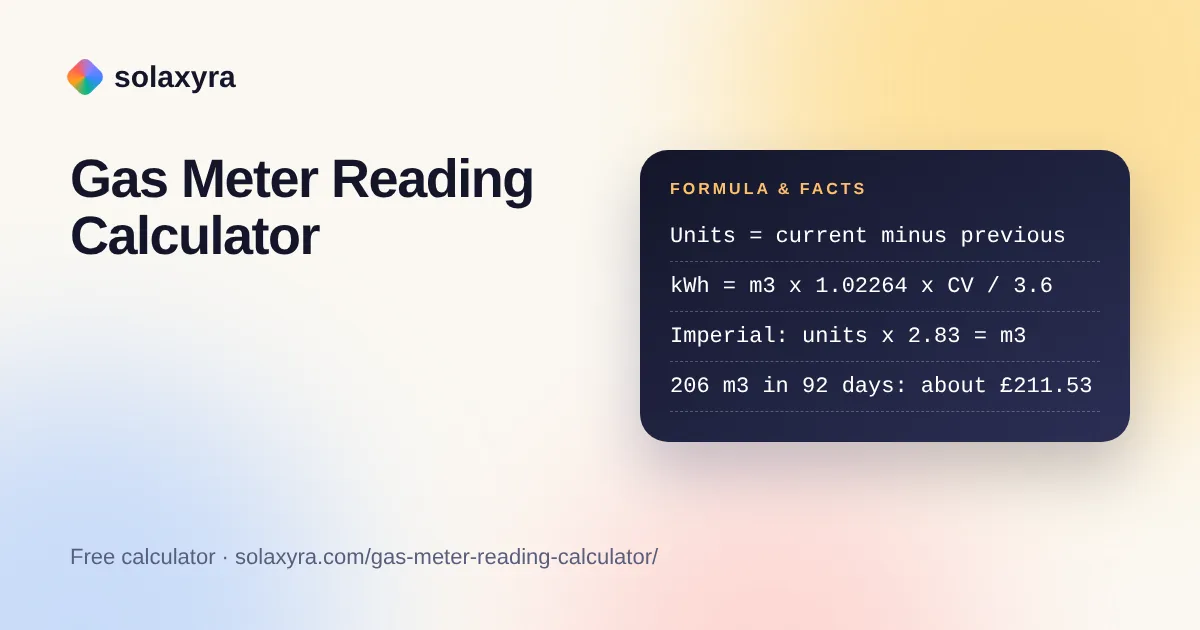
Quick answer: A gas meter reading calculator subtracts the previous reading from the current one, converts the units to kWh (m3 x 1.02264 x calorific value / 3.6, with imperial units first multiplied by 2.83) and prices them. Example: 206 m3 over 92 days is about 2,311 kWh, or £211.53 at the October 2026 cap.
What Is a Gas Meter Reading Calculator?
A gas meter reading calculator is a tool that converts the change in your meter between two dates into energy and money. In plain words: units used equal the current reading minus the previous reading; cubic metres equal units for a metric meter, or units times 2.83 for an imperial meter; kWh equal cubic metres times 1.02264 times the calorific value, divided by 3.6; and the cost equals kWh times the unit rate plus days times the daily standing charge.
This is the method set out in the GOV.UK guide to gas meter readings and bill calculation. Meters measure volume, but suppliers charge for energy, so the calorific value on your bill (the energy in each cubic metre) and the 1.02264 correction for temperature and pressure turn volume into kWh.
How Do You Use the Gas Meter Reading Calculator?
- Choose metric if the meter shows m3 or cubic metres, or imperial if it shows ft3 or cubic feet.
- Enter the previous reading from your last bill or your own record, and the reading on the meter today, using the black digits only.
- Enter the dates of both readings so the standing charge and daily average are worked out for the right number of days.
- Copy the calorific value, unit rate and standing charge from your bill, and say whether those prices include VAT.
- If your bill used an estimated reading, enter it to see how far the estimate was from the real figure.
How Do You Read a Gas Meter Correctly?
Read the digits from left to right and write down only the black digits, ignoring any red digits and anything after a decimal point. GOV.UK guidance says to ignore digits shown in red and to include any leading zeros when you give the reading to your supplier. In its examples, a metric meter shows five black digits and an imperial meter four.
- Metric meters measure in cubic metres and are usually marked m3 or cubic metres.
- Imperial meters measure in hundreds of cubic feet and are usually marked ft3 or cubic feet.
- Smart meters show the reading on their display; check with your supplier which screen shows the cumulative volume.
- Take both readings at a similar time of day if you want an accurate daily average.
The gas meter reading calculator treats a current reading lower than the previous one as a meter that has rolled past zero, such as 9,950 to 0,048 on a four-digit imperial meter, which is 98 units. Check the readings before relying on that result.
How Much Gas Is One Unit on My Meter?
One metric unit is one cubic metre, about 11.2 kWh; one imperial unit is 100 cubic feet, or 2.83 cubic metres, about 31.8 kWh. The table uses the GOV.UK example calorific value of 39.5 MJ/m3 and the Ofgem cap gas unit rate for 1 October to 31 December 2026 of 7.97p per kWh, which includes VAT at 5%.
| Meter type | One unit is | kWh per unit | Cost per unit at 7.97p | 100 units in kWh | 100 units cost |
|---|---|---|---|---|---|
| Metric (m3) | 1 cubic metre | 11.22 | 89.4p | 1,122 kWh | £89.43 |
| Imperial (ft3) | 100 cubic feet = 2.83 m3 | 31.75 | £2.53 | 3,175 kWh | £253.08 |
Choosing the wrong meter type is the most expensive mistake: the same 100 units cost nearly three times more on an imperial meter. If your figure looks far too high or low, check the meter type first. The kWh to m3 calculator converts single amounts both ways.
How Do I Check an Estimated Gas Bill?
Take an actual reading, enter the estimated reading from the bill alongside it, and the gas meter reading calculator shows the difference in units, kWh and pounds. With the example readings, a bill estimated at 4,800 when the meter really reads 4,718 has charged for 82 m3 too many, about 920 kWh or £73.33 of energy. Give the supplier the actual reading so the next bill corrects the estimate; an under-estimate means a catch-up charge later.
What Standing Charge and VAT Apply to Gas?
Under the Ofgem price cap for 1 October to 31 December 2026, the average direct debit gas standing charge is 29.68p per day and the unit rate is 7.97p per kWh, both including VAT at 5%. Ofgem notes that VAT has been removed from electricity bills from 1 October 2026 to 31 March 2027, but gas still carries 5%. If your tariff lists prices without VAT, choose the option to add 5%; the gas meter reading calculator then shows the VAT separately.
Worked Example: A Summer Quarter on a Metric Meter
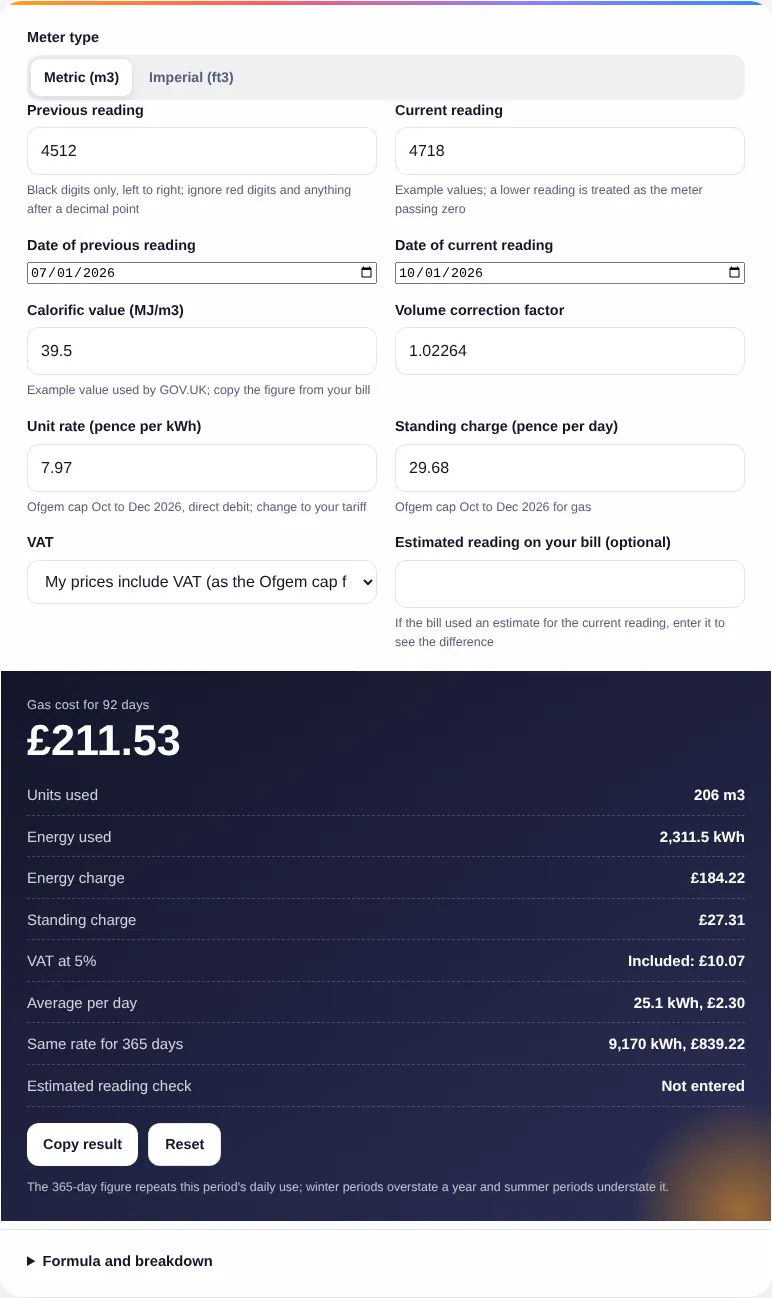
Example: a household reads its metric meter as 4,512 on 1 July 2026 and 4,718 on 1 October 2026, a period of 92 days. The bill shows a calorific value of 39.5 MJ/m3, and prices are the October 2026 cap including VAT. The gas meter reading calculator works through it as follows.
- Units used: 4,718 minus 4,512 = 206 m3.
- Energy: 206 x 1.02264 x 39.5 / 3.6 = 2,311.5 kWh.
- Energy charge: 2,311.5 x 7.97p = £184.22.
- Standing charge: 92 x 29.68p = £27.31, making £211.53, of which £10.07 is VAT.
- Daily average: 25.1 kWh, about £2.30 a day; repeated for 365 days that is 9,170 kWh and £839.22.
Summer readings understate a full year because heating use is low, so treat the 365-day figure as a floor in July and a ceiling in January. To see which appliances drive the rest of your energy use, try the energy consumption calculator, and to compare gas heating with a heat pump, use the heat pump running cost calculator. If you smell gas, the HSE domestic gas safety FAQs advise calling 0800 111 999 and opening doors and windows; only a Gas Safe registered engineer may work on gas appliances.
Frequently Asked Questions
How do I calculate gas usage from meter readings?
Subtract the previous reading from the current one to get units used. For a metric meter that is cubic metres; for an imperial meter multiply by 2.83. Then multiply by 1.02264 and the calorific value on your bill, and divide by 3.6 to get kWh.
Which numbers do I read on a gas meter?
Read the black digits from left to right and ignore any red digits or numbers after a decimal point. Keep leading zeros when you submit the reading. In GOV.UK’s examples a metric meter shows five black digits and an imperial meter shows four.
How do I know if my gas meter is metric or imperial?
Look for the unit printed on the meter. Metric meters usually show m3 or cubic metres, while imperial meters show ft3 or cubic feet. The difference matters, because one imperial unit holds 2.83 times as much gas as one metric unit.
What happens when my gas meter goes back to zero?
When a meter passes its highest number it starts again from zero, so the new reading is lower than the old one. Add 100,000 for a five-digit meter or 10,000 for a four-digit meter to the new reading before subtracting. The calculator does this automatically and flags it.
Does the calculator include the standing charge and VAT?
Yes. It multiplies the number of days between the readings by your daily standing charge and adds it to the energy charge. Ofgem cap prices already include 5% VAT on gas; if your tariff shows prices without VAT, choose the add 5% option.
How much gas does a home use per day?
It varies widely with season, house and heating. In the summer example on this page a household used 25.1 kWh a day. Enter readings taken a week or a month apart in winter and summer to see your own range, and use the 365-day figure with care.
Checked October 2026 by the Solaxyra Editorial Team. Sources: GOV.UK, Gas meter readings and bill calculation, Ofgem, energy price cap October to December 2026, HSE, Domestic gas safety FAQs, Wikipedia, Cubic foot.