This guide explains what a solar inverter does, the main types used in UK homes, how inverters are sized against the panels, and what to expect for lifespan and replacement. The inverter is the part of a solar system that does the most work.
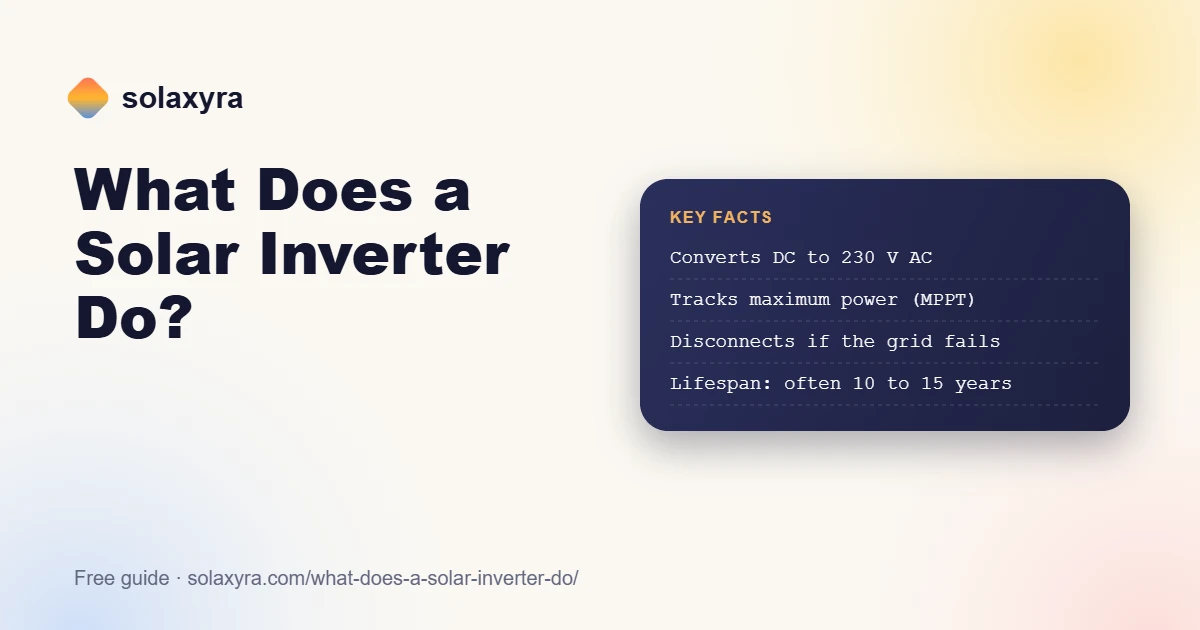
Quick answer: A solar inverter converts the direct current (DC) made by solar panels into the 230 V alternating current (AC) your home and the grid use. It also tracks the best operating point of the panels and shuts down safely if the grid fails. Most homes use a string inverter or a hybrid inverter that can also run a battery.
The inverter’s main jobs
- Conversion. Panels produce DC at a voltage that varies with light and temperature. The inverter turns it into AC at the grid’s voltage and frequency.
- Maximum power point tracking. It constantly adjusts the operating voltage to get the most power from the panels.
- Safety. If the grid goes down, it disconnects so it does not send power into lines that engineers may be working on.
- Monitoring. Most inverters report generation to an app so you can spot problems.
Types of inverter
| Type | How it works | Best for |
|---|---|---|
| String inverter | One central unit for one or more strings of panels | Simple, unshaded roofs |
| Hybrid inverter | String inverter with a built-in battery charger | Systems with a battery now or later |
| Microinverters | A small inverter on each panel | Shaded or complex roofs |
| String inverter with optimisers | Optimisers on each panel feed a central inverter | Partial shade, panel-level monitoring |
How is an inverter sized?
Inverters are usually sized close to the panel array’s kWp, often slightly smaller, because panels rarely produce their full rating in UK conditions. A DC to AC ratio of around 1.1 to 1.3 is common. In Great Britain, inverters of up to 3.68 kW per phase can usually be connected under G98 notification; larger ones need G99 approval from the network operator.
How efficient are inverters?
Modern inverters typically convert around 96 to 98% of DC power to AC at their peak, with a slightly lower weighted efficiency across real conditions. Our inverter efficiency calculator shows what the losses mean in kWh.
How long does a solar inverter last?
Many string inverters last around 10 to 15 years, often with a 5 to 10 year warranty, sometimes extendable. Panels typically last 25 years or more, so most systems need one inverter replacement during their life. Microinverters often come with longer warranties.
Signs of an inverter problem
- No generation on a sunny day in your app.
- A red light or fault code on the unit.
- Frequent shut-downs, which can be caused by high grid voltage.
Frequently Asked Questions
Do I need an inverter for solar panels?
Yes, to use the power in your home or export it, unless you only run DC loads off-grid.
What size inverter do I need for 4 kW of panels?
Often a 3.6 to 4 kW inverter, depending on the design and connection rules.
What is a hybrid inverter?
An inverter that handles both solar panels and a battery.
How much does it cost to replace a solar inverter?
Often around £800 to £1,500 fitted for a typical home string inverter.
Checked November 2026 by the Solaxyra Editorial Team. Sources: Energy Saving Trust: Solar panels, Energy Networks Association: Connecting to the network (G98/G99).