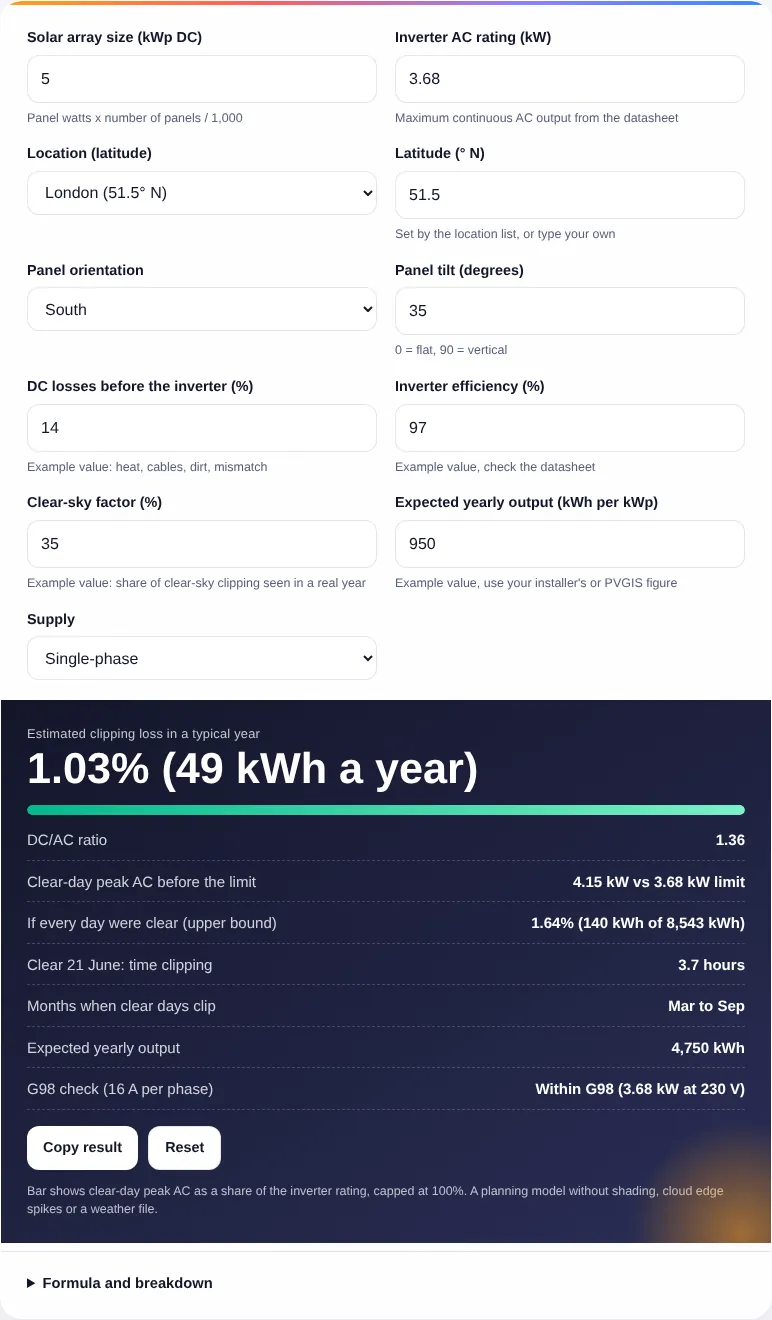
Bar shows clear-day peak AC as a share of the inverter rating, capped at 100%. A planning model without shading, cloud edge spikes or a weather file.
Formula and breakdown
n/a
n/a
n/a
n/a
This inverter clipping calculator estimates how much solar energy is lost each year when a PV array produces more DC power than the inverter can convert, for homeowners, installers and designers in the UK and Europe choosing between a larger array and a larger inverter. It models the sun hour by hour for your latitude, tilt and orientation, shows the DC/AC ratio, and checks the inverter size against the UK G98 threshold.
Quick answer: An inverter clipping calculator compares the array's peak AC output with the inverter rating across the year. With 14% losses, a south-facing UK array only clips above a DC/AC ratio of about 1.2. A 5 kWp array on a 3.68 kW inverter in London loses about 1% of its yearly output.

What Is an Inverter Clipping Calculator?
An inverter clipping calculator is a tool that estimates the energy a solar inverter cannot pass on because the panels' DC output, after losses, is above the inverter's maximum AC rating. In plain words: at every moment, AC output equals the smaller of panel power times inverter efficiency and the inverter limit, and clipping is the part above that limit, added up over the year.
The key number is the DC/AC ratio, also called the inverter loading ratio: array size in kWp divided by inverter AC rating in kW. A 5 kWp array on a 3.68 kW inverter has a ratio of 1.36. Panels are rated at 1,000 W/m², but after heat, cable and other losses a UK array rarely delivers its full rating, so a ratio above 1 is normal and often clips very little.
How Do You Use the Inverter Clipping Calculator?
- Enter the array size in kWp and the inverter's maximum AC output in kW from its datasheet.
- Pick the nearest location, or type a latitude between 35 and 66° N.
- Choose the panel orientation and tilt. Use the east-west split for arrays with half the panels on each roof face feeding one inverter.
- Check the DC losses and inverter efficiency. Both are example values; your installer's design report may give better ones.
- Leave the clear-sky factor at the example 35% unless you have a better figure, and enter the expected yearly output per kWp for your site.
- Read the typical-year loss, the clear-sky upper bound and the G98 check, then open the breakdown to see each formula.
How Does the Calculator Model Clipping?
It steps through every five minutes of a year, works out the sun's position, estimates clear-sky sunlight on the tilted panels, and adds up any power above the inverter limit. That gives a clear-sky clipping figure, which is the most an array could lose if every day were cloudless.
Sun height comes from the latitude, the hour angle and a declination approximation that uses the Earth's 23.44° tilt, as described on Wikipedia's position of the Sun page. Clear-sky beam strength uses the empirical formula 1,353 x 0.7^(AM^0.678) W/m², where AM is the air mass, with diffuse sky light taken as 10% of the beam. That formula reproduces the intensity table in Wikipedia's air mass (solar energy) article, for example 1,040 W/m² with the sun overhead and 930 W/m² at air mass 1.5.
Real years have cloud, so the inverter clipping calculator multiplies the clear-sky clipping by a clear-sky factor. Its 35% example comes from matching this model to an hourly PVGIS typical year for 45° N, explained below.
At What DC/AC Ratio Does Clipping Start?
With 14% DC losses and a 97% efficient inverter, a south-facing array at 35° tilt peaks at about 0.83 kW of AC per kWp on a clear UK summer day, so clipping starts just above a DC/AC ratio of 1.2. The table shows the inverter clipping calculator's clear-sky upper bound for three latitudes.
| DC/AC ratio | London 51.5° N | Edinburgh 55.9° N | Madrid 40.4° N |
|---|---|---|---|
| 1.2 | 0.00% | 0.00% | 0.00% |
| 1.25 | 0.21% | 0.12% | 0.23% |
| 1.3 | 0.74% | 0.56% | 0.88% |
| 1.4 | 2.40% | 2.06% | 2.80% |
| 1.5 | 4.49% | 4.02% | 5.19% |
| 1.6 | 6.81% | 6.24% | 7.82% |
| 1.8 | 11.69% | 10.96% | 13.47% |
These are clear-sky figures from the model, south facing, 35° tilt, 14% losses, 97% inverter efficiency. A real year loses much less, because most hours are cloudier than this. Lower losses, cold sunny spring days and bright cloud edges can push short peaks higher than the model shows.
How Much Clipping Happens in a Real Year?
In real weather, clipping is usually about a third to a half of the clear-sky figure. Run on a PVGIS typical meteorological year for 45° N 8° E in northern Italy, hourly data with the same 14% losses gave the losses below.
| DC/AC ratio | South, 35° tilt | East, 35° tilt | West, 35° tilt |
|---|---|---|---|
| 1.3 | 0.41% | 0.01% | 0.03% |
| 1.4 | 1.49% | 0.26% | 0.41% |
| 1.5 | 3.10% | 0.95% | 1.22% |
| 1.6 | 5.09% | 1.95% | 2.33% |
| 1.7 | 7.26% | 3.18% | 3.66% |
For the south-facing array, the hourly data loses 34% to 53% of what this model predicts under clear skies, rising with the ratio. That is where the 35% example factor comes from. Hourly averages smooth out short peaks, so true losses can be a little higher. Cloudier UK sites will often sit lower. A UK hourly series could not be checked for this page, so treat the UK typical-year result as an estimate.
Does Panel Orientation Change Clipping?
Yes, strongly. East or west facing panels peak lower than south facing ones, and an east-west split on one inverter peaks lower still, because the two halves never face the sun together.
In the model for London at 35° tilt, the clear-day peak is about 0.83 kW per kWp facing south, 0.76 facing east and 0.62 for an east-west split. An east-west array can therefore run a DC/AC ratio near 1.6 before it clips at all. Our solar panel orientation calculator shows how much yearly output each direction gives up, and the inverter clipping calculator shows what that lower peak means for inverter size.
What Do G98 and G99 Mean for Inverter Size?
In Great Britain, G98 covers type-tested generators up to and including 16 A per phase, and anything larger falls under G99, according to MCS guidance on notifying DNOs. At 230 V, 16 A is 3.68 kW per phase, or 11.04 kW across three phases.
That is why many UK homes pair a 4 to 5 kWp array with a 3.68 kW inverter: the ratio stays near 1.1 to 1.36 and clipping stays small. Under G98 the network operator is notified within 28 days of commissioning; under G99 permission to connect is needed first. The G98 line in the inverter clipping calculator is a simple size check. Your installer confirms the route, and any change to the inverter or wiring must be done by a qualified installer to BS 7671.
When Is Clipping Worth Accepting?
Clipping is worth accepting when the extra panels add more energy in mornings, evenings and cloudy hours than the inverter cuts off at midday. In the default inverter clipping calculator example, 49 kWh a year is lost against 4,750 kWh produced.
At the Ofgem price cap rate of 26.32p per kWh, those 49 kWh are worth about £13 a year if you would have used them, or less if they would have been exported. Use our solar inverter size calculator to compare inverter options and the solar panel output calculator for the yearly kWh figure to enter here. Above a ratio of about 1.5 on a south-facing roof, losses rise quickly and a larger inverter or a battery on the DC side is worth pricing.
Worked Example: 5 kWp on a 3.68 kW Inverter in London
Example: a south-facing roof in London at 35° tilt has 12 panels of about 415 W, 5 kWp in total, on a 3.68 kW single-phase inverter. DC losses are taken as 14%, inverter efficiency as 97%, and expected output as an example 950 kWh per kWp.
- DC/AC ratio: 5 / 3.68 = 1.36. The inverter limit is 1 / 1.36 = 0.736 kW per kWp.
- Clear-day peak: 0.829 kW per kWp x 5 = 4.15 kW, above the 3.68 kW limit.
- Clear-sky year: 8,543 kWh before the limit, 140 kWh above it, which is 1.64%.
- Typical year: 35% x 140 = 49 kWh. Expected output 950 x 5 = 4,750 kWh, so the loss is about 1.03%.
- On a clear 21 June the inverter sits at its limit for about 3.7 hours; clear days clip from March to September.
- G98: 3.68 kW is within 16 A at 230 V on a single phase.
Frequently Asked Questions
Is inverter clipping bad for my solar system?
Clipping is a design trade-off rather than a fault. The inverter simply limits its output and the panels operate below their maximum point for that time. Most UK systems with a DC/AC ratio up to about 1.3 lose well under 1% of yearly output, which is often cheaper than a larger inverter.
What is a good DC/AC ratio in the UK?
For a south-facing roof, ratios up to about 1.2 clip almost nothing in this model, and 1.3 to 1.4 costs roughly 0.5% to 1.5% of yearly output in a London typical-year estimate. East or west roofs and east-west splits can go higher. The right figure also depends on export limits and inverter prices.
Why does the calculator show two clipping figures?
The upper bound assumes every day is cloudless, the most clipping physically possible in the model. The typical-year figure multiplies that by the clear-sky factor, an example value of 35% taken from matching the model to hourly PVGIS data. Change the factor to test cloudier or sunnier sites.
Does a battery reduce clipping?
Only a DC-coupled battery, charged on the panel side of a hybrid inverter that supports it, can capture some power above the inverter's AC limit. An AC-coupled battery sits after the inverter, so it can only store what the inverter has already converted and does not recover clipped energy.
Does clipping happen more in summer or spring?
In the model, clear days clip from March to September for the default London array, with most loss from May to July. Cold spring days can briefly clip harder in practice, because panels make more power when cool, which the fixed loss figure here does not capture.
How accurate is this inverter clipping calculator?
It is a planning estimate. It uses a clear-sky sun model and an example cloud factor rather than local hourly weather, and ignores shading and short cloud-edge spikes. For a final design, ask your installer for a simulation with hourly or sub-hourly weather data for your site.
Checked October 2026 by the Solaxyra Editorial Team. Sources: Wikipedia: Air mass (solar energy), Wikipedia: Position of the Sun, Wikipedia: Solar zenith angle, MCS: Notifying DNOs (G98 and G99), JRC: PVGIS typical meteorological year data, Ofgem: Energy price cap 1 October to 31 December 2026.