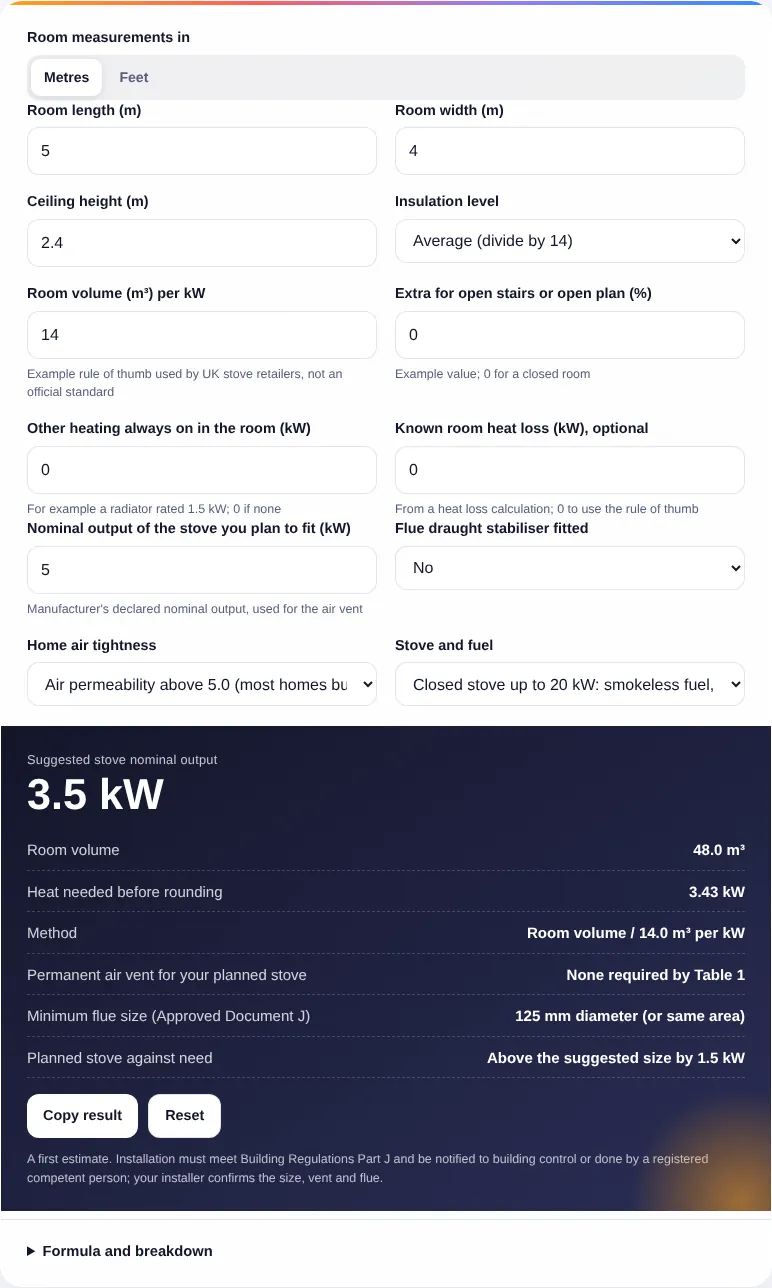
A first estimate. Installation must meet Building Regulations Part J and be notified to building control or done by a registered competent person; your installer confirms the size, vent and flue.
Formula and breakdown
n/a
n/a
n/a
This stove size calculator estimates the nominal heat output in kW that a wood burning or multi-fuel stove needs to heat one room, for homeowners in the UK and Ireland choosing a stove before getting quotes. It uses the room volume and insulation level, or a heat loss figure if you have one, and then works out the permanent air vent and minimum flue size that Approved Document J sets for the stove you plan to fit.
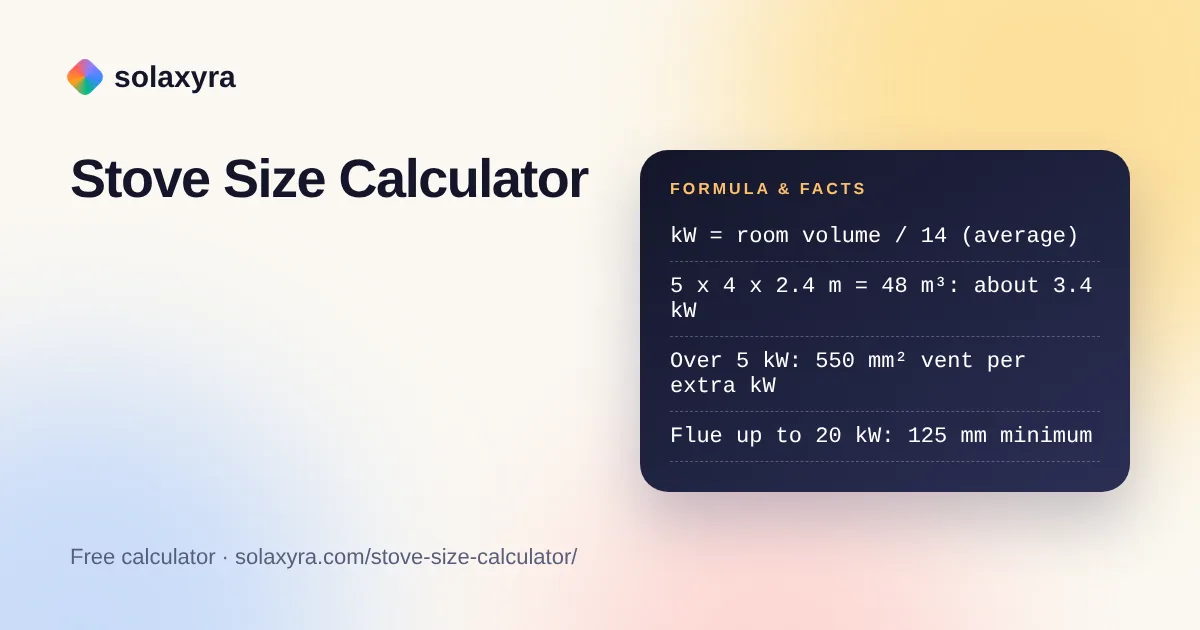
Quick answer: A stove size calculator divides the room volume in cubic metres by a rule of thumb, often 14 m³ per kW for average insulation. A 5 x 4 m room with a 2.4 m ceiling is 48 m³, so it needs about 3.4 kW, and a 3.5 kW stove fits. Stoves over 5 kW normally need a permanent air vent.
What Is a Stove Size Calculator?
A stove size calculator is a tool that estimates how much heat output a stove needs so that it can warm a room without being too large for the space. The quick method is: room length x width x height gives the volume in m³, and the volume divided by a factor for the insulation level gives kW. The factor is a rule of thumb used by UK stove retailers, not a figure from Building Regulations, so the tool shows it as an editable value.
The more accurate route is a heat loss calculation, which adds up the heat escaping through walls, windows, floor, ceiling and air leaks at a cold outside temperature. If you have done one with our heat loss calculator, enter the figure in kW and the stove size calculator uses it instead of the rule of thumb.
How Do You Use the Stove Size Calculator?
- Choose metres or feet, then enter the room’s length, width and ceiling height.
- Pick an insulation level, or type your own volume per kW factor.
- Add an allowance if the room is open plan or has an open staircase that carries heat away.
- Enter any other heating that will stay on in the room, such as a radiator, so the stove is not oversized.
- If you know the room’s heat loss in kW from a calculation, enter it to replace the rule of thumb.
- Enter the nominal output of the stove you are considering, whether it has a flue draught stabiliser, and how airtight the home is, then read the air vent and flue size.
What Size Wood Burning Stove Do I Need for My Room?
For the room sizes in the table below, the rule of thumb gives about 2 to 6 kW at average insulation, but the right figure depends on volume and insulation. The table shows the same calculation for common room sizes with a 2.4 m ceiling, using three example factors: 10 m³ per kW for a poorly insulated room, 14 for average and 25 for a very well insulated room.
| Room (2.4 m ceiling) | Volume | Poor (÷ 10) | Average (÷ 14) | Very good (÷ 25) |
|---|---|---|---|---|
| 3.5 x 3 m | 25.2 m³ | 2.5 kW | 1.8 kW | 1.0 kW |
| 4 x 3.5 m | 33.6 m³ | 3.4 kW | 2.4 kW | 1.3 kW |
| 5 x 4 m | 48.0 m³ | 4.8 kW | 3.4 kW | 1.9 kW |
| 6 x 4.5 m | 64.8 m³ | 6.5 kW | 4.6 kW | 2.6 kW |
| 7 x 5 m | 84.0 m³ | 8.4 kW | 6.0 kW | 3.4 kW |
| 8 x 6 m (open plan) | 115.2 m³ | 11.5 kW | 8.2 kW | 4.6 kW |
The spread is wide: the same 5 x 4 m room needs 4.8 kW if poorly insulated but only 1.9 kW if very well insulated. That is why, in the stove size calculator, choosing the insulation level or entering a real heat loss figure matters more than the exact room size.
Is It Bad to Have a Stove That Is Too Big?
Yes. HETAS, which runs approval schemes for solid fuel appliances in the UK, warns that a stove that is too large can tempt you to run it at low output, which creates a risk of slumbering. Run at its rated output instead, an oversized stove simply puts more heat into the room than it loses.
The HETAS guide to choosing a wood burning stove also notes that a stove takes time to build up before it gives its rated output. The stove size calculator rounds the estimate up to the next 0.5 kW and then shows how far your planned stove is above or below it, so you can see at a glance whether you are oversizing.
Does a Stove Over 5 kW Need an Air Vent?
In most homes, yes. Approved Document J Table 1 asks for a permanent air vent of 550 mm² for each kW of rated output above 5 kW when there is no flue draught stabiliser and the home’s air permeability is above 5.0 m³/(h·m²). At 5 kW or below, that case needs no vent. These figures come from the Approved Document J published on GOV.UK for England; check the building regulations where you live elsewhere.
Two other cases need more. In an airtight home, with air permeability of 5.0 or less, the vent is 550 mm² for every kW of rated output, so even a small stove needs one. With a flue draught stabiliser, the figures are 300 mm² per kW for the first 5 kW and 850 mm² per kW above that, or 850 mm² per kW in an airtight home.
Approved Document J notes that a dwelling built before 2008 is unlikely to have air permeability below 5.0 unless airtightness work has been done, and that a manufacturer’s instructions take precedence where they ask for a larger vent. The stove size calculator works out whichever of the four cases matches your home.
What Flue Size Does a Stove Need?
A closed stove up to 20 kW that burns smokeless fuel, or that meets Clean Air Act requirements when burning wood or bituminous coal, needs a flue of at least 125 mm diameter, or a square or rectangular flue of the same area. Approved Document J Table 2 sets 150 mm for other closed appliances up to 30 kW, and the stove size calculator shows the right minimum for the stove type you choose.
Your installer will also need to assess the existing chimney or flue system. Approved Document J requires an appropriate means of warning of carbon monoxide release for fixed solid fuel appliances, and the work must either be notified to a building control body before it starts or be carried out by an installer registered with a competent person scheme. Do not fit a stove yourself without one of these routes.
What Does Ecodesign Mean for a New Stove?
Ecodesign rules for solid fuel local space heaters have applied since 1 January 2022 under Regulation (EU) 2015/1185, published as retained law on legislation.gov.uk. A closed fronted stove burning logs or other solid fuel must reach at least 65% seasonal space heating efficiency, and its particulate emissions must not exceed 40 mg/m³ at 13% oxygen.
For pellet stoves the limits are 79% efficiency and 20 mg/m³. When you compare models, use the nominal output on the manufacturer’s data sheet, because Approved Document J defines rated heat output as the manufacturer’s declared nominal output, and for a multi-fuel stove the air supply is designed for the fuel that gives the highest output.
Worked Example: A Poorly Insulated Living Room With Open Stairs
Example: a living room in an older terraced house measures 6 x 4.5 m with a 2.5 m ceiling, has solid walls and an open staircase, and the owner is considering an 8 kW stove with no draught stabiliser.
- Volume: 6 x 4.5 x 2.5 = 67.5 m³.
- Rule of thumb for poor insulation: 67.5 / 10 = 6.75 kW.
- Open stairs allowance of 15% (example value): 6.75 x 1.15 = 7.76 kW, rounded up to an 8.0 kW stove.
- Air vent for 8 kW, no stabiliser, home built before 2008: 550 x (8 minus 5) = 1,650 mm², about 17 cm² of free area.
- Flue: an approved stove under 20 kW burning dry wood needs at least a 125 mm flue.
If the same room had cavity wall and loft insulation, the average factor of 14 would give 4.82 kW, or 5.55 kW with the stairs allowance, rounded up to a 6.0 kW stove that would need a 550 mm² vent. To compare the running cost of logs against other heating, try the heating fuel cost comparison calculator, check the cost of an electric alternative with the electric heater running cost calculator, or price whole-house heat with the heat pump running cost calculator. The firewood calculator estimates how many logs a season takes.
Frequently Asked Questions
How do I calculate what size stove I need?
Multiply the room’s length, width and height in metres to get its volume, then divide by a factor for the insulation level. A commonly used factor is 14 m³ per kW for average insulation. A 48 m³ room needs about 3.4 kW. A heat loss calculation gives a more reliable figure, and the stove size calculator accepts either.
Is a 5 kW stove big enough for my living room?
By the rule of thumb of 14 m³ per kW, a 5 kW stove suits a room of about 70 m³, such as 6 x 4.8 m with a 2.4 m ceiling, with average insulation. A poorly insulated room of that size would need more, and a well insulated one much less.
Do I need an air vent for a 5 kW stove?
Not usually. Approved Document J requires 550 mm² per kW only above 5 kW when there is no draught stabiliser and air permeability is above 5.0. In an airtight home, or with a draught stabiliser, a vent is needed even for 5 kW or less.
What happens if my stove is too big for the room?
At full output it puts more heat into the room than the room loses, so it gets too hot and people turn the air down to run it low. HETAS warns that running an oversized stove at low output creates a risk of slumbering. Choose a stove close to the calculated need rather than the largest you can fit.
What is nominal heat output on a stove?
It is the heat output in kW that the manufacturer declares for the appliance, and Approved Document J uses it as the rated output for sizing air vents. Some data sheets also give a higher maximum figure, so use the nominal one when comparing stoves.
Can I install a wood burning stove myself?
Only if you notify a building control body before the work starts. Otherwise use an installer registered with a competent person scheme, who does not need to notify building control in advance. Approved Document J also requires a means of warning of carbon monoxide, such as a CO alarm.
Checked October 2026 by the Solaxyra Editorial Team. Sources: Approved Document J, 2010 edition incorporating 2010, 2013 and 2022 amendments (gov.uk), Regulation (EU) 2015/1185 Annex II (legislation.gov.uk), HETAS: How to choose the perfect wood burning stove.