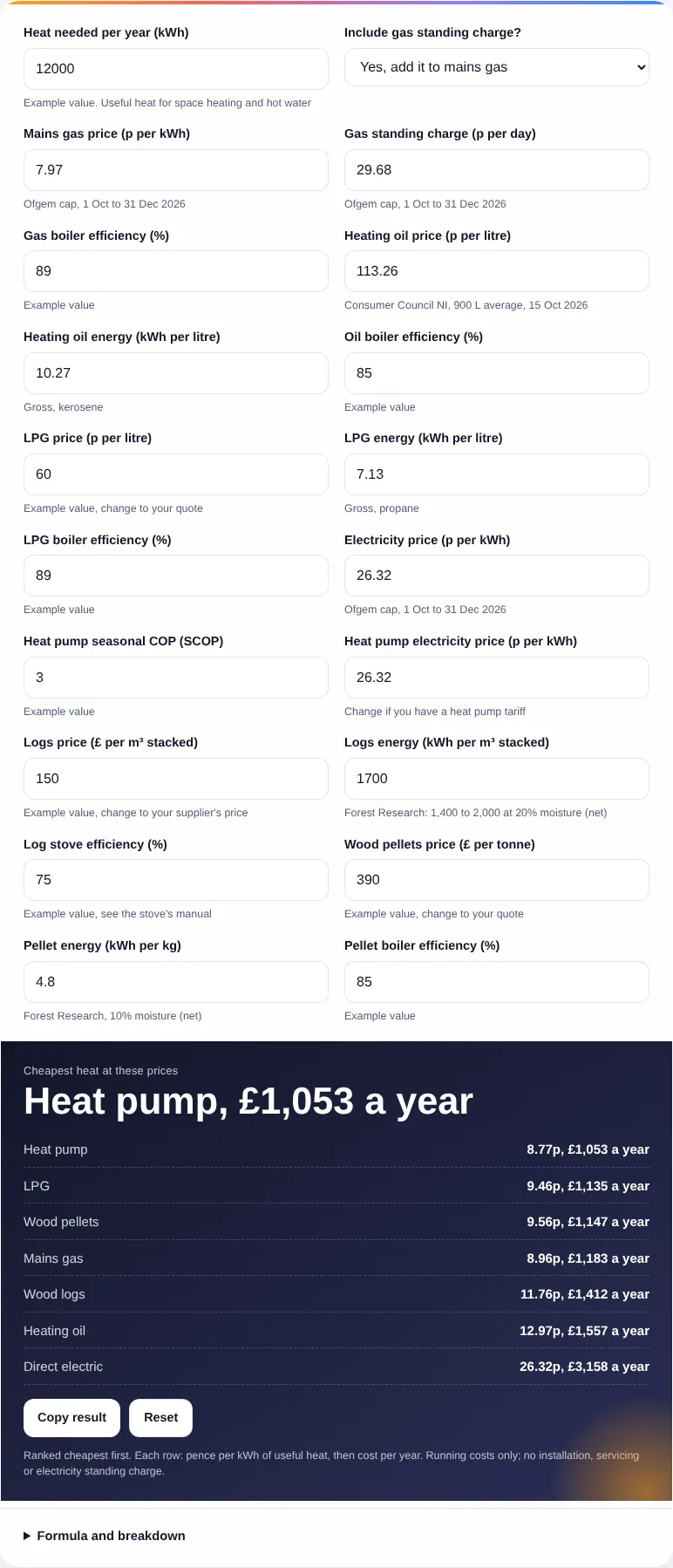
Ranked cheapest first. Each row: pence per kWh of useful heat, then cost per year. Running costs only; no installation, servicing or electricity standing charge.
Formula and breakdown
n/a
This heating fuel cost comparison calculator ranks seven ways to heat a home, mains gas, heating oil, LPG, direct electric, a heat pump, wood logs and wood pellets, by the cost of each kWh of useful heat and by yearly cost, for households in the UK and Ireland. Every price, energy content and efficiency is editable, so you can compare your own quotes on a fair, like-for-like basis.
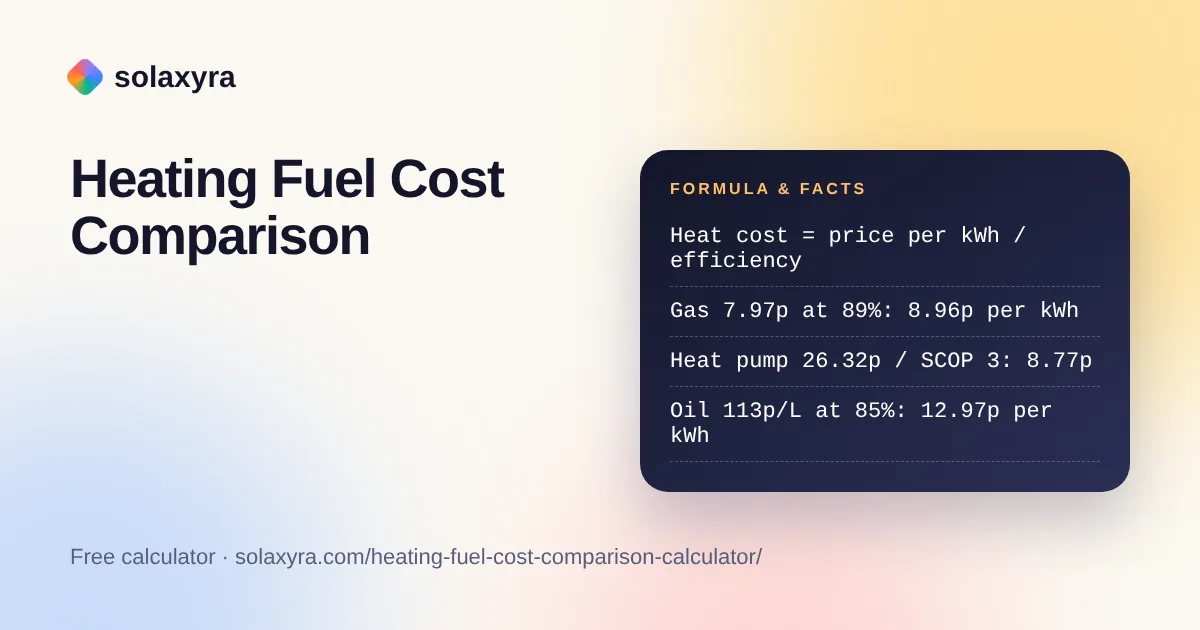
Quick answer: A heating fuel cost comparison calculator divides each fuel's price per kWh by the heating system's efficiency or SCOP. At October 2026 cap prices, gas heat from an 89% boiler costs about 9.0p per kWh, a SCOP 3 heat pump about 8.8p, kerosene at 113p a litre about 13.0p and direct electric 26.3p.
What Is a Heating Fuel Cost Comparison Calculator?
A heating fuel cost comparison calculator is a tool that puts different fuels on the same footing by working out what one kWh of heat delivered to the home costs with each. In plain words: convert each price to pence per kWh of fuel using the fuel's energy content, divide by the boiler, stove or heat pump efficiency, then multiply by the heat your home needs in a year.
Raw prices cannot be compared directly because fuels are sold in different units: gas and electricity per kWh, oil and LPG per litre, pellets per tonne and logs per cubic metre. Efficiency matters as much as price. The Wikipedia article on electric heating notes that resistive heaters turn all their electricity into heat, while heat pumps reach a COP of 1.5 to 6.0, meaning 1.5 to 6 kWh of heat per kWh of electricity.
How Do You Use the Heating Fuel Cost Comparison Calculator?
- Enter the heat your home needs a year in kWh. Use an EPC figure, a heat loss estimate or your current gas use times boiler efficiency.
- Decide whether to add the gas standing charge to the gas option. Choose yes if you would only pay it to heat with gas.
- Check each fuel's price. Gas and electricity default to the Ofgem cap; heating oil to the latest official Northern Ireland average; LPG, logs and pellets are example values to replace with your quotes.
- Check the energy contents and efficiencies, and enter your heat pump's seasonal COP.
- Read the ranking, cheapest first, with pence per kWh of heat and the yearly cost. Open the breakdown to see each line of working.
What Is the Cheapest Way to Heat a Home in the UK?
At October 2026 prices a heat pump with a seasonal COP of 3 gives the cheapest heat of the default options at about 8.8p per kWh, just below mains gas at about 9.0p, while direct electric heating at 26.32p per kWh is the dearest. The table shows every default input and result of the heating fuel cost comparison calculator for a home needing 12,000 kWh of heat a year. Our guide to the cheapest way to heat a house in the UK covers insulation and controls as well as fuel choice.
| Fuel | Price used | Energy content | Efficiency | Pence per kWh of heat | Cost for 12,000 kWh |
|---|---|---|---|---|---|
| Heat pump | 26.32p per kWh (cap) | n/a | SCOP 3 (example) | 8.77p | £1,053 |
| Mains gas | 7.97p per kWh (cap) | n/a | 89% (example) | 8.96p | £1,075, or £1,183 with standing charge |
| LPG | 60p per litre (example) | 7.13 kWh per litre (gross) | 89% (example) | 9.46p | £1,135 |
| Wood pellets | £390 per tonne (example) | 4.8 kWh per kg (net) | 85% (example) | 9.56p | £1,147 |
| Wood logs | £150 per m³ stacked (example) | 1,700 kWh per m³ (net) | 75% (example) | 11.76p | £1,412 |
| Heating oil | 113.26p per litre (CCNI, 15 Oct 2026) | 10.27 kWh per litre (gross) | 85% (example) | 12.97p | £1,557 |
| Direct electric | 26.32p per kWh (cap) | n/a | 100% | 26.32p | £3,158 |
The LPG, pellet and log rows depend entirely on example prices that we could not verify against an official source, so their place in the ranking is only illustrative. With your own quotes entered, the heating fuel cost comparison calculator gives a ranking you can rely on.
Where Do the Prices and Energy Values Come From?
Gas and electricity prices come from the Ofgem price cap for 1 October to 31 December 2026: 7.97p per kWh and 29.68p a day for gas, 26.32p per kWh for electricity, on direct debit. Ofgem says VAT has been removed from electricity bills from 1 October 2026 to 31 March 2027, while gas still carries 5% VAT.
The heating oil price is the Consumer Council for Northern Ireland average of £1,019.36 for 900 litres on 15 October 2026. Kerosene's 10.27 kWh per litre and LPG's 7.13 kWh per litre are gross values worked out from the higher heating values in the Wikipedia heat of combustion table and published densities. Log and pellet energy contents are the net values in the Forest Research table of typical calorific values: 4.8 kWh per kg for pellets at 10% moisture and 1,400 to 2,000 kWh per stacked m³ for air-dry logs at 20% moisture.
Why Does Gross or Net Energy Content Matter?
Gross (higher) values include the heat recoverable from water vapour in the flue gas, net (lower) values do not, and the gap is about 7% for kerosene. A fair comparison uses the same basis for a fuel's energy content and its appliance efficiency, otherwise one fuel looks several per cent better than it is.
UK gas bills convert meter readings to kWh using the gross calorific value, so the calculator uses gross figures for oil and LPG too and applies boiler efficiencies on the same basis. Forest Research publishes wood fuel values on a net basis, and stove efficiencies are commonly quoted net, so those rows stay net. If your appliance data uses the other basis, adjust the energy content or efficiency in the heating fuel cost comparison calculator to match.
When Does a Heat Pump Beat a Gas Boiler?
A heat pump beats a gas boiler on running cost when its SCOP is above the electricity price divided by the cost of gas heat: 26.32p / 8.96p, about 2.94, at cap prices if you keep the gas connection. If switching lets you drop the gas standing charge, the break-even falls to about 2.67 for a home needing 12,000 kWh a year.
A heat pump tariff with cheaper electricity lowers the break-even further: enter it as the heat pump electricity price in the heating fuel cost comparison calculator. Our heat pump running cost calculator compares a switch in more detail, and the heat pump vs gas boiler guide covers installation costs and grants. For a single electric room heater, the electric heater running cost calculator is a better fit.
What Does This Comparison Leave Out?
The ranking covers fuel running costs only: installation, servicing, chimney sweeping, fuel storage, and the electricity a boiler pump or pellet auger uses are not included. Electricity standing charges are left out because almost every home pays them anyway.
Safety rules also differ by fuel. Gas boilers must be fitted and serviced by a Gas Safe registered engineer, new oil tanks at homes in England must meet building regulations, and wood stoves need a correctly installed flue. Our heating oil cost calculator and firewood calculator go deeper into those two fuels, and the electricity cost calculator prices any electric appliance.
Worked Example: Comparing Options for an Off-Gas Bungalow
Example: a bungalow in Lincolnshire needs about 12,000 kWh of heat a year and has no gas connection. The owner compares oil at the 15 October 2026 Northern Ireland average with a heat pump at SCOP 3, and gas is ruled out.
- Oil fuel price: 113.26p / 10.27 kWh = 11.03p per kWh. Heat: 11.03p / 0.85 = 12.97p per kWh.
- Oil yearly cost: 12,000 x 12.97p = £1,557.
- Heat pump: 26.32p / 3 = 8.77p per kWh of heat, so 12,000 x 8.77p = £1,053.
- Direct electric storage or panel heaters at the standard rate: 12,000 x 26.32p = £3,158.
- Running cost gap between oil and the heat pump: £1,557 minus £1,053 = £504 a year.
Lowering the heat pump SCOP to 2.5 in the heating fuel cost comparison calculator raises its cost to £1,263, still about £294 below oil at this price.
Frequently Asked Questions
How do you compare heating fuel costs fairly?
Convert every price to pence per kWh of fuel using its energy content, then divide by the efficiency of the boiler, stove or heat pump. That gives the cost of each kWh of heat delivered, which can be compared directly across gas, oil, LPG, electricity and wood.
Is a heat pump cheaper than gas?
At October 2026 cap prices, yes if its seasonal COP is above about 2.94, or about 2.67 if switching also removes the gas standing charge for a home needing 12,000 kWh a year. A cheaper heat pump tariff lowers the break-even further.
Is heating oil cheaper than gas?
Not at current prices. At the Northern Ireland average of about 113p a litre on 15 October 2026, oil heat from an 85% boiler costs about 13.0p per kWh, against about 9.0p from mains gas at the cap price with an 89% boiler.
Why are LPG, logs and pellets shown as examples?
We could not find a current official national price for these fuels, so the defaults are labelled example values. Enter the prices from your own supplier quotes and the ranking updates immediately. Prices for these fuels vary widely by region and order size.
Does this heating fuel cost comparison calculator include standing charges?
It can add the gas standing charge of 29.68p a day to the gas option, which suits homes that would only pay it to heat with gas. Electricity standing charges are left out because nearly every home pays them regardless of heating fuel.
How much energy is in a cubic metre of logs?
Forest Research gives 1,400 to 2,000 kWh per stacked cubic metre for air-dry logs at 20% moisture, on a net basis. The range reflects wood density and how tightly the logs are stacked. Wetter logs give less heat and burn less cleanly.
Checked October 2026 by the Solaxyra Editorial Team. Sources: Ofgem: Energy price cap 1 October to 31 December 2026, Consumer Council for Northern Ireland: Home heating oil price checker (15 October 2026), Forest Research: Typical calorific values of fuels, Wikipedia: Heat of combustion, Wikipedia: Kerosene, Wikipedia: Electric heating, HSE: Domestic gas safety FAQs, GOV.UK: Storing oil at your home.