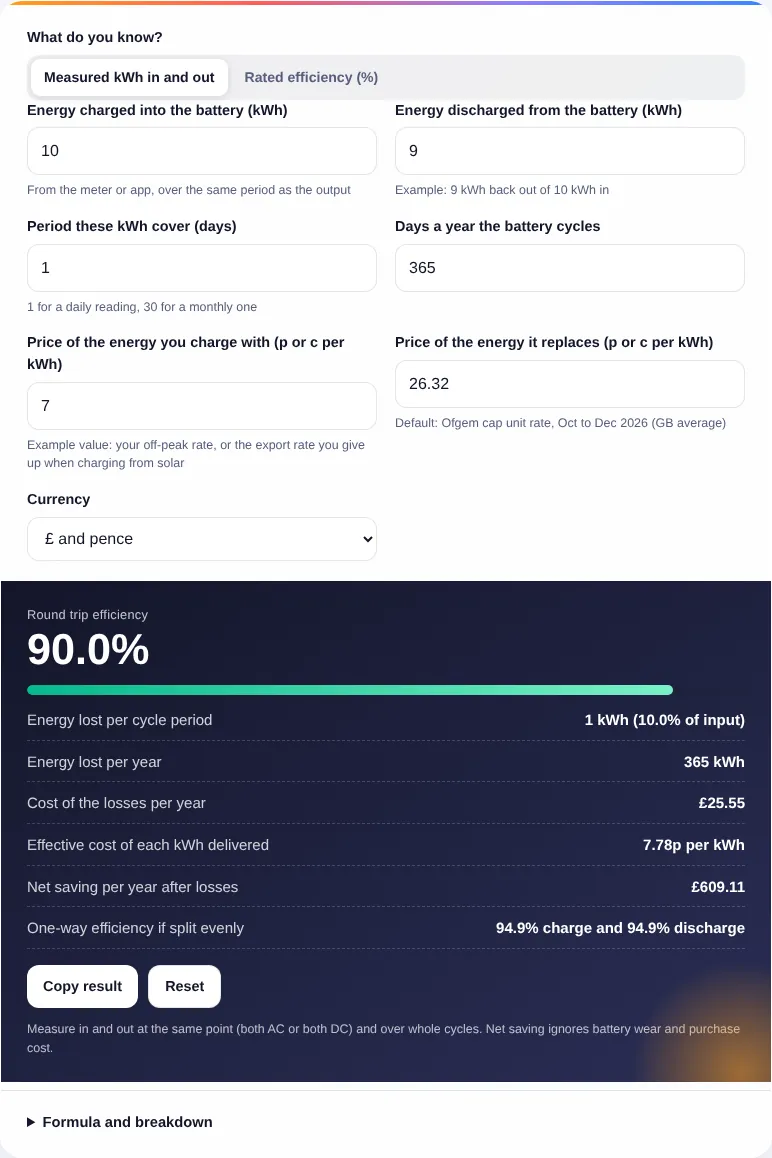
Measure in and out at the same point (both AC or both DC) and over whole cycles. Net saving ignores battery wear and purchase cost.
Formula and breakdown
n/a
n/a
n/a
This round trip efficiency calculator works out how much of the energy you put into a home or off-grid battery comes back out, and turns the missing kWh into money per year, for UK and European battery owners, installers and anyone comparing a datasheet figure with real meter readings. Enter measured kWh in and out, or a rated percentage, plus your charging and replaced prices.
Quick answer: A round trip efficiency calculator divides the energy discharged from a battery by the energy charged into it. 9 kWh out for 10 kWh in is 90%. Charging 10 kWh a day at 7p per kWh, the lost 365 kWh a year costs about £25.55, and each delivered kWh effectively costs 7.78p.

What Is a Round Trip Efficiency Calculator?
A round trip efficiency calculator is a tool that measures the share of energy a storage system returns after a full charge and discharge, and prices the energy lost on the way. In plain words: round trip efficiency equals kWh out divided by kWh in, times 100, and the loss in money equals the lost kWh times the price of the energy you charged with.
The loss happens in several places: the inverter or charger converting AC to DC and back, the internal resistance of the cells, the battery management system and, if the battery sits idle, its own standby use and self-discharge. Simulation tools such as HOMER assume the loss is split evenly between charging and discharging, so a battery with 81% round trip efficiency is modelled as 90% on the way in and 90% on the way out. The round trip efficiency calculator shows that one-way figure as the square root of the round trip value.
How Do You Use the Round Trip Efficiency Calculator?
- Choose measured kWh if you have readings, or rated efficiency if you only have a datasheet percentage.
- Enter the kWh charged into the battery and, in measured mode, the kWh discharged, over the same period. Pick a period where the battery starts and ends at about the same state of charge.
- Enter how many days the readings cover and how many days a year the battery cycles.
- Enter the price of the energy you charge with: your off-peak rate, or the export payment you give up when you store solar instead of exporting it.
- Enter the price of the energy the battery replaces, which defaults to the Ofgem price cap unit rate.
- Read the efficiency, the kWh and money lost each year, the effective cost of each kWh the battery delivers and the net saving after losses.
How Do You Calculate Battery Round Trip Efficiency?
Divide the kWh discharged by the kWh charged over complete cycles and multiply by 100: 236 kWh out for 268 kWh in is 88.1%. The readings must be measured at the same point. If the charge figure is AC from the grid and the discharge figure is AC to the house, you get the system round trip efficiency, which includes the inverter. A DC-only figure from the battery’s own management system will look better because it leaves the inverter out.
The period matters too. If the battery is fuller at the end of the period than at the start, some of the energy charged is still stored and the efficiency looks too low; the opposite makes it look too high. Monthly totals smooth this out. The round trip efficiency calculator rejects an output above the input, because over whole cycles a battery cannot give back more than it took in.
What Is a Good Round Trip Efficiency for a Home Battery?
A lithium home battery system typically returns about 85% to 95% of what it takes in, with lithium iron phosphate systems often quoted in the low 90s. GivEnergy, for example, states 93% for its LiFePO4 batteries and describes 80% as the figure older systems were judged by. Treat any number as a starting point: real results depend on the inverter, temperature, the charge and discharge rate and how long the battery sits idle.
Research supports those conditions. A 2023 study of lithium-ion cells on arXiv found energy efficiency was higher at lower currents and warmer temperatures and fell only slowly as the cells aged. For other storage technologies, the Wikipedia article on grid energy storage gives about 75% to 85% for pumped hydro, 60% to 80% for advanced compressed air and roughly 41% for hydrogen made by electrolysis and turned back into electricity.
| Round trip efficiency | kWh lost a year (10 kWh in a day) | Cost at 7p per kWh | Cost at 15p per kWh | Effective cost per kWh delivered (7p in) |
|---|---|---|---|---|
| 75% | 912.5 | £63.88 | £136.88 | 9.33p |
| 80% | 730 | £51.10 | £109.50 | 8.75p |
| 85% | 547.5 | £38.33 | £82.13 | 8.24p |
| 90% | 365 | £25.55 | £54.75 | 7.78p |
| 93% | 255.5 | £17.88 | £38.33 | 7.53p |
| 95% | 182.5 | £12.78 | £27.38 | 7.37p |
The 7p and 15p columns are example prices, not quoted tariffs: think of them as a cheap overnight rate and an export payment you give up when charging from solar. Each five-point drop in efficiency costs more when the charging energy is worth more.
How Much Money Do Battery Losses Cost a Year?
For a battery cycling 10 kWh a day, each percentage point of round trip efficiency is worth about 36.5 kWh a year, or about £2.56 at 7p per kWh. That is usually small next to the saving from shifting energy, which is why the round trip efficiency calculator shows the net figure too: kWh out times the price it replaces, minus kWh in times the price you paid. The home battery savings calculator takes the next step to payback, and the solar battery size calculator uses efficiency to size the battery in the first place.
The default replaced price is the Ofgem price cap electricity unit rate for 1 October to 31 December 2026, 26.32p per kWh for a GB direct debit customer, a period when Ofgem says VAT is removed from electricity bills. Your own tariff may differ, so change it.
When Does Round Trip Efficiency Make Battery Cycling Lose Money?
Cycling loses money when the charging price divided by the efficiency is not below the price the stored energy replaces: at 90% efficiency, energy bought at 20p costs 22.2p once delivered. The round trip efficiency calculator warns you when that happens. The rule matters for time-of-use arbitrage, where the gap between cheap and peak rates must be wider than the losses, and for solar, where storing a kWh is only worth it if the replaced import price beats the export payment divided by the efficiency.
This page deals only with energy losses. How many cycles a battery survives is a separate question, covered by the battery cycle life calculator, and how fast it can safely charge or discharge is covered by the C-rate calculator. For running time under a load, use the battery runtime calculator. Home batteries in the UK should be installed by a competent installer, with electrical work meeting BS 7671.
Worked Example: Checking a Home Battery Against Its Datasheet
Example: a household battery on an off-peak tariff shows 268 kWh charged and 236 kWh discharged in the app over 30 days, with the battery at the same charge level on both dates. Round trip efficiency = 236 / 268 = 88.1%. The 32 kWh lost in 30 days scales to 32 / 30 x 365 = 389.3 kWh a year.
At an example off-peak price of 7p per kWh, the losses cost 389.3 x 7p = £27.25 a year, and each delivered kWh effectively costs 7 / 0.881 = 7.95p. Replacing energy at the 26.32p cap rate, the battery delivers 236 / 30 x 365 = 2,871 kWh worth £755.73 for £228.25 of charging, a net £527.49 a year before wear and purchase cost. If the same battery were charged from solar that could otherwise earn an example 15p export payment, the same losses would cost £58.40. The measured 88.1% is below a 93% datasheet figure, which is normal when the AC readings include the inverter and standby use.
Frequently Asked Questions
What is round trip efficiency?
Round trip efficiency is the share of energy a storage system gives back after being charged and then discharged. It equals kWh out divided by kWh in, times 100. A battery that takes in 10 kWh and returns 9 kWh has a round trip efficiency of 90%, with 1 kWh lost as heat.
What round trip efficiency do lithium home batteries have?
Lithium home battery systems typically return about 85% to 95% of the energy put in, and lithium iron phosphate systems are often quoted in the low 90s. Measured figures at the meter are usually a few points lower than datasheet figures because they include inverter conversion and standby consumption.
Does round trip efficiency include the inverter?
It depends where you measure. AC in and AC out at the meter includes the inverter and gives the system figure that matters for your bills. A DC figure from the battery’s management system covers only the battery. Always compare like with like when checking a datasheet.
How do I convert round trip efficiency to one-way efficiency?
If the loss is split evenly between charging and discharging, take the square root of the round trip efficiency. A round trip of 81% gives 90% each way, and 90% gives about 94.9% each way. Real systems do not always split evenly, so treat this as an estimate.
Why is my battery’s round trip efficiency lower than the datasheet?
Common reasons are measuring AC rather than DC, standby use by the inverter and management system, cold temperatures, high charge or discharge rates, and a period where the battery ended emptier or fuller than it started. Use a month of readings at a similar state of charge for a fair figure.
Is a battery with lower round trip efficiency still worth it?
Often yes, because losses are usually small next to the price gap a battery exploits. A battery is worth cycling when the charging price divided by the efficiency is below the price it replaces. If that gap is narrow, losses can wipe out the saving, so check your own prices.
Checked October 2026 by the Solaxyra Editorial Team. Sources: Ofgem: price cap 1 October to 31 December 2026, Wikipedia: Grid energy storage, HOMER Knowledge Base: battery throughput, arXiv: efficiency degradation of lithium-ion batteries, GivEnergy: round trip efficiency.