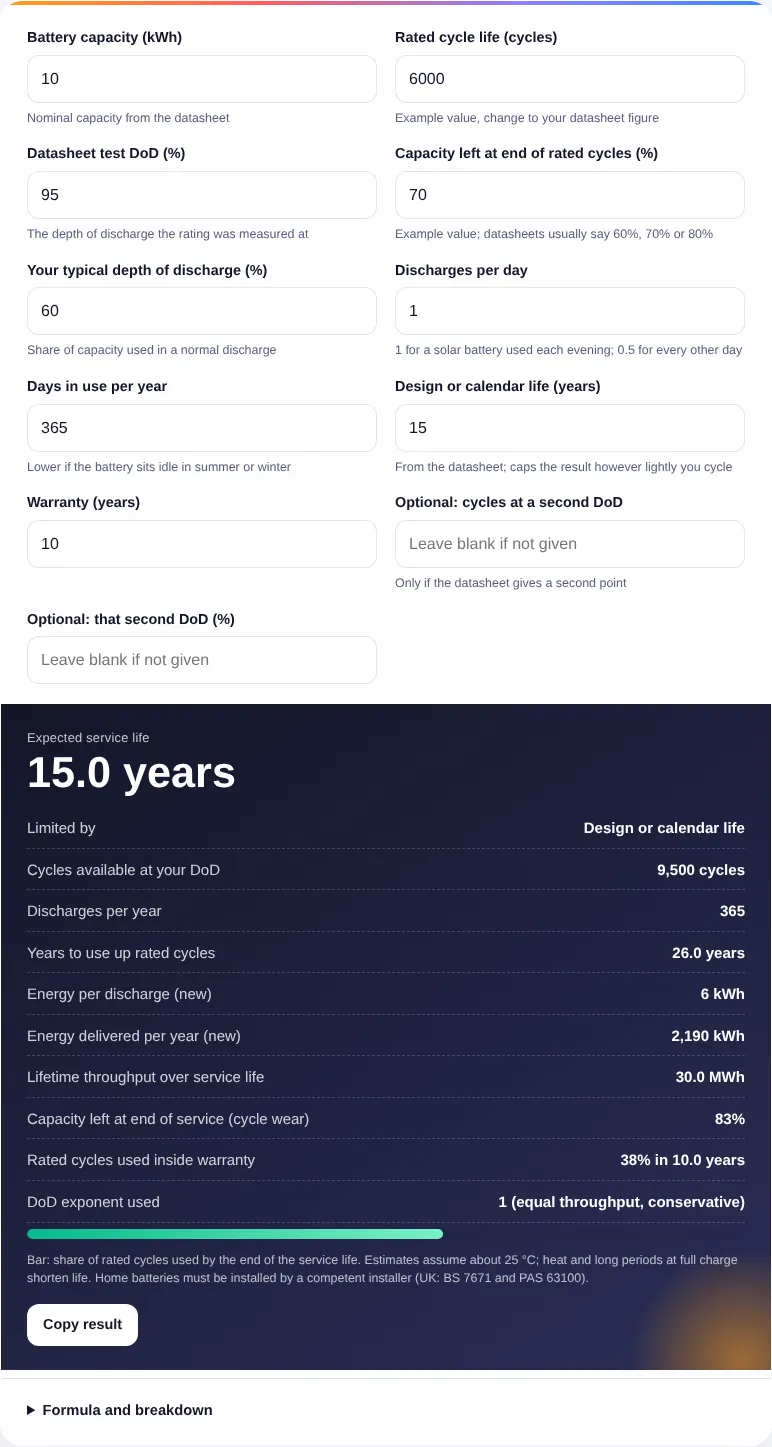
Bar: share of rated cycles used by the end of the service life. Estimates assume about 25 °C; heat and long periods at full charge shorten life. Home batteries must be installed by a competent installer (UK: BS 7671 and PAS 63100).
Formula and breakdown
n/a
n/a
n/a
This tool estimates how many years a rechargeable battery will last from its datasheet cycle rating and the way you actually use it, for home solar batteries, off-grid banks, leisure batteries and power stations in the UK, Europe and beyond. The battery cycle life calculator adjusts the rated cycles for your depth of discharge, counts the cycles you use each year, caps the answer at the design life, and shows the energy the battery will deliver before it reaches end of life.
Quick answer: A battery cycle life calculator divides the cycles available at your depth of discharge by the cycles you use each year. Example: a battery rated 6,000 cycles at 95% depth of discharge, used to 60% once a day, has about 9,500 equivalent cycles, or 26 years of cycling, so its 15 year design life is the real limit.

What Is a Battery Cycle Life Calculator?
A battery cycle life calculator is a tool that converts a datasheet cycle rating into an expected service life in years for your own pattern of charging and discharging. In plain words: adjust the rated cycles for how deeply you discharge, divide by the number of discharges per year, and compare the result with the calendar or design life, because the battery ends its useful life at whichever limit comes first.
A cycle is one discharge and recharge. Datasheets quote cycle life at a stated depth of discharge (DoD), the share of capacity removed in each cycle, usually at about 25 °C, and to a stated end of life, often 70% or 80% of the original capacity. Change any of those three conditions and the cycle count changes, which is why the battery cycle life calculator asks for all of them.
How Do You Use the Battery Cycle Life Calculator?
- Enter the battery’s nominal capacity in kWh.
- Enter the rated cycle life and the DoD it was measured at, both from the datasheet.
- Enter the capacity left at the end of the rated cycles; if the datasheet does not say, 70% is a common basis but treat it as an example.
- Enter your typical depth of discharge and how many discharges you do per day.
- Enter the days in use per year, the design or calendar life and the warranty length.
- If the datasheet gives cycle counts at two different depths, add the second point; the battery cycle life calculator then fits the curve to your battery instead of using the conservative default.
- Read the service life, which limit applies, the lifetime energy throughput and the capacity left at the end.
How Does Depth of Discharge Change Battery Cycle Life?
Shallower discharges give more cycles: as a conservative rule, a battery delivers about the same total energy over its life, so halving the depth of discharge roughly doubles the cycle count. That is the “equal throughput” rule the battery cycle life calculator uses by default, with an exponent k of 1. Many lithium cells do better than this at shallow depths, and some datasheets show it with cycle counts at two depths.
When you enter a second datasheet point, the battery cycle life calculator fits k from your own data: k = ln(cycles 2 / cycles 1) / ln(DoD 1 / DoD 2). Example: 6,000 cycles at 95% and 9,000 cycles at 50% give k = 0.63, which means cycles rise more slowly than the equal throughput rule suggests for deep cycling. Fitting from your datasheet avoids relying on a generic exponent that may not match your cells.
How Many Years Will a 6,000 Cycle Battery Last?
A 6,000 cycle battery used for one full cycle a day lasts about 16 years of cycling, because 6,000 / 365 = 16.4; at partial depths it lasts longer on cycles alone but is then usually limited by its design life. The table shows years to the rated cycles for common ratings using the equal throughput rule, before any design life cap.
| Datasheet rating | Your DoD and use | Cycles at your DoD | Years of cycling |
|---|---|---|---|
| 6,000 at 95% DoD | 30%, once a day | 19,000 | 52.1 |
| 6,000 at 95% DoD | 60%, once a day | 9,500 | 26.0 |
| 6,000 at 95% DoD | 90%, once a day | 6,333 | 17.4 |
| 6,000 at 95% DoD | 90%, twice a day | 6,333 | 8.7 |
| 4,000 at 90% DoD | 60%, once a day | 6,000 | 16.4 |
| 4,000 at 90% DoD | 90%, twice a day | 4,000 | 5.5 |
| 3,000 at 80% DoD | 60%, once a day | 4,000 | 11.0 |
| 3,000 at 80% DoD | 90%, once a day | 2,667 | 7.3 |
Results above about 15 to 20 years should be read as “cycling is not the limit”. Electronics, seals and calendar ageing end most batteries’ lives before then, which is why the tool caps the answer at the design life you enter.
What Is Calendar Life and Why Does It Cap the Result?
Calendar life is the time a battery lasts even when it is barely used, because the cells age chemically whether or not they are cycled. Lithium-ion degradation is strongly temperature-dependent, small at room temperature but faster above about 35 °C or below about 5 °C, and cells stored at a high state of charge lose capacity more quickly. For example, the Pylontech US5000 datasheet lists more than 6,000 cycles at 95% DoD at 25 °C together with a design life of more than 15 years and a 10 year warranty, so a gently used US5000 is limited by its design life, not its cycles.
How Do Battery Warranties Treat Cycles?
Home battery warranties usually promise a minimum remaining capacity after a number of years, sometimes with a cap on cycles or on total energy throughput. Tesla’s Powerwall warranty for Europe, for example, covers ten years with 80% energy retention in the UK and Ireland and unlimited cycles for solar self-consumption and backup use. The “rated cycles used inside warranty” row shows how much of the cycle rating you would use during the warranty period; if it reaches 100%, the battery could hit its cycle limit before the warranty ends, so read any throughput cap in your own warranty carefully.
Worked Example: A Home Solar Battery Used Every Evening
Example: a 10 kWh lithium iron phosphate battery is rated 6,000 cycles at 95% DoD, with 70% capacity left at the end of its rated cycles, a 15 year design life and a 10 year warranty. It is discharged to about 60% each evening, every day of the year.
- Cycles at 60% DoD: 6,000 x (95 / 60) = 9,500 cycles.
- Discharges per year: 1 x 365 = 365.
- Years to rated cycles: 9,500 / 365 = 26.0 years. The design life of 15 years is lower, so the service life is 15 years and it is calendar limited.
- Share of rated cycles used in 15 years: 15 / 26.0 = 57.6%, so cycle wear alone leaves about 100 minus 30 x 0.576 = 83% of capacity.
- Energy per discharge when new: 10 x 60% = 6 kWh, or 2,190 kWh a year.
- Lifetime throughput: 2,190 x 15 x an average capacity of 91.4% = about 30.0 MWh.
If this household added a second, overnight cheap-rate discharge, the cycling time would halve to about 13 years, which becomes the limit instead. To see whether a battery of this size suits your evening use, try the solar battery size calculator; to estimate what each cycle is worth on your tariff, use the home battery savings calculator. For hours of runtime from one charge, rather than years of life, the battery runtime calculator is the right tool, and the battery cost per kWh calculator spreads the purchase price over the throughput.
How Can You Make a Battery Last Longer?
Keep the battery cool and avoid leaving it at 100% charge for long periods: these two habits slow calendar ageing, which is the limit for most lightly cycled home batteries. Practical steps:
- Install the battery where it stays close to the datasheet temperature range, not in direct sun or an unheated outbuilding that freezes.
- Use the minimum and maximum state of charge settings in your inverter or app so daily use avoids the extremes where you do not need them.
- Do not cycle twice a day unless the savings justify the extra wear; the tool shows the life you trade.
- Keep firmware up to date, since battery management systems control charge limits and balancing.
Installation safety matters as much as lifespan. A home battery connected to the electrical installation must be installed by a competent installer; in the UK the work must meet BS 7671, and the BSI specification PAS 63100:2024 on fire protection of battery storage in dwellings rules out locations such as escape routes, bedrooms, lofts and roof voids. Never open battery modules or bypass the battery management system.
Frequently Asked Questions
What does battery cycle life mean?
Cycle life is the number of full charge and discharge cycles a battery can complete before its capacity falls to a stated end of life, often 70% or 80% of new. The rating only applies at the depth of discharge and temperature given on the datasheet.
Does a partial discharge count as a full cycle?
No. Two discharges to 50% are roughly one full equivalent cycle in energy terms. This calculator adjusts the rated cycles for your depth of discharge, so a shallow discharge uses only part of a rated cycle, and shallower cycling usually gives at least as much total energy.
How long do LiFePO4 batteries last in years?
It depends on the cycle rating, depth of discharge and use. A battery rated 6,000 cycles used once a day at full depth reaches its rating in about 16 years; at partial depth the datasheet design life, such as more than 15 years for one common home battery, usually ends service first.
What is lifetime energy throughput?
Lifetime throughput is the total energy a battery delivers before end of life, in kWh or MWh. It equals energy per discharge times the number of discharges, reduced slightly as capacity fades. Some warranties cap throughput, so compare the calculator result with your warranty terms.
Does temperature affect battery cycle life?
Yes. Lithium-ion batteries degrade fastest when used or stored hot, above about 35 °C, or very cold, below about 5 °C. Datasheet cycle ratings are usually measured at about 25 °C, so a hot garage or loft-like space will shorten life compared with the estimate.
Why does the calculator cap the result at the design life?
Batteries age even when unused, through chemical changes in the cells and wear in electronics. A lightly cycled battery could show 40 or 50 years on cycles alone, which is not realistic, so the service life is the lower of cycling years and the design life.
Checked October 2026 by the Solaxyra Editorial Team. Sources: Pylontech US5000 datasheet, Tesla Powerwall warranty, Europe, Wikipedia, Depth of discharge, Wikipedia, Lithium-ion battery, BSI, PAS 63100:2024.