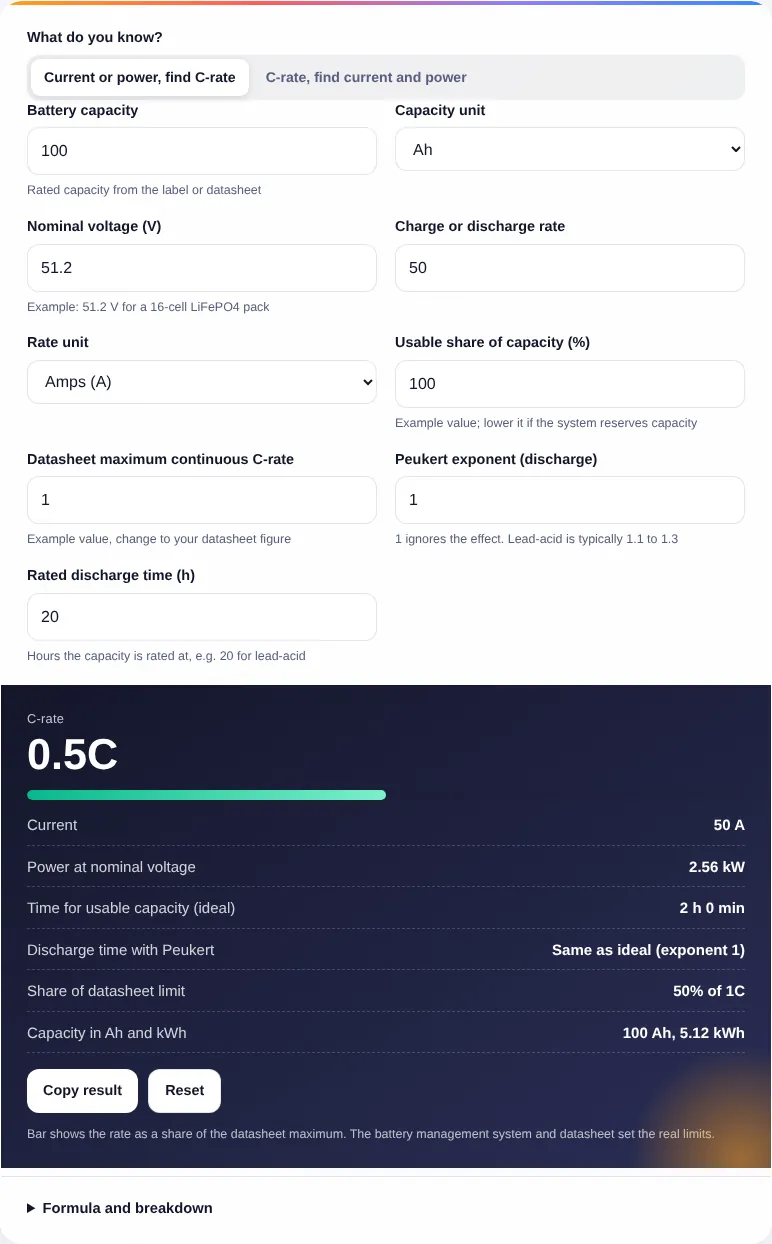
Bar shows the rate as a share of the datasheet maximum. The battery management system and datasheet set the real limits.
Formula and breakdown
n/a
n/a
n/a
This C rate calculator converts between a battery’s charge or discharge current and its C-rate, and shows the matching power in kW and the ideal time to empty or fill it, for home battery owners, installers, campervan and off-grid users, and hobbyists in the UK, Europe and beyond. It accepts capacity in Ah, mAh, Wh or kWh, checks the rate against your datasheet limit and can apply Peukert’s law for lead-acid batteries.
Quick answer: A C rate calculator divides the charge or discharge current in amps by the battery capacity in amp-hours. A 100 Ah battery delivering 50 A runs at 0.5C and would take about 2 hours to empty. For power, divide kW by kWh: 2.56 kW from a 5.12 kWh battery is also 0.5C.

What Is a C Rate Calculator?
A C rate calculator is a tool that expresses a battery’s charge or discharge current as a multiple of its capacity, where 1C is the current that would fully charge or discharge it in one hour. In plain words: C-rate equals current in amps divided by capacity in amp-hours, and the ideal time in hours equals 1 divided by the C-rate.
The definition in the Wikipedia article on electric batteries is the current through the battery divided by the current at which it would deliver its nominal capacity in one hour. So 1C empties a battery in one hour, 0.5C in two hours and 2C in half an hour. Because power equals current times voltage, the same ratio holds for kW and kWh at nominal voltage, which is how home battery specifications are usually written.
How Do You Use the C Rate Calculator?
- Choose whether you know the current or power, or the C-rate.
- Enter the battery capacity and pick its unit: Ah, mAh, Wh or kWh.
- Enter the nominal voltage, which converts between Ah, kWh, amps and kW.
- Enter the current in A, or power in kW or W, or the C-rate you want to check.
- Add the datasheet maximum continuous C-rate and, if the system reserves part of the battery, the usable share.
- For lead-acid batteries, set a Peukert exponent and the rated discharge time, and the C rate calculator shows the shorter real runtime at high current.
How Do You Calculate the C-Rate of a Battery?
Divide the current by the capacity in amp-hours: a 200 Ah battery charged at 40 A is at 40 / 200 = 0.2C. If the capacity is in kWh and the rate in kW, divide those instead: a 10 kWh battery discharging at 5 kW is at 0.5C. To go the other way, multiply: current = C-rate x Ah, and power = C-rate x kWh.
The table shows what common C-rates mean for a 100 Ah, 51.2 V lithium iron phosphate pack, which stores 5.12 kWh. Our Ah to kWh converter handles the capacity conversion for other packs.
| C-rate | Current | Power at 51.2 V | Ideal time, full to empty |
|---|---|---|---|
| 0.05C | 5 A | 256 W | 20 h |
| 0.1C | 10 A | 512 W | 10 h |
| 0.2C | 20 A | 1.02 kW | 5 h |
| 0.5C | 50 A | 2.56 kW | 2 h |
| 1C | 100 A | 5.12 kW | 1 h |
| 2C | 200 A | 10.24 kW | 30 min |
What C-Rate Can My Battery Handle?
The safe C-rate is whatever the manufacturer’s datasheet gives as the maximum continuous charge and discharge current, and the two figures are often different. Enter that figure in the C rate calculator to see your rate as a share of the limit. Battery management systems enforce these limits and may cut the power if they are exceeded.
Running at a lower C-rate is kinder to the battery. Wikipedia notes that charging or discharging at a higher C-rate reduces a battery’s usable life and capacity, and that maximum capacity is found at a low C-rate. If you need a certain power, a bigger battery runs at a lower C-rate for the same kW. The solar inverter size calculator helps match inverter power to the battery.
Why Does a Lead-Acid Battery Give Less Capacity at High Current?
A lead-acid battery delivers less of its rated capacity at high current because of internal losses, an effect described by Peukert’s law: t = H x (C / (I x H))^k, where H is the rated discharge time, C the rated capacity, I the current and k the Peukert exponent. According to the Wikipedia article on Peukert’s law, k is typically 1.1 to 1.3 for lead-acid, from about 1.05 for AGM to as high as 1.6 for some flooded batteries.
The table shows hours to empty for a 100 Ah battery rated at the 20-hour rate. With k = 1 the result is the ideal 1 / C-rate figure.
| Current (C-rate) | k = 1.0 | k = 1.1 | k = 1.2 | k = 1.3 |
|---|---|---|---|---|
| 5 A (0.05C) | 20 h | 20 h | 20 h | 20 h |
| 10 A (0.1C) | 10 h | 9.33 h | 8.71 h | 8.12 h |
| 20 A (0.2C) | 5 h | 4.35 h | 3.79 h | 3.30 h |
| 50 A (0.5C) | 2 h | 1.59 h | 1.26 h | 1.00 h |
| 100 A (1C) | 1 h | 0.74 h | 0.55 h | 0.41 h |
Peukert’s law ignores temperature and ageing, and the exponent tends to rise as a battery ages, so treat these figures as estimates. For full runtime planning with an inverter, use the battery runtime calculator.
Is C-Rate the Same for Charging and Discharging?
The formula in the C rate calculator is the same, but the limits usually are not: a battery’s datasheet normally lists separate maximum charge and discharge currents, and the two can differ. A 0.5C charge on a 100 Ah battery is 50 A whether it comes from a mains charger, solar controller or inverter. The battery charging time calculator adds charger losses and the slower final stage to that simple figure.
For home batteries in the UK, the installation itself also matters. The BSI overview of PAS 63100:2024 sets fire safety rules for battery storage in dwellings, including where batteries may be located, and requires the battery to be selected and erected in accordance with BS 7671. A home battery should be installed by a qualified electrician or certified installer.
Worked Example: Can a 5 kWh Home Battery Run a 3.6 kW Load?
Example: a household in Cardiff has a 5.12 kWh, 51.2 V home battery (100 Ah) whose datasheet, for this example, gives a maximum continuous discharge of 0.5C. In the evening the oven and kettle together draw 3.6 kW.
- Current: 3,600 W / 51.2 V = 70.3 A.
- C-rate: 70.3 A / 100 Ah = 0.70C.
- Datasheet check: 0.70C / 0.5C = 141% of the limit, so the battery cannot supply this load alone; the shortfall would come from the grid or the system would limit output.
- Maximum continuous power: 0.5C x 5.12 kWh = 2.56 kW.
- At 2.56 kW the ideal time from full to empty is 1 / 0.5 = 2 hours, less if the system keeps a reserve.
Frequently Asked Questions
What does 1C mean on a battery?
1C is the current that would fully charge or discharge the battery in one hour. For a 100 Ah battery, 1C is 100 A; for a 10 kWh battery, 1C is 10 kW. A rate of 0.5C is half that current and takes about two hours, while 2C is double and takes about 30 minutes.
How do I convert C-rate to amps?
Multiply the C-rate by the capacity in amp-hours. A 0.2C rate on a 280 Ah battery is 0.2 x 280 = 56 A. If the capacity is given in kWh, first divide kWh x 1,000 by the nominal voltage to get Ah, or multiply C-rate by kWh to get kW directly.
How long does a battery last at 0.5C?
In theory 2 hours from full to empty, because time equals 1 divided by the C-rate. In practice slightly less, because of losses, any capacity the system keeps in reserve, and for lead-acid the Peukert effect. Enter the usable share and a Peukert exponent to see a more realistic figure.
Is a higher C-rate better?
A higher maximum C-rate means a battery can deliver or accept more power for its size, which suits high loads and fast charging. Running at a high rate all the time is not better: it reduces usable capacity and life. For long life, operate well inside the datasheet limit.
What is the difference between C-rate and kW?
C-rate is relative to the battery’s size, while kW is absolute power. Divide kW by the battery’s kWh to get the C-rate. A 5 kW inverter is 1C for a 5 kWh battery but only 0.5C for a 10 kWh battery, which is why larger batteries handle the same load more comfortably.
Does Peukert’s law apply to lithium batteries?
Peukert’s law was developed for lead-acid batteries, and the exponents published for it are lead-acid values. Lithium batteries lose much less capacity at higher currents, so leave the exponent at 1 for lithium unless the manufacturer gives a figure, and rely on the datasheet discharge curves instead.
Checked October 2026 by the Solaxyra Editorial Team. Sources: Wikipedia: Electric battery (C-rate), Wikipedia: Peukert’s law, BSI: PAS 63100:2024 overview.