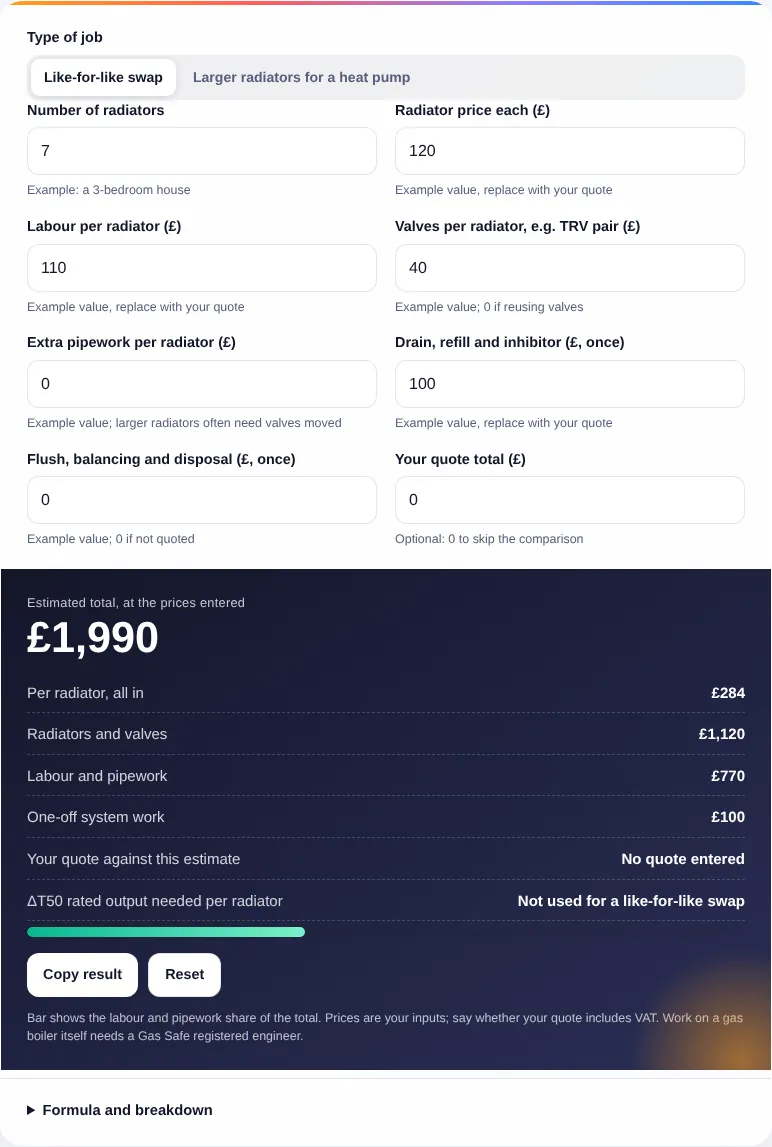
Bar shows the labour and pipework share of the total. Prices are your inputs; say whether your quote includes VAT. Work on a gas boiler itself needs a Gas Safe registered engineer.
Formula and breakdown
n/a
n/a
n/a
This radiator replacement cost calculator adds up the cost of replacing one radiator or every radiator in a home, either like for like or with larger radiators for a heat pump, for households in the UK and Ireland comparing quotes. Every price is an input you can replace with your installer's figure, and the heat pump mode also shows how large each new radiator must be at a lower water temperature, which is what drives the extra cost.
Quick answer: A radiator replacement cost calculator adds radiator, valve and labour prices for each radiator, then one-off system work. Example: seven radiators at an example £120 each, £40 of valves and £110 of labour each, plus £100 to drain, refill and add inhibitor, total £1,990, about £284 per radiator at those prices.
What Is a Radiator Replacement Cost Calculator?
A radiator replacement cost calculator is a tool that totals the materials, labour and system work for swapping radiators, so a quote can be checked line by line. In plain words: total cost equals the number of radiators times the sum of radiator price, valves, labour and any pipework changes per radiator, plus one-off jobs such as draining and refilling the system, adding inhibitor, flushing and balancing.
For a heat pump, the radiator replacement cost calculator also divides each room's heat loss by a correction factor for the lower water temperature. That gives the rated output the new radiator needs on its ΔT50 catalogue figure, which is usually much larger than the radiator it replaces.
How Do You Use the Radiator Replacement Cost Calculator?
- Choose a like-for-like swap, or larger radiators for a heat pump.
- Enter the number of radiators, then the radiator price, valves and labour per radiator from your quote or a supplier's price list.
- For heat pump radiators, add any extra pipework per radiator, pick the new system's delta T and enter each room's heat loss per radiator.
- Enter the one-off system work and, if you have one, your installer's total quote.
- Read the total, the cost per radiator, the split between materials, labour and system work, and how far your quote sits above or below the sum of its parts.
How Much Does It Cost to Replace a Radiator?
The cost of one radiator is the radiator itself plus valves plus labour, plus a share of draining and refilling the system, so prices from quotes and price lists are the only reliable guide. In the default example, a like-for-like swap at an example £120 radiator, £40 of valves and £110 of labour comes to £270 before system work, or about £284 each when £100 of system work is shared across seven radiators.
Online averages vary widely and come from trade lead sites rather than official statistics, so this page does not quote them as fact. What moves the price is clear: the radiator type and size, whether the new radiator's valve positions match the old pipe tails, whether new thermostatic radiator valves are fitted, access to pipes under floors, and whether the system needs a flush. Ask each installer to price these items separately, then enter them in the radiator replacement cost calculator.
How Much Bigger Do Radiators Need to Be for a Heat Pump?
At a mean water temperature 30 °C above the room (ΔT30), a radiator gives about 51% of its ΔT50 catalogue output, so it needs a ΔT50 rating about 1.95 times the room's heat loss. The table uses the Stelrad correction factor table, which converts ΔT50 catalogue outputs to other temperature differences.
| System delta T | Example water and room temperatures | Output factor against ΔT50 | ΔT50 rating needed for a 900 W room |
|---|---|---|---|
| ΔT50 | Mean water 70 °C, room 20 °C | 1.000 | 900 W |
| ΔT30 | Mean water 50 °C, room 20 °C | 0.513 | 1,754 W |
| ΔT25 | Mean water 45 °C, room 20 °C | 0.404 | 2,228 W |
| ΔT20 | Mean water 40 °C, room 20 °C | 0.302 | 2,980 W |
Delta T is the mean of the flow and return water temperatures minus the room temperature. Flow at 55 °C and return at 45 °C gives a mean of 50 °C, so a 20 °C room is at ΔT30. Each room's heat loss should come from a room-by-room calculation, which you can estimate with the heat loss calculator and check against existing radiators with the radiator output calculator.
Do You Have to Replace Radiators When Fitting a Heat Pump?
Not always: radiators that are already larger than the room needs may give enough heat at the heat pump's flow temperature, and only undersized rooms need a change. The Energy Saving Trust's air source heat pump advice lists radiator upgrades as one of the things that change installation cost, alongside the size of the heat pump and the property, and gives a typical installed cost of around £12,000 for an air source heat pump.
The same page says households in England and Wales can get £7,500 towards an air source heat pump through the Boiler Upgrade Scheme. Where radiators are part of the heat pump installation, they are usually priced within the installer's quote. Running costs depend partly on whether radiators are sized correctly, which you can test with the heat pump running cost calculator at different efficiencies.
Who Can Replace Radiators Safely?
A competent plumber or heating engineer can swap radiators on a wet central heating system; any work on a gas boiler or other gas appliance must be done by a Gas Safe registered engineer, as HSE guidance states. Draining the system, refilling, bleeding air and adding inhibitor are part of the job, and the system should be balanced afterwards so every radiator heats evenly.
If you are replacing radiators with electric heaters instead, compare running costs with the electric heater running cost calculator, and have any new circuits installed by a qualified electrician to BS 7671, notifiable under Part P in England and Wales.
Worked Example: Upsizing Seven Radiators for a Heat Pump
Example: a 3-bedroom semi in Nottingham is switching to an air source heat pump designed to run at ΔT30. The installer prices seven larger double panel radiators at an example £220 each, £40 of valves, £110 of labour and £60 of extra pipework per radiator, plus £100 for draining, refilling and inhibitor. The living room loses 900 W at design conditions.
- Radiators and valves: 7 x (£220 + £40) = £1,820.
- Labour and pipework: 7 x (£110 + £60) = £1,190.
- System work: £100. Total: £1,820 + £1,190 + £100 = £3,110, about £444 per radiator.
- Living room radiator: 900 W / 0.513 = 1,754 W rated at ΔT50, about 1.95 times the heat loss.
- Quote check: a £3,000 quote is £110, about 4%, below the sum of these example parts, and the radiator replacement cost calculator shows it as £110 below (4%).
Frequently Asked Questions
How much does it cost to replace all the radiators in a house?
Multiply the number of radiators by the radiator, valve, labour and pipework cost for each, then add one-off system work. Example: seven like-for-like radiators at £270 each plus £100 of system work is £1,990. Larger heat pump radiators with extra pipework cost more per radiator.
Is it cheaper to replace radiators like for like?
Usually, because a radiator with the same width and valve positions fits the existing pipe tails, so little or no pipework changes. Larger heat pump radiators often need valves moved or pipes extended, which adds labour. The calculator shows that extra cost as pipework per radiator.
What does ΔT50 mean on a radiator?
It is the catalogue rating condition: the radiator's output when the mean water temperature is 50 °C above the room, for example 70 °C water in a 20 °C room. At lower water temperatures output falls; at ΔT30 a radiator gives about 51% of its ΔT50 figure.
Do I need new valves when replacing a radiator?
Not always, but new radiators are a good time to fit thermostatic radiator valves if the old valves are worn or manual. Enter 0 for valves if the installer is reusing the existing ones, or the valve price per radiator if new ones are quoted.
Can I replace a radiator myself?
A competent person can swap a radiator on a wet system, but it means isolating or draining the system, refilling, bleeding and adding inhibitor. Any work on a gas boiler or gas appliance must be done by a Gas Safe registered engineer.
Why does the radiator replacement cost calculator ask for my quote?
So you can see whether the total is in line with the parts you were quoted or have priced yourself. A quote far above the sum of its parts may include extras, such as a power flush or making good, that you can ask the installer to itemise.
Checked October 2026 by the Solaxyra Editorial Team. Sources: Stelrad: radiator correction factors, Energy Saving Trust: air source heat pumps, HSE: domestic gas safety FAQs.