Estimate for planning. Boiler and heat pump changes must be made by a Gas Safe registered engineer or a qualified heat pump installer.
Formula and breakdown
n/a
n/a
n/a
This radiator output calculator converts the ΔT50 output printed in a radiator datasheet into the heat it really gives at your flow, return and room temperatures, for UK and European homes checking a boiler flow setting or planning a heat pump.
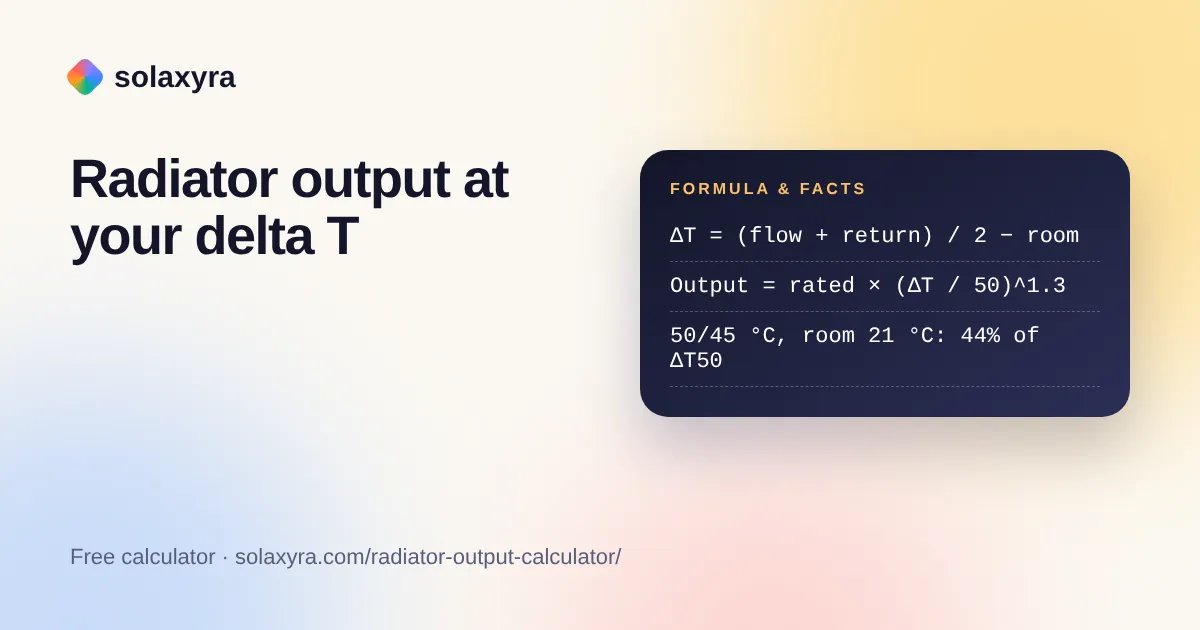
Quick answer: A radiator output calculator multiplies the ΔT50 catalogue output by (your ΔT / 50) to the power 1.3, where ΔT is the average of flow and return temperatures minus room temperature. A 1,000 W radiator gives about 438 W at 50 °C flow, 45 °C return and a 21 °C room.
What Is a Radiator Output Calculator?
A radiator output calculator is a tool that corrects a radiator's catalogue rating for the temperatures your heating system actually runs at. In plain words: work out how much hotter the water is than the room on average (delta T), divide by the delta T the catalogue used (normally 50 °C), raise the result to the power of the radiator exponent (about 1.3), and multiply by the catalogue output.
Catalogue outputs are measured under the European test standard EN 442. Research published in the REHVA Journal on EN 442 rating conditions sets out the design point of 75 °C flow, 65 °C return and a 20 °C room, which gives the 50 K over-temperature behind the ΔT50 label, and the characteristic equation output = constant × ΔT to the power n. Your system almost never runs at exactly that point, so the printed figure is a reference, not a promise.
How Do You Use the Radiator Output Calculator?
- Choose watts or BTU per hour and enter the catalogue output from the radiator's datasheet.
- Enter the delta T that figure is quoted at. Most current UK and EU data uses 50 °C; some older tables use 60 °C.
- Enter your flow and return temperatures. A boiler display or heat pump app usually shows flow; return is typically 5 °C to 20 °C lower.
- Enter the room temperature you want to hold.
- Keep the exponent at 1.3 unless the manufacturer gives a different value.
- Optionally enter the room's heat loss in watts to see whether the radiator covers it and what catalogue output a replacement would need.
- Switch between arithmetic and logarithmic mean if you want the more exact figure for a large flow to return drop.
How Do You Calculate Radiator Output at a Different Delta T?
Actual output = catalogue output × (actual ΔT / catalogue ΔT)^1.3, with ΔT = (flow + return) / 2 − room. Zehnder, a radiator manufacturer, defines delta T in exactly this way in its guide to delta T correction factors and describes 1.3 as the exponent that represents most radiators.
Because the exponent is above 1, output falls faster than delta T. Halving delta T from 50 °C to 25 °C does not halve the output; it leaves about 41%. The logarithmic mean, ΔT = (flow − return) / ln[(flow − room) / (return − room)], gives a slightly smaller delta T when the drop across the radiator is large and is the more accurate choice in that case.
How Close Is the 1.3 Exponent to Manufacturer Tables?
The 1.3 exponent reproduces published correction tables to within about 0.02 across the usual range. The table compares the factor this radiator output calculator uses with figures published by Stelrad and in a Worcester Bosch technical bulletin.
| Delta T (°C) | Factor with n = 1.3 | Stelrad table | Worcester Bosch TB0029 |
|---|---|---|---|
| 20 | 0.304 | 0.302 | not listed |
| 25 | 0.406 | 0.404 | 0.400 |
| 30 | 0.515 | 0.513 | 0.510 |
| 35 | 0.629 | 0.627 | 0.643 |
| 40 | 0.748 | 0.747 | 0.759 |
| 45 | 0.872 | 0.871 | 0.878 |
| 50 | 1.000 | 1.000 | 1.000 |
| 55 | 1.132 | 1.132 | 1.126 |
| 60 | 1.267 | 1.268 | 1.254 |
Where a manufacturer publishes its own exponent or table for a specific model, use that figure. Type it into the exponent box and the radiator output calculator will follow it.
How Much Heat Does a Radiator Give at Heat Pump Temperatures?
A radiator rated 1,000 W at ΔT50 gives about 438 W at 50 °C flow and 45 °C return in a 21 °C room, and about 237 W at 40/35 °C. The table runs from classic boiler temperatures down to low heat pump temperatures, all for a 21 °C room and n = 1.3.
| Flow / return (°C) | Delta T (°C) | Output of a 1,000 W ΔT50 radiator | ΔT50 rating needed for 1,000 W |
|---|---|---|---|
| 75 / 65 | 49.0 | 974 W | 1,027 W |
| 70 / 60 | 44.0 | 847 W | 1,181 W |
| 65 / 55 | 39.0 | 724 W | 1,381 W |
| 60 / 50 | 34.0 | 606 W | 1,651 W |
| 55 / 50 | 31.5 | 548 W | 1,823 W |
| 50 / 45 | 26.5 | 438 W | 2,283 W |
| 45 / 40 | 21.5 | 334 W | 2,996 W |
| 40 / 35 | 16.5 | 237 W | 4,226 W |
| 35 / 30 | 11.5 | 148 W | 6,757 W |
The right-hand column is why heat pump surveys look room by room: a radiator that was generous on a 70 °C boiler may need replacing with a larger double or triple panel, while others may already be big enough. Lower flow temperatures also make a heat pump more efficient, which you can test against running costs in the heat pump running cost calculator.
What Should You Do if a Radiator Is Too Small?
If the result covers less than the room heat loss, you can raise the flow temperature, fit a larger radiator, add a second emitter, or reduce the heat loss with insulation. Each has a trade-off. Raising flow temperature costs efficiency on both condensing boilers and heat pumps. The Energy Saving Trust explains that a lower flow temperature helps a boiler run more efficiently, but warns that where one control serves both radiators and a hot water cylinder, the setting should be no lower than 65 °C so the cylinder reaches 60 °C.
A portable heater can bridge a cold room short term; the electric heater running cost calculator shows what that costs per hour. For a lasting fix, start from a proper room heat loss figure using the heat loss calculator and then size emitters with the radiator size calculator.
Safety: replacing radiators, changing pipework or adjusting anything inside a gas boiler must be done by a Gas Safe registered engineer in the UK, or a registered gas installer under the rules where you live. Heat pump systems should be designed and commissioned by a qualified installer. Changing the flow temperature from the boiler's own user controls, as described in its manual, is something you can do yourself.
Worked Example: Checking a Living Room Radiator for a Heat Pump
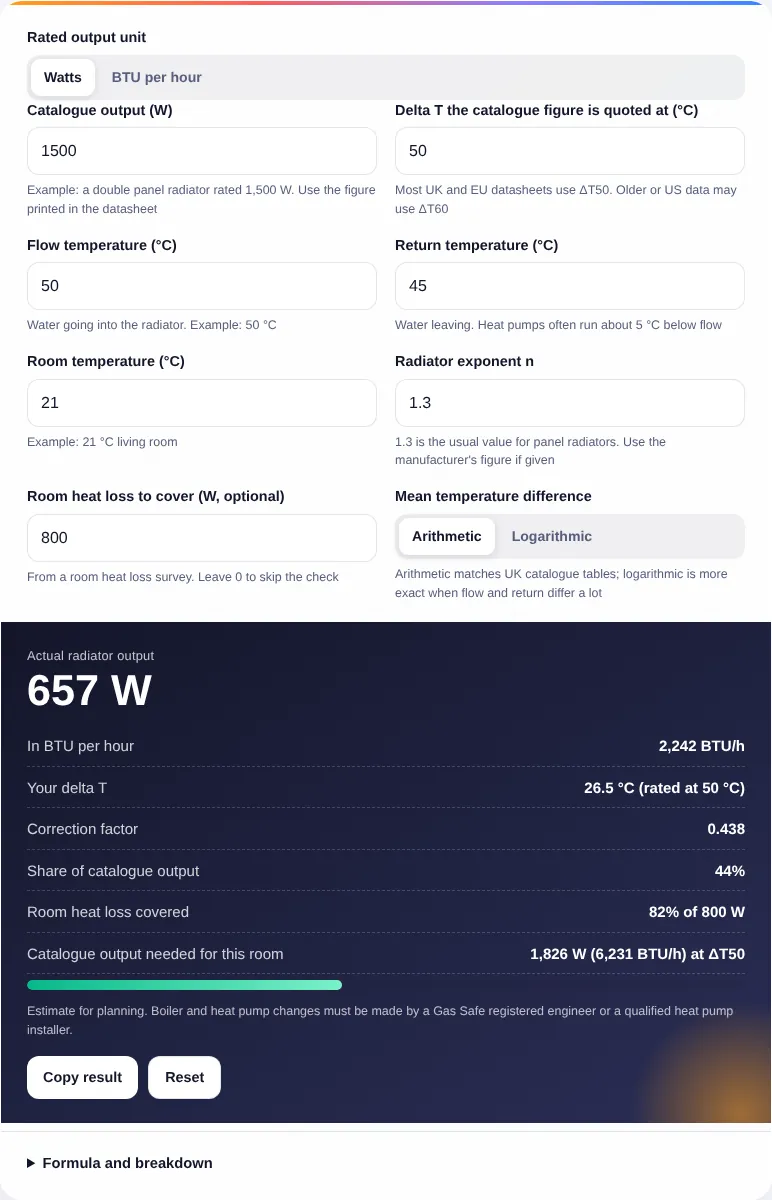
Example: a living room in a 1970s semi needs 800 W at 21 °C on a cold day, according to its heat loss survey. It has a double panel radiator rated 1,500 W at ΔT50, and the proposed heat pump will run at 50 °C flow and 45 °C return.
- Delta T = (50 + 45) / 2 − 21 = 26.5 °C.
- Factor = (26.5 / 50)^1.3 = 0.530^1.3 = 0.438.
- Output = 1,500 × 0.438 = 657 W, which is 2,242 BTU/h.
- Coverage = 657 / 800 = 82% of the heat loss, so the room would fall short on the coldest days.
- Catalogue output needed = 800 / 0.438 = 1,826 W at ΔT50.
In this example a replacement radiator of at least about 1,850 W at ΔT50 would do the job, or the existing one could stay if the flow temperature rose to about 55 °C on the coldest days. With the logarithmic mean the delta T is 26.4 °C and the answer barely changes, because the 5 °C drop across the radiator is small.
Frequently Asked Questions
What does ΔT50 mean on a radiator?
ΔT50 means the catalogue output was measured with the average water temperature 50 °C above the room. Under EN 442 that is 75 °C flow, 65 °C return and a 20 °C room. Real systems often run cooler, so the radiator gives less than the figure printed in the brochure.
Why is the exponent 1.3?
Heat leaves a radiator partly by convection, which rises faster than the temperature difference itself, so output grows a little more than in proportion to ΔT. Zehnder describes 1.3 as typical of most radiators. Convectors and fan-assisted emitters differ, so use the manufacturer's figure where one is given.
How much output does a radiator lose with a heat pump?
At 50 °C flow, 45 °C return and a 21 °C room, a panel radiator gives about 44% of its ΔT50 rating. At 45 °C flow it falls to about a third. That is why heat pump designs often need some larger radiators or a lower room heat loss.
Should I use the arithmetic or logarithmic mean?
Use arithmetic to match UK manufacturers' correction tables, which define ΔT as the average of flow and return minus room temperature. The logarithmic mean is more exact when the drop between flow and return is large, such as 20 °C, and gives a slightly lower output.
How do I convert BTU to watts for a radiator?
Divide BTU per hour by 3.412 to get watts, or multiply watts by 3.412 to get BTU per hour. A radiator listed at 5,000 BTU/h is about 1,465 W. Check which delta T the BTU figure was quoted at before comparing models.
Can I lower my boiler flow temperature myself?
Many combi boilers let you lower the radiator flow setting from the control panel, following the manual. If a hot water cylinder shares the same control, the Energy Saving Trust advises keeping it at 65 °C or more. Any work inside the boiler must be done by a Gas Safe registered engineer.
Checked October 2026 by the Solaxyra Editorial Team. Sources: REHVA Journal on EN 442, Zehnder correction factors, Stelrad correction factor table, Worcester Bosch TB0029, Energy Saving Trust thermostats and controls, Wikipedia: British thermal unit.