Estimates for unshaded panels from a solar geometry model with direct and diffuse light. Results agree with published UK guidance (east or west about 15 to 20% below south) but are not a site survey. For site-specific figures use PVGIS, and have mounting and wiring done by a certified installer.
Formula and breakdown
n/a
This solar panel orientation calculator shows what share of the best possible yearly output your panels get from the direction they face and their tilt, for homes in the UK, Ireland and European capitals. Enter any compass direction, or split panels between two roof faces such as east and west, and the tool estimates the loss against a south-facing panel at the best angle, with an optional kWh figure.
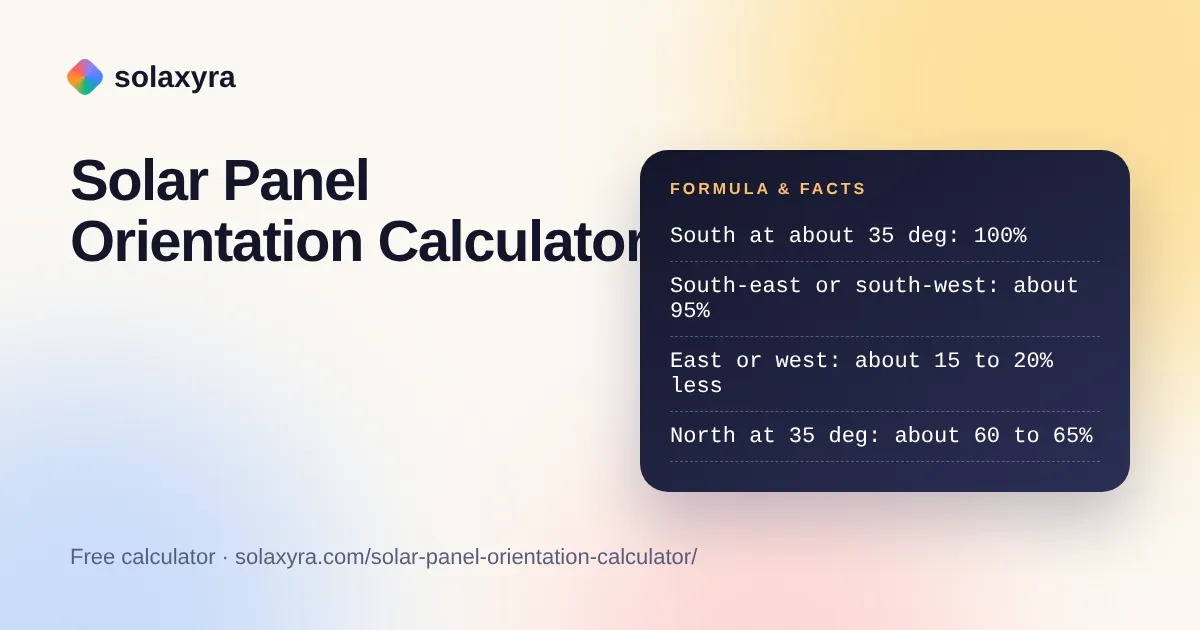
Quick answer: A solar panel orientation calculator compares your roof’s direction and tilt with the best possible setup. In the UK, south-facing panels at about 35° are best. East or west faces typically give around 15% to 20% less over a year, south-east and south-west about 5% less, and north-facing panels about a third less or more.
What Is a Solar Panel Orientation Calculator?
A solar panel orientation calculator is a tool that estimates how much sunlight panels receive over a year depending on the compass direction they face (azimuth) and their tilt, compared with the best orientation for the same place. In the northern hemisphere the best direction is due south, because the sun is in the southern sky at midday.
In plain words, the method follows the sun hour by hour through a year, works out the angle between the sun and the panel surface, and adds up direct sunlight hitting the panel, diffuse light from the sky and a little light reflected from the ground. The total for your direction and tilt is divided by the total for the best case, which gives the percentage shown. The PVGIS user manual measures azimuth from due south, with east as -90° and west as 90°, so the tool also converts your compass bearing into that form for use in PVGIS.
How Do You Use the Solar Panel Orientation Calculator?
- Choose one roof face, or two faces if your panels are split, for example across an east-west roof.
- Pick your city, or enter a custom latitude and sky type.
- Enter the compass direction the panels face: 90 for east, 180 for south, 270 for west. A phone compass app held flat against the roof line gives a good reading.
- Enter the tilt in degrees. For two faces, add the second direction and the share of panels on it.
- Optionally enter system size and an annual yield per kWp from PVGIS to see estimated kWh.
- Read the percentage, the loss and the bar chart showing every main direction at your tilt.
How Much Less Do East or West Facing Solar Panels Produce?
East or west facing panels usually produce around 15% to 20% less over a year than south-facing ones in the UK, which is the range the Energy Saving Trust gives in its solar panel advice. This calculator gives about 17% less for east or west at 35° in London. Real roofs vary: a co-operative in Brighton measured its east-west panels at 22° producing 92% of its south-facing ones, and a London homeowner found his west panels made about 5% more than his east ones over a year, partly because mornings were cloudier. The model treats east and west equally, so use it for comparison and PVGIS or local data for detail.
Is an East-West Roof Worth It for Solar Panels?
An east-west roof is usually worth using, because the loss is moderate and the output is spread across the day. Morning panels cover breakfast-time use and afternoon panels keep producing into early evening, when many households are at home, so more of the energy can be used in the home rather than exported. Splitting panels across both faces at a lower pitch, such as 15° to 20°, cuts the loss further, because flatter panels see more of the sky in every direction. Compare the self-use benefit with the solar self consumption calculator.
Can Solar Panels Work on a North-Facing Roof?
North-facing panels on a typical 35° UK roof collect only about 60% to 65% of the best yield in this model, and the Energy Saving Trust does not recommend installing them. The penalty shrinks sharply on shallow roofs: at 15° a north face still gets close to 80%, because the panel is nearly flat. If a north face is the only option, compare the reduced output with the cost, and check the payback with the solar payback calculator before deciding.
Does the Best Tilt Change When Panels Do Not Face South?
Yes, the further panels turn from south, the flatter the best tilt becomes. For east or west faces in the UK, a flat or low tilt loses least, while steep tilts lose most. That is why east-west frames on flat roofs often use low angles. For south-facing panels, the solar panel angle calculator finds the best tilt for your city.
Solar Panel Output by Direction and Tilt in London
Share of the best annual yield for unshaded panels in London, from the calculator’s model. The best case is due south at about 34°.
| Direction | Flat (0°) | 15° | 30° | 45° | Vertical (90°) |
|---|---|---|---|---|---|
| South | 89% | 97% | 100% | 99% | 71% |
| South-east or south-west | 89% | 94% | 95% | 93% | 67% |
| East or west | 89% | 88% | 84% | 79% | 56% |
| North-east or north-west | 89% | 81% | 72% | 63% | 42% |
| North | 89% | 78% | 67% | 56% | 35% |
The flat column is the same for every direction because a flat panel has no direction. Shading from chimneys, trees or neighbouring buildings is not included and can matter more than orientation.
Worked Example: Aisha’s East-West Terrace in Manchester
Aisha in Manchester lives in a terraced house with roof faces pointing east (90°) and west (270°), both pitched at 30°. Her installer proposes 4 kWp split evenly across the two faces.
- Each face collects about 84% of the best annual yield, so the split array also averages about 84%.
- The same 4 kWp facing south at 30° would collect almost 100%.
- Using an example yield of 950 kWh per kWp at the best orientation, the east-west array makes about 4 x 950 x 0.84 = 3,190 kWh a year, against about 3,790 kWh for a south-facing array.
Aisha has no south face, so the real comparison is 3,190 kWh against nothing. Because she is out during the middle of the day, the morning and evening spread suits her use. She replaces the example yield with the PVGIS figure for her postcode before relying on the kWh estimate, and her installer arranges the two faces on separate MPPT inputs.
Frequently Asked Questions
Which direction should solar panels face in the UK?
Due south gives the most energy over a year in the UK and the rest of the northern hemisphere. South-east and south-west lose only around 5%, and east or west around 15% to 20%, so most roofs that do not face north are still suitable.
Is west better than east for solar panels?
Over a year they are close, and the model treats them equally. Real data often favours west slightly where mornings are cloudier, and west-facing panels produce in late afternoon when many households are home, which can raise the share of solar power used directly.
What is azimuth in PVGIS?
PVGIS measures azimuth from due south: 0° is south, -90° is east and 90° is west. A compass bearing is converted by subtracting 180°, so a panel facing 225° on a compass, south-west, has a PVGIS azimuth of 45°.
How do I find the direction my roof faces?
Stand in the garden or on the street and hold a phone compass parallel to the roof slope, pointing the way the panels would face. Online map tools also show building outlines, from which you can estimate the angle of the roof line. Small errors of 10° to 15° change the result very little.
Should I split panels between east and west roofs?
Splitting gives similar annual output to using one side but spreads generation across the day, which suits households with morning and evening demand. Panels on each face should go to separate MPPT inputs or use microinverters or optimisers, so the faces do not hold each other back.
Does orientation matter for balcony and wall solar panels?
Yes, and more than on roofs, because vertical panels lose most when they turn away from south. A vertical south-facing panel in London gets about 71% of the best yield, while a vertical east or west panel gets about 56%. A small tilt helps if the mounting allows it.
Checked October 2026 by the Solaxyra Editorial Team. Sources: Energy Saving Trust, PVGIS user manual, Jacobson and Jadhav (2018), Wikipedia: Position of the Sun.