This guide explains how to read a gas meter, whether it is a metric meter in cubic metres, an older imperial meter in cubic feet or a smart meter, and how to convert the reading into kWh so you can check your bill.
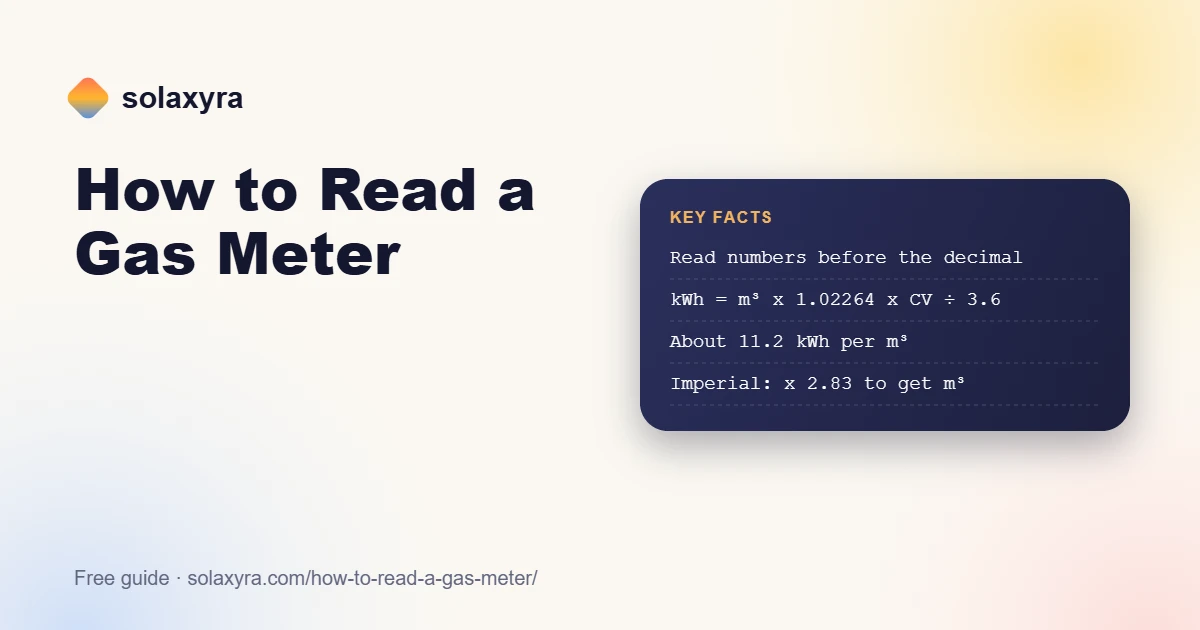
Quick answer: Write down the numbers before the decimal point, ignoring red digits or those after it. For metric meters (m³), kWh = units used × 1.02264 × calorific value (about 39.5) ÷ 3.6, roughly 11.2 kWh per m³. For imperial meters (ft³), multiply the hundreds of cubic feet by 2.83 first to get m³.
Is your meter metric or imperial?
- Metric meters show m³ on the face and usually have five digits before a decimal point, often with red digits after it.
- Imperial meters show ft³ or cubic feet and usually have four black digits. They measure in hundreds of cubic feet.
- Smart meters show the reading on a small screen, sometimes after pressing a button.
How to read a metric gas meter
- Write down the digits from left to right before the decimal point or the red digits.
- Ignore the numbers after the decimal point or in red.
- Note the date. Two readings a month apart show what you used in between.
How to read an imperial gas meter
- Write down the first four digits, from left to right.
- Ignore any red digits or the dial that moves fastest.
- The difference between two readings is in hundreds of cubic feet.
How to read a smart gas meter
Press the button marked A or 9 until the display shows a figure in m³, often labelled as the meter index. Some meters need you to press a button to wake the screen. Your supplier receives readings automatically, but it is useful to check them.
How do you convert a gas reading to kWh?
Gas is billed in kWh, so suppliers convert the volume using a volume correction factor of 1.02264 and a calorific value that describes the energy in the gas, usually around 37.5 to 43 MJ per m³, and often about 39.5.
- Subtract the old reading from the new one to get the units used.
- For imperial meters, multiply by 2.83 to convert hundreds of cubic feet to m³.
- Multiply by 1.02264.
- Multiply by the calorific value from your bill.
- Divide by 3.6 to convert megajoules to kWh.
Worked conversion examples
Using a calorific value of 39.5 and the October to December 2026 gas cap of 7.97p per kWh:
| Units used | Meter type | m³ | kWh | Cost |
|---|---|---|---|---|
| 100 | Metric | 100 | 1,122 | £89.42 |
| 250 | Metric | 250 | 2,805 | £223.56 |
| 40 | Imperial (hundreds ft³) | 113.2 | 1,270 | £101.22 |
Why does my gas bill differ from my own calculation?
The calorific value changes a little each billing period, and suppliers use the actual figure for your area. Standing charges, 29.68p a day under the current cap, are added on top. Estimated readings can also cause differences, so send actual readings when asked.
Frequently Asked Questions
Which numbers do I read on a gas meter?
The digits before the decimal point or the red numbers.
How many kWh is 1 m³ of gas?
About 11.2 kWh, depending on the calorific value.
How do I know if my gas meter is imperial?
It shows ft³ or cubic feet and usually has four main digits.
How often should I read my gas meter?
Monthly is ideal, or whenever your supplier asks, to avoid estimated bills.
Checked November 2026 by the Solaxyra Editorial Team. Sources: Ofgem: How to read your meter, National Gas: Calorific value, Ofgem: Energy price cap, 1 October to 31 December 2026.