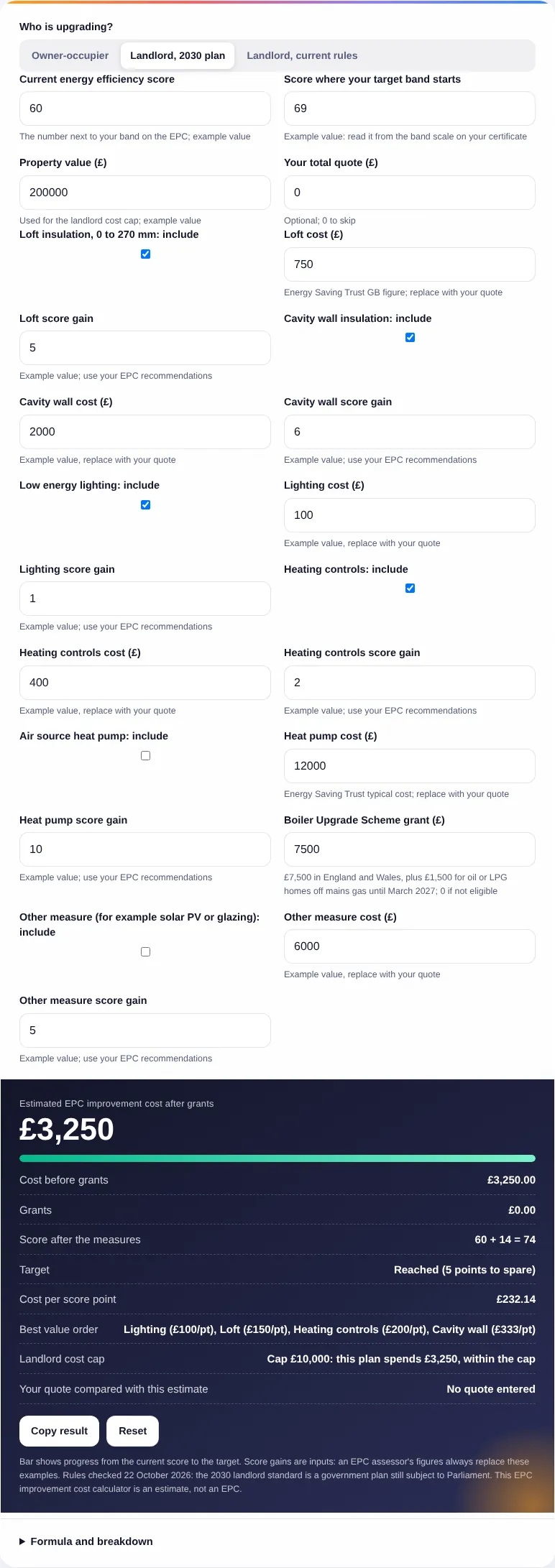
Bar shows progress from the current score to the target. Score gains are inputs: an EPC assessor’s figures always replace these examples. Rules checked 22 October 2026: the 2030 landlord standard is a government plan still subject to Parliament. This EPC improvement cost calculator is an estimate, not an EPC.
Formula and breakdown
n/a
n/a
n/a
This EPC improvement cost calculator estimates what it costs to lift a home's Energy Performance Certificate score to a target band, for owners in England and Wales and for private landlords planning for the proposed EPC C standard in 2030. You tick the measures on your certificate, enter their costs and score gains, and the tool shows the cost after grants, the new score, the cost per point and how the plan sits against the landlord cost cap.
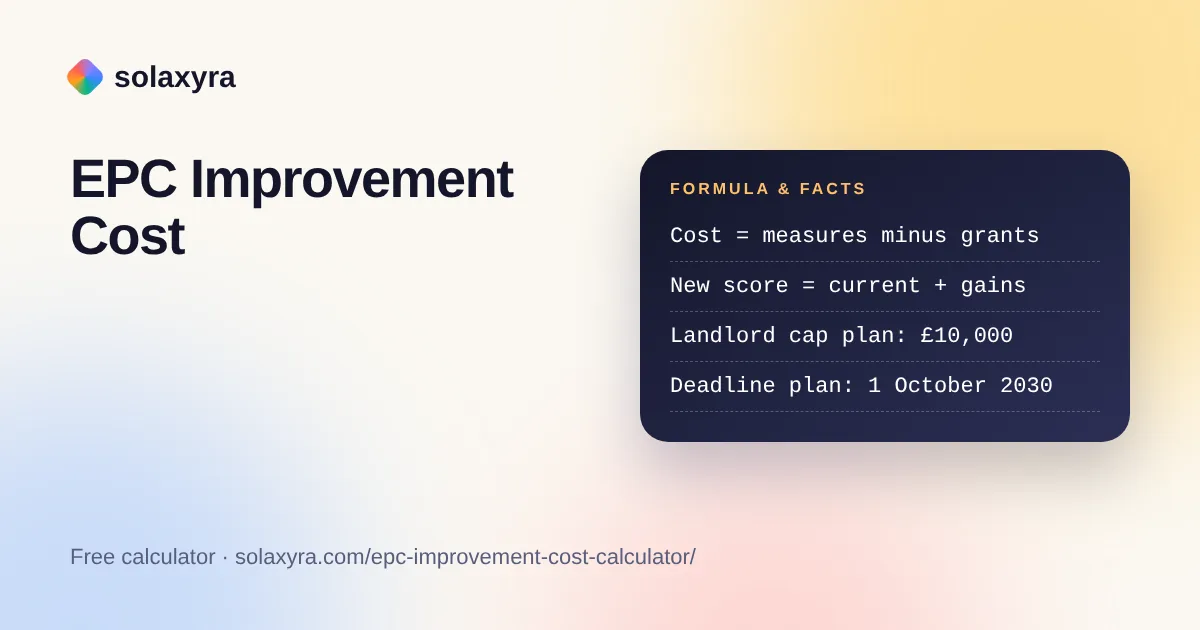
Quick answer: An EPC improvement cost calculator adds the cost of each measure, takes off grants and adds each measure's score gain to your current score. Government plans cap required landlord spending at £10,000 per property by 1 October 2030, and its impact assessment puts the average spend at £5,400.
What Is an EPC Improvement Cost Calculator?
An EPC improvement cost calculator is a tool that totals the cost of energy efficiency measures and shows whether they raise a home's energy efficiency score enough to reach a target band. In plain words: cost after grants equals the sum of the chosen measure costs minus grants, the new score equals the current score plus the score gains of those measures, and the cost per point equals cost after grants divided by the total gain.
The score is the Energy Efficiency Rating shown beside the band on your certificate, and bands run from A, the most efficient, to G, the least. A certificate is valid for 10 years. Each measure's effect depends on the home, so the gains in the tool are examples: replace them with the figures from your own certificate or assessor.
How Do You Use the EPC Improvement Cost Calculator?
- Choose owner-occupier, landlord under the 2030 plan, or landlord under current rules.
- Enter your current score from the EPC, and the score where your target band starts, read from the band scale on the certificate.
- Tick the measures you are considering. Replace each example cost with your quote and each example score gain with your certificate's figure.
- For a heat pump, enter the Boiler Upgrade Scheme grant if you are eligible.
- For landlords, enter the property value so the tool can apply the right cap.
- Read the cost after grants, whether the target is reached, the cost per point and the best-value order.
What Do Common EPC Improvements Cost?
Only a few measures have a published national cost figure, so the calculator separates them from examples. The Energy Saving Trust gives £750 to insulate a loft from 0 to 270 mm in Great Britain, and around £12,000 as a typical air source heat pump installation. Everything else is an example to replace with a quote.
| Measure | Default cost in the tool | Where the figure comes from | Notes |
|---|---|---|---|
| Loft insulation, 0 to 270 mm | £750 | Energy Saving Trust, Great Britain | £600 when topping up from 120 mm; £1,100 in Northern Ireland |
| Cavity wall insulation | £2,000 | Example value | Varies with wall area and access |
| Low energy lighting | £100 | Example value | Depends on fittings |
| Heating controls | £400 | Example value | Programmer, room thermostat, radiator valves |
| Air source heat pump | £12,000 | Energy Saving Trust typical cost | Boiler Upgrade Scheme grant of £7,500 in England and Wales |
| Other measure | £6,000 | Example value | For example solar PV or glazing |
For a detailed price on one measure, use the heat pump installation cost estimate, the loft insulation savings estimate or the solar panel calculator, then bring the figure back here. Running cost changes after a heat pump can be checked with the heat pump running cost calculator.
What Are the EPC Rules for Landlords in 2030?
The government plans that all private tenancies in England and Wales meet a higher standard by 1 October 2030, with no earlier date for new tenancies. That comes from its January 2026 response on improving the energy performance of privately rented homes. The changes still need Parliament's approval, and the government aims to bring the regulations into force in 2027.
The key numbers in that response, which the EPC improvement cost calculator uses in its 2030 landlord mode, are:
- A cost cap of up to £10,000 per property, or 10% of the value for homes worth under £100,000.
- Spend on measures installed since 1 October 2025 counts towards the cap.
- Boiler Upgrade Scheme funding does not count towards the cap.
- If the standard is not met after reaching the cap, a cost cap exemption can be registered, valid for 10 years.
- A home rated C or higher on the current Energy Efficiency Rating before 1 October 2029 is treated as compliant until that EPC expires or is replaced.
- A maximum penalty of £30,000 per breach for each non-compliant property.
The new standard will be measured with new metrics, a fabric performance metric plus either a heating system or smart readiness metric, and the government has said it will confirm the band boundaries later. Until then, the transition rule makes the current score the practical target, which is what this tool works with.
What Are the Rules for Landlords Today?
Today the minimum is band E. GOV.UK's landlord guidance on the minimum energy efficiency standard says landlords cannot let a property rated below E without a valid exemption, are not currently required to spend more than £3,500 including VAT, and face a maximum fine of £5,000 per property. Choose the current rules option to test a plan against that cap.
Which Measures Does the EPC Improvement Cost Calculator Rank Best?
The cheapest measure per point usually goes first, and the tool sorts your ticked measures by cost per point after grants. With the example figures, lighting comes out at £100 per point, loft insulation at £150, heating controls at £200 and cavity wall insulation at about £333. A heat pump with a £7,500 grant and an £11,000 quote comes out at £350 per point if it adds 10 points.
Value per point is not the only test. Some measures cut bills more than their score suggests, and some homes cannot take certain measures. Check your quotes, then use the EPC improvement cost calculator to compare combinations until the target is reached at the lowest cost after grants. The EPC rating estimate helps if you do not yet have a certificate.
Worked Example: A Rented House Worth £85,000
Example: a landlord in England owns a house valued at £85,000 with a current score of 55. The target is the score where band C starts on the certificate, 69 in this example. The plan is loft insulation (£750, 5 points), low energy lighting (£100, 1 point), heating controls (£400, 2 points) and an air source heat pump quoted at £11,000 (10 points) with a £7,500 Boiler Upgrade Scheme grant.
- Cost before grants: £750 + £100 + £400 + £11,000 = £12,250.
- Cost after grants: £12,250 minus £7,500 = £4,750.
- New score: 55 + 5 + 1 + 2 + 10 = 73, which is 4 points above the target.
- Cost cap: the home is worth under £100,000, so the cap is 10% of £85,000 = £8,500.
- Spend counted towards the cap: £4,750, because grant funding is excluded. The plan is within the cap.
Cost per point is £4,750 divided by 18 points, about £264. A builder's package quote of £4,500 would be £250, or 5.3%, below this estimate.
Frequently Asked Questions
How much does it cost to improve an EPC rating to C?
It depends on the measures your certificate recommends. The government's impact assessment estimates an average landlord spend of £5,400 to meet the planned standard. Add the cost and score gain of each measure in the calculator, take off grants, and check whether the new score reaches band C.
What is the £10,000 cap for landlords?
Under the government's January 2026 plan, private landlords in England and Wales will not have to spend more than £10,000 per property to reach the new standard, or 10% of the value for homes worth under £100,000. Spend on measures installed since 1 October 2025 counts, but Boiler Upgrade Scheme funding does not.
When do rented homes need EPC C?
The plan is that all private tenancies in England and Wales meet the higher standard by 1 October 2030, with no earlier date for new tenancies. The changes still need Parliament's approval, and the government aims to lay the regulations to come into force in 2027.
What are the current EPC rules for landlords?
Today, landlords cannot let a property rated below E unless a valid exemption is registered. GOV.UK guidance says they are not currently required to spend more than £3,500 including VAT, and the maximum fine is £5,000 per property. Use the current rules option in the calculator.
Where do I find how many points each measure adds?
Your EPC lists recommended improvements and the rating the home could reach, and a domestic energy assessor can give the score effect of each measure. The calculator's default gains are examples only, because the effect of any measure depends on the home, so always replace them with figures for your property.
Does a heat pump grant count towards the landlord cost cap?
No. The government response says Boiler Upgrade Scheme funding does not count towards the £10,000 cap. The grant is £7,500 for an air or ground source heat pump in England and Wales, with an extra £1,500 for oil or LPG homes off mains gas until March 2027.
Checked October 2026 by the Solaxyra Editorial Team. Sources: GOV.UK: Improving the energy performance of privately rented homes, government response, GOV.UK: Minimum energy efficiency standard, landlord guidance, GOV.UK: Boiler Upgrade Scheme, Energy Saving Trust: Roof and loft insulation, Energy Saving Trust: Air source heat pumps, GOV.UK: Find an energy certificate.