Not an official EPC. This converts a score you already have into its band. Only an accredited assessor can produce an EPC; check existing certificates free on the GOV.UK register.
Formula and breakdown
n/a
n/a
This EPC rating calculator converts an energy efficiency score (SAP points) into its A to G Energy Performance Certificate band, shows how many points you need to reach the next band or band C, and checks the private rented minimum, for homeowners, buyers and landlords in England, Wales and Northern Ireland. It is not an official EPC and cannot rate your home from scratch: only an accredited assessor can produce a certificate, and you can view any existing one free on the GOV.UK find an energy certificate service.
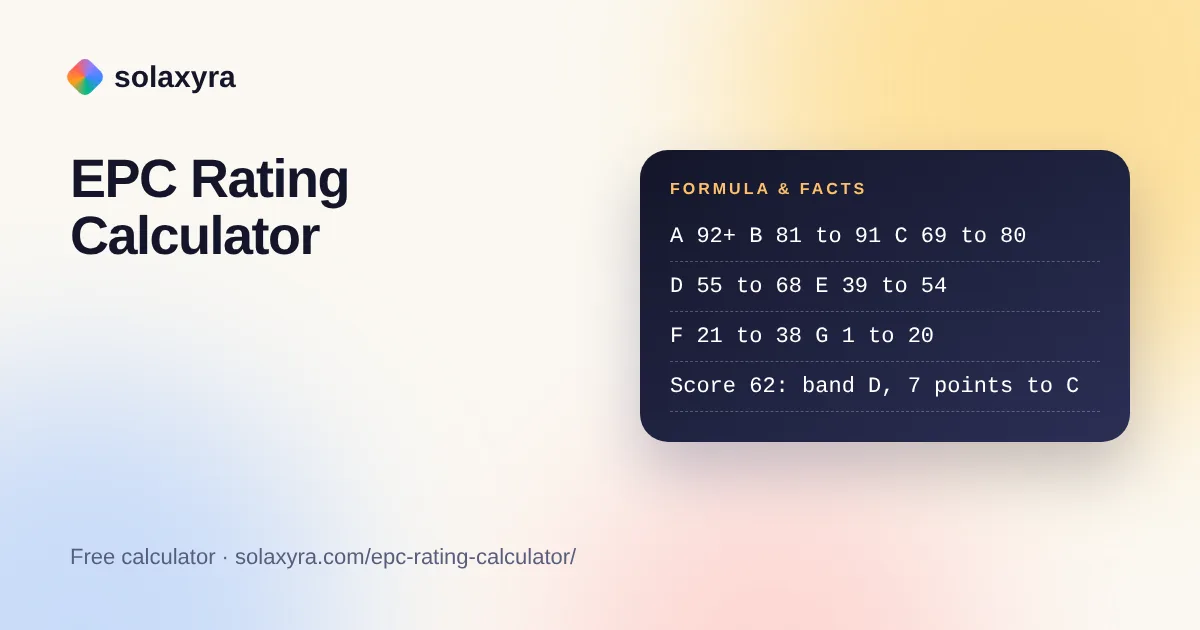
Quick answer: An EPC rating calculator maps a SAP score to a band: A is 92 or more, B 81 to 91, C 69 to 80, D 55 to 68, E 39 to 54, F 21 to 38 and G 1 to 20. A home scoring 62 is band D and needs 7 more points for band C. It is not an official EPC.
What Is an EPC Rating Calculator?
An EPC rating calculator is a tool that looks up which energy efficiency band a given score falls into, using the same score ranges printed on domestic EPCs. In plain words: find the highest band whose lower limit is at or below your score. A score of 62 is at or above 55, the lower limit of band D, but below 69, the lower limit of band C, so it is band D.
The score is the SAP rating. The Standard Assessment Procedure (SAP) is the government method for rating homes, and its specification describes the rating as a scale of 1 to 100 where a higher number means lower running costs. It reflects the modelled energy costs of space heating, water heating, ventilation and lighting, minus savings from on-site generation, adjusted for floor area, and it can exceed 100 when renewable generation is installed. Existing homes are assessed with the reduced data version, RdSAP.
How Do You Use the EPC Rating Calculator?
- Find your certificate on the GOV.UK register by postcode, or on the Scottish EPC Register if the home is in Scotland.
- Enter the current energy efficiency score shown next to the current rating.
- Optionally enter the potential score, or the score shown after a recommended improvement, to see the band it would reach.
- Choose how the home is used to see the private rented minimum check for England and Wales.
- Read the band, the points to the next band and the points to band C, then open the breakdown to see the band limits used.
What Are the EPC Bands and SAP Score Ranges?
There are seven bands, from A (most efficient) to G (least efficient), and each covers a fixed range of SAP points. The ranges below are the ones printed on the rating chart of domestic EPCs lodged on the GOV.UK register.
| Band | SAP score range | Points to reach the band above |
|---|---|---|
| A | 92 or more | Top band |
| B | 81 to 91 | From 81: 11 points to A |
| C | 69 to 80 | From 69: 12 points to B |
| D | 55 to 68 | From 55: 14 points to C |
| E | 39 to 54 | From 39: 16 points to D |
| F | 21 to 38 | From 21: 18 points to E |
| G | 1 to 20 | From 1: 20 points to F |
The middle bands are narrow, so a home near the top of D can reach C with a single measure, while a home at the bottom of D may need several. That is why the EPC rating calculator shows points to the next band rather than the band alone.
How Is an Official EPC Rating Calculated?
An accredited assessor visits the home, records its construction, insulation, heating, hot water, windows, lighting and any renewables, and enters them into approved RdSAP software, which produces the SAP score and band. This page cannot reproduce that model; it only interprets a score you already have.
The GOV.UK guidance on energy performance certificates says an EPC contains information about a property’s energy use and typical energy costs, with recommended steps to improve it, rates it from A (best) to G (worst) and is valid for 10 years. To get a new one you pay an accredited assessor, and you can be fined if you do not get an EPC when you need one.
What EPC Rating Does a Rented Home Need?
A privately rented home in England or Wales must normally be rated band E or above: landlords cannot let or continue to let a property rated below E unless a valid exemption is registered. The GOV.UK minimum energy efficiency standard guidance says landlords are not currently required to spend more than £3,500 including VAT on improvements, and that the government aims for as many rented homes as possible to reach band C or equivalent by 2030. The EPC rating calculator flags scores below 39 when you select a private let.
What Moves an EPC Score Up?
The quickest guide is your own certificate: it lists recommended improvements and the potential rating the home could reach if they are carried out, so enter that figure as the potential score to see the band it reaches. Because the score is built on modelled running costs, measures that cut heating demand or energy cost usually help most.
- Insulation: the cavity wall insulation savings calculator and loft insulation savings calculator estimate the bill saving behind those recommendations.
- Heating: a more efficient system lowers modelled costs; compare options with the heat pump running cost calculator.
- Generation: SAP deducts savings from on-site generation, so solar panels can raise the score; size a system with the solar panel calculator.
- Windows: the double glazing savings calculator shows the saving from replacing single glazing.
Are EPC Ratings Changing in 2026?
Changes are planned, but at the time of checking, EPCs are still issued on the SAP-based A to G scale shown above. The UK government consulted from 21 January to 18 March 2026 on an EPC based on the new Home Energy Model, with four proposed headline metrics: fabric performance, heating system, smart readiness and energy cost. The Scottish Government has announced reforms including a new rating system and a cut in validity from ten to five years, expected during 2026 subject to Parliamentary approval. Check the latest guidance before relying on a band for a sale or let.
Worked Example: From Band D to Band C
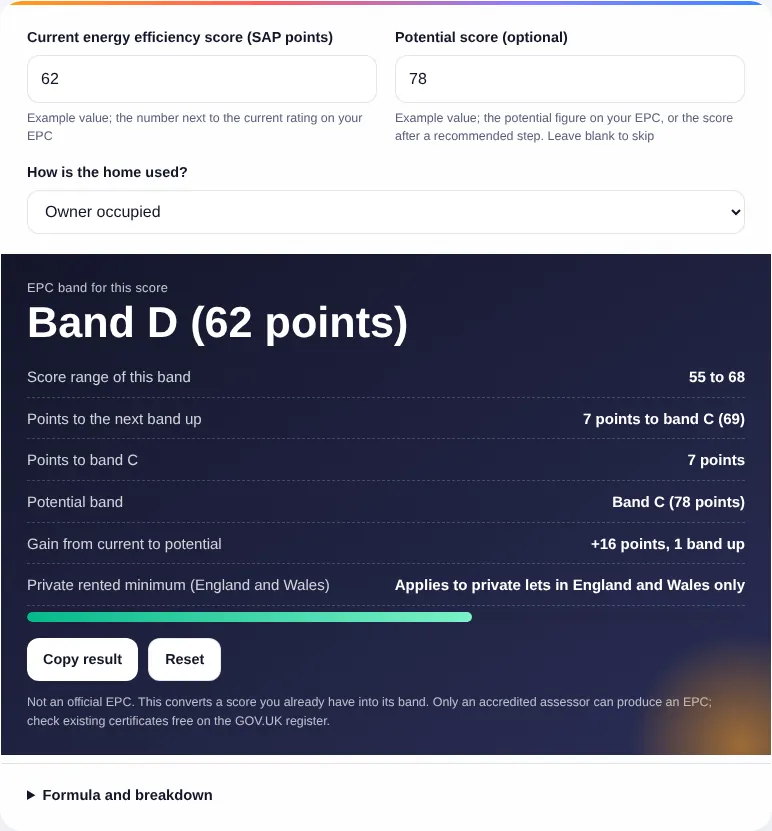
Example: a semi-detached house has an EPC showing a current score of 62 and a potential score of 78. The EPC rating calculator gives the following.
- Current band: 62 is at least 55 and below 69, so band D (55 to 68).
- Points to the next band: 69 minus 62 = 7 points to band C.
- Potential band: 78 is at least 69 and below 81, so band C (69 to 80).
- Gain: 78 minus 62 = 16 points, one band up.
- As a private let in England or Wales, a score of 62 is above the band E minimum of 39.
For context, the government’s statistical release for July to September 2024 found that 85% of existing dwellings lodging an EPC in England were rated C or D, so a band D home sits in the most common range.
Frequently Asked Questions
Is this EPC rating calculator an official EPC?
No. It only converts a score you already have into its band and shows the gap to other bands. An official EPC must be produced by an accredited assessor using approved software. Existing certificates in England, Wales and Northern Ireland can be viewed free on the GOV.UK find an energy certificate service.
What SAP score is band C?
Band C covers SAP scores from 69 to 80. A score of 68 is the top of band D, and 81 is the bottom of band B. The calculator shows how many points separate your current score from 69 so you can judge whether one improvement is enough.
Can an EPC score be higher than 100?
Yes. The SAP specification describes the rating as a 1 to 100 scale, but says it can exceed 100 when renewable generation is used, because savings from on-site generation are deducted from modelled costs. Any score of 92 or more is band A.
How long is an EPC valid?
An EPC is valid for 10 years, according to GOV.UK guidance for England, Wales and Northern Ireland. Scotland has announced plans to cut validity to five years as part of wider EPC reform, so check the current Scottish rules if the home is there.
How do I find my home’s EPC?
Search by postcode on the GOV.UK find an energy certificate service for England, Wales and Northern Ireland, or use the Scottish EPC Register for Scotland. Downloading an existing certificate is free. If no valid certificate exists, you need to book an accredited assessor.
What is the minimum EPC rating for renting?
In England and Wales, a private landlord cannot normally let a home rated below band E, which means a SAP score below 39, unless a valid exemption is registered. The government’s stated aim is for as many rented homes as possible to reach band C or equivalent by 2030.
Checked October 2026 by the Solaxyra Editorial Team. Sources: GOV.UK, Find an energy certificate, GOV.UK, Energy performance certificates, GOV.UK, Private rented property minimum energy efficiency standard, BRE, SAP 10.2 specification, GOV.UK, EPC statistical release July to September 2024, DESNZ, Home Energy Model EPC consultation, Scottish Government, Reforming EPCs.