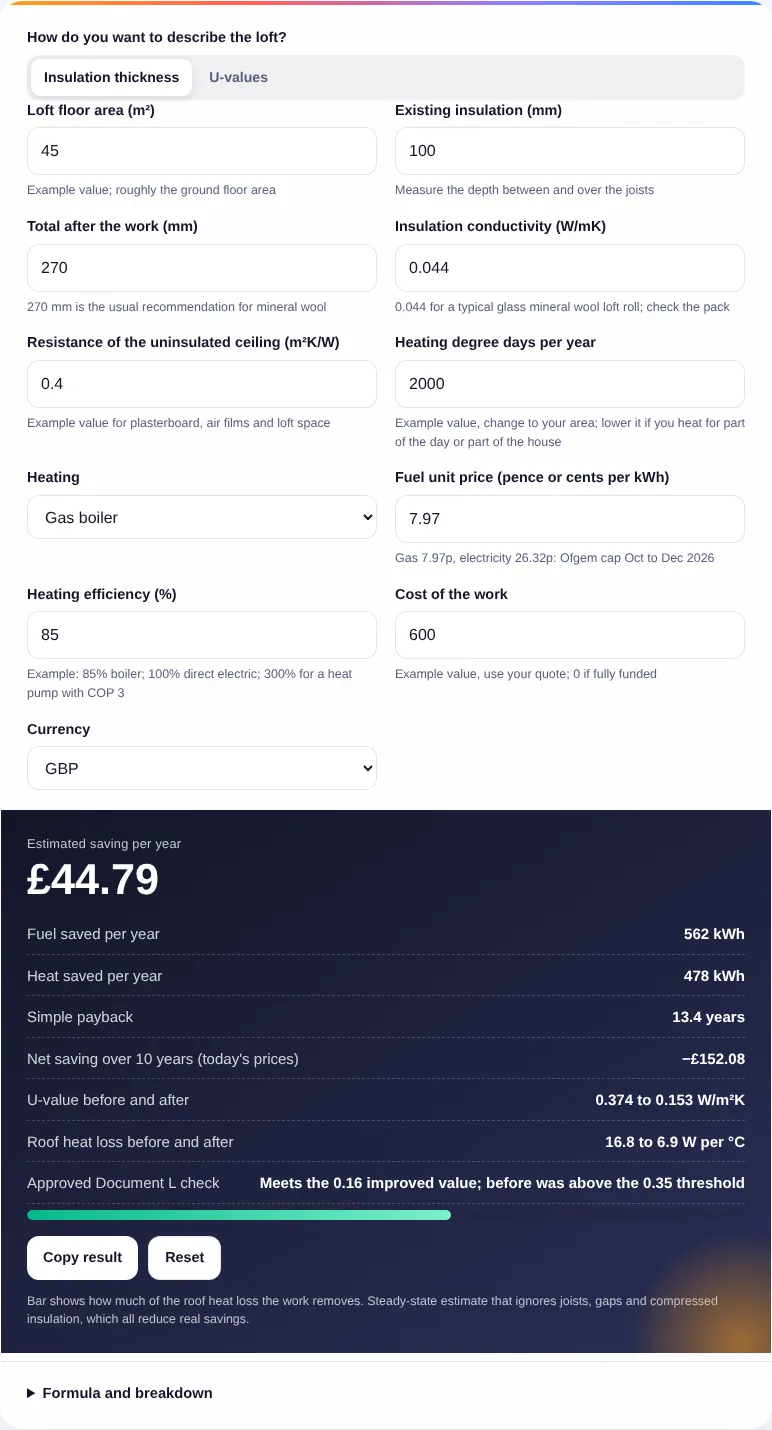
Bar shows how much of the roof heat loss the work removes. Steady-state estimate that ignores joists, gaps and compressed insulation, which all reduce real savings.
Formula and breakdown
n/a
n/a
n/a
This loft insulation savings calculator estimates how much heating energy and money you save each year by adding loft insulation, and how long the work takes to pay back, for homeowners and landlords in the UK, Ireland and Europe. Instead of a fixed figure per house type, it works from your loft area, the insulation depth or U-values before and after, local heating degree days and your fuel price, and checks the result against Approved Document L.
Quick answer: A loft insulation savings calculator multiplies the drop in U-value by loft area, heating degree days and 24, then divides by heating efficiency and applies your fuel price. Topping up 100 mm to 270 mm over 45 m2 saves about 562 kWh of gas, roughly £45 a year at 7.97p per kWh.
What Is a Loft Insulation Savings Calculator?
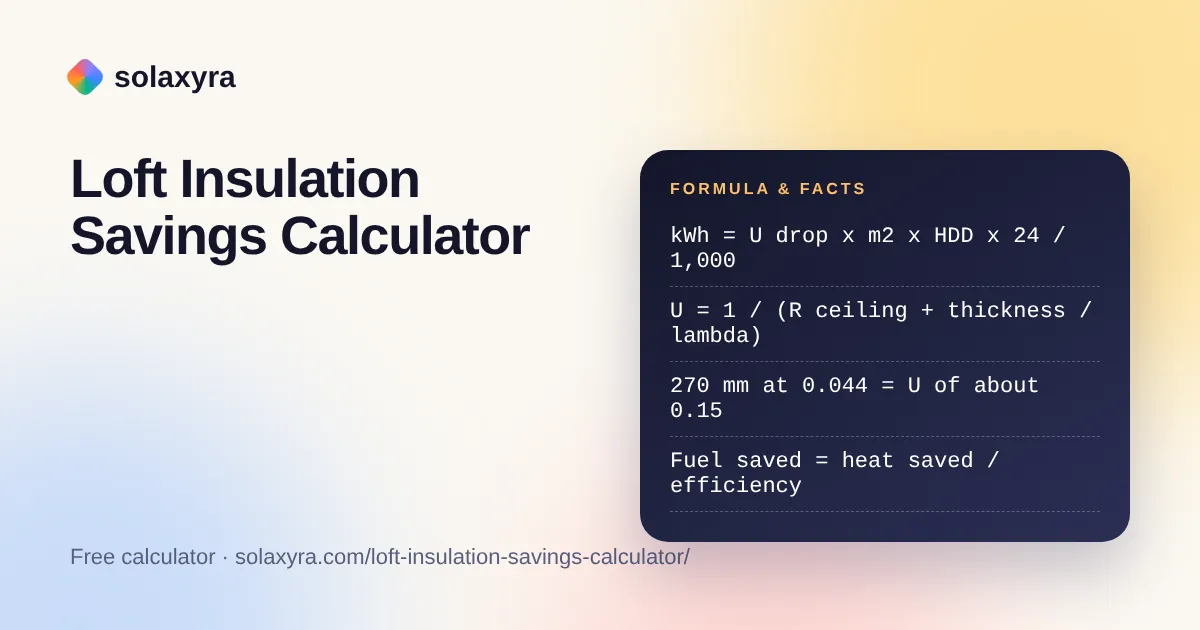
A loft insulation savings calculator is a tool that converts the improvement in your roof’s U-value into kilowatt-hours of heat saved and then into money. In plain words: heat saved in kWh equals (U-value before minus U-value after) times loft area in square metres times heating degree days times 24, divided by 1,000; fuel saved equals heat saved divided by heating efficiency.
The U-value is the heat in watts that passes through one square metre for each degree of temperature difference, so a lower number means less heat lost. The loft insulation savings calculator estimates it as 1 divided by the resistance of the uninsulated ceiling plus the insulation thickness divided by its conductivity. Knauf Insulation’s Loft Roll 44, for example, has a conductivity of 0.044 W/mK and a stated resistance of 2.25 m2K/W at 100 mm. Heating degree days measure how cold a year is; the Wikipedia article on heating degree days shows the same energy formula used here.
How Do You Use the Loft Insulation Savings Calculator?
- Enter the loft floor area, which is usually close to the ground floor area of the house.
- Choose Insulation thickness and enter the depth you have now and the total depth after the work, or choose U-values if a survey or EPC gives them.
- Check the conductivity on the insulation pack; leave the ceiling resistance at the example value unless you know better.
- Enter heating degree days for your area. Lower the figure if you heat only part of the day or part of the house.
- Pick your heating type, which fills the Ofgem cap price and an example efficiency, then enter the quote for the work.
How Much Does Loft Insulation Save per Year?
The saving depends mostly on how much insulation is already there: with the example inputs, insulating an empty 45 m2 loft to 270 mm saves about £475 a year on gas, but topping up from 100 mm saves about £45. The Energy Saving Trust loft insulation advice says an uninsulated home loses around 25% of its heat through the roof, recommends at least 270 mm of mineral wool, and puts the GB saving from topping up 120 mm to 270 mm at £17 a year, with typical costs of £750 for a full installation and £600 for a top-up.
Our steady-state method with the example inputs gives about £34 for that same 120 to 270 mm top-up, roughly double the EST figure. The difference comes from the assumptions: the formula treats the whole house as heated for the full degree-day total. If you heat part-time, set a lower thermostat or have a smaller loft, reduce the degree days until the result matches your situation; halving them halves the saving.
Is It Worth Adding More Than 270 mm?
Usually not on savings alone, because each extra 100 mm saves less than the one before: in the example, going from 270 to 300 mm saves under £3 a year. The table uses 45 m2, 2,000 degree days, conductivity 0.044, a gas boiler at 85% and 7.97p per kWh.
| Insulation depth | U-value (W/m2K) | Upgrade step | Gas saved per year | Saving per year |
|---|---|---|---|---|
| 0 mm | 2.500 | n/a | n/a | n/a |
| 100 mm | 0.374 | 0 to 100 mm | 5,402 kWh | £430.55 |
| 150 mm | 0.263 | 100 to 150 mm | 284 kWh | £22.61 |
| 200 mm | 0.202 | 150 to 200 mm | 153 kWh | £12.22 |
| 270 mm | 0.153 | 200 to 270 mm | 125 kWh | £9.97 |
| 300 mm | 0.139 | 270 to 300 mm | 37 kWh | £2.93 |
| 400 mm | 0.105 | 300 to 400 mm | 84 kWh | £6.72 |
What U-Value Does Building Regulations Expect for a Loft?
For England, Approved Document L sets an improved U-value of 0.16 W/m2K when an existing roof is upgraded, and a threshold of 0.35 W/m2K above which an upgrade is expected during renovation work. The figures come from Table 4.3 of Approved Document L, Volume 1: Dwellings, 2021 edition incorporating 2023 amendments; a new roof element in an existing dwelling has a limiting value of 0.15 in Table 4.2. The loft insulation savings calculator flags both checks. Scotland, Wales and Northern Ireland have their own building standards.
Does the Saving Change With a Heat Pump or Electric Heating?
Yes. The heat saved is the same, but the fuel saved and its price change. With direct electric heating at 26.32p per kWh, every kWh of heat saved is worth 26.32p, so insulation pays back far faster than with gas at 7.97p and an 85% boiler, which saves about 9.4p per kWh of heat. With a heat pump at a COP of 3, each kWh of heat costs about 8.8p, close to gas. Prices are the Ofgem cap for 1 October to 31 December 2026, and the heat pump running cost calculator compares the systems in more detail.
What Should You Check Before Insulating a Loft?
Check ventilation, damp and access first, because insulation changes how air and moisture move through the roof space and a cold, poorly ventilated loft can suffer condensation. The Energy Saving Trust advises using a professional for flat roofs, lofts used as living space, or where there are damp or structural concerns.
- Keep eaves vents clear so air can move through the loft.
- Do not cover recessed downlights or bury cables that need to dissipate heat without checking with a qualified electrician; in the UK electrical work must meet BS 7671.
- Use boarding raised above the insulation if you need storage, so it is not squashed.
Worked Example: Topping Up a Semi-Detached Loft
Example: a semi-detached house with a 45 m2 loft has 100 mm of old mineral wool and a gas boiler. A quote of £600 tops it up to 270 mm with rolls rated at 0.044 W/mK. The example uses 2,000 degree days and the October 2026 gas cap price of 7.97p per kWh.
- U before: 1 / (0.40 + 0.100 / 0.044) = 0.374 W/m2K, above the 0.35 threshold.
- U after: 1 / (0.40 + 0.270 / 0.044) = 0.153 W/m2K, meeting the 0.16 improved value.
- Heat saved: (0.374 minus 0.153) x 45 x 2,000 x 24 / 1,000 = 478 kWh.
- Gas saved at 85% efficiency: 478 / 0.85 = 562 kWh, worth £44.79 a year.
- Payback: 600 / 44.79 = 13.4 years. If the household heats for about half of the degree-day total, the saving falls to about £22 and payback doubles.
Funded schemes can make the payback immediate, so enter 0 as the cost if the work is free. To see the effect on your whole bill, add the reduction to your other loads in the energy consumption calculator.
Frequently Asked Questions
How much does loft insulation save per year?
It depends on the starting depth, loft area, climate and fuel. The Energy Saving Trust puts the saving from topping up 120 mm to 270 mm at £17 a year in Great Britain, while insulating an empty loft saves much more. Enter your own figures for a personal estimate.
Is it worth topping up loft insulation to 270 mm?
It is usually worth it if you have 100 mm or less, but the gains shrink quickly with depth. In the example, going from 0 to 100 mm saves far more than going from 200 to 270 mm. Check the payback against your quote before deciding.
What U-value should a loft have?
Approved Document L gives an improved U-value of 0.16 W/m2K for upgrading a roof in an existing home, and a threshold of 0.35 above which an upgrade is expected when renovating. Around 270 mm of mineral wool with conductivity 0.044 reaches about 0.15.
Why might my real savings be lower than the estimate?
The calculation assumes the whole house is heated for the full degree-day total and the insulation is continuous. Part-time heating, a lower thermostat, timber joists, gaps and squashed insulation all reduce the real saving. Lower the degree days to match how you actually heat.
Does loft insulation save money with a heat pump?
Yes, but the money saved per kWh of heat is smaller because a heat pump makes several units of heat per unit of electricity. With a COP of 3, enter 300% efficiency. Better insulation can also allow a smaller heat pump or lower flow temperature.
Can I install loft insulation myself?
Many people insulate an easy-access loft themselves, but the Energy Saving Trust advises using a professional for flat roofs, lofts used as living space or where there are damp or structural concerns. Keep eaves ventilation clear, because insulation changes how moisture moves through the roof.
Checked October 2026 by the Solaxyra Editorial Team. Sources: Energy Saving Trust, Roof and loft insulation, GOV.UK, Approved Document L Volume 1, Ofgem, energy price cap October to December 2026, Knauf Insulation, Loft Roll 44, Wikipedia, Heating degree day.